
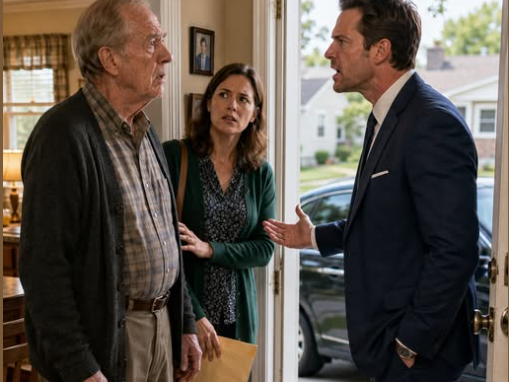
Elliot did not knock.
He pushed my front door open so hard it slammed against the wall.
Claire looked up from the kitchen table where we had been sorting through hospital paperwork.
“There she is,” Elliot snapped, pointing at his sister.
“Tell me you didn’t do it.”
Claire remained seated.
“I don’t know what you’re talking about.”
“My wife saw the bracelet online.
She called the jeweler this morning.
You sold Mom’s bracelet?”
Claire answered quietly.
“Yes.”
“You had no right!”
I stared at him.
“No right?” I repeated.
He ignored me.
“That bracelet was worth far more than what they paid you.
It belonged to the family.”
Claire folded her hands.
“It belonged to Mom.
She gave it to me before she died.”
“It was still part of our family history.”
She looked directly into his eyes.
“I turned family history into Dad’s chance to stay alive.”
For a moment, nobody spoke.
Elliot paced across my worn living room as though he owned the place.
“You should have called me before selling it.”
“I did call you,” I said quietly.
“You told me there was no money.”
His jaw tightened.
“That’s different.”
“No,” Claire replied.
“It’s exactly the same.”
Elliot’s expensive watch flashed as he rubbed his forehead.
“You’ve embarrassed me.”
I blinked.
“What?”
“My wife told everyone Claire had to sell jewelry because I refused to help.
Now people are talking.”
Claire almost laughed.
“You’re worried about gossip?”
“I’m worried about my reputation.”
Something inside me cracked.
For sixty-eight years I had believed that disappointment came in loud explosions.
Instead, it arrived quietly.
It sounded exactly like my son’s voice.
“I think you should leave,” I said.
He looked surprised.
“Dad?”
“You heard me.”
“I’m here now.”
“Three days ago, I begged.”
“I’ve been busy.”
“I was trying not to die.”
Silence settled over the room.
Then Elliot reached into his jacket.
“I brought the money.”
He placed an envelope on the coffee table.
“There.”
“No.”
His eyebrows lifted.
“What do you mean, no?”
“I don’t want it.”
“You needed it.”
“I needed it three days ago.”
Claire gently squeezed my shoulder.
“We already figured it out.”
“What do you mean?”
Claire looked at me.
I nodded.
She smiled.
“Aunt Linda started a fundraiser.”
“The church collected donations.”
“Dad’s old union sent money.”
“The machinists he worked with for forty years each gave what they could.”
“One retired man mailed twenty dollars with a note saying, ‘Arthur once fixed my furnace for free.'”
“A woman Dad barely remembered from church paid for his medications.”
“The neighborhood showed up.”
I watched Elliot’s face lose its color.
People with almost nothing had saved me.
The millionaire had not.
Two weeks later I had surgery.
Claire slept in the uncomfortable hospital chair every night.
My grandson Ethan finished homework beside my bed.
The nurses adored him because he carried coffee to everyone without being asked.
Elliot visited only once.
He arrived wearing a tailored navy suit.
He stayed exactly eleven minutes.
Most of that time he answered emails.
Before leaving, he kissed my forehead awkwardly.
“Get better.”
Then he disappeared.
Recovery was slow.
Cancer changes the way a man counts blessings.
You stop measuring life by years.
You measure it by mornings.
By conversations.
By people who actually show up.
Claire never missed one appointment.
She drove nearly ninety minutes each way after teaching school all day.
Sometimes she arrived exhausted.
Sometimes she brought homemade soup.
Sometimes she simply sat beside me while we watched baseball without saying a word.
Those became my favorite evenings.
One rainy afternoon, Attorney Harold Simmons arrived carrying a leather folder.
He had prepared Margaret’s will twenty-three years earlier.
“I found something while updating another client’s file,” he explained.
“I think your children should know.”
He unfolded a sealed envelope.
Margaret’s handwriting covered the front.
To Arthur.
Open only when both children have become adulTS.
 AT 3 A.M., MY TWIN CALLED FOR HELP—HER HUSBAND SAID IT WAS A FAMILY MATTER, BUT BEFORE SUNRISE, HIS OWN SECRETS PUT HIM IN HANDCUFFS FOREVER AND CHANGED EVERYTHING
 My Husband Ordered Me to Hide the Bruises Before His Mother Arrived—But When They Walked Through My Front Door, the Only Person Waiting Was My Father, and Everything They Thought They Controlled Began to Collapse
I stared at it.
“I never knew this existed.”
Harold sighed.
“It was accidentally filed inside another estate folder.
We discovered it during an archive review.”
My hands shook as I opened it.
Margaret’s words filled the page.
Arthur…
If you’re reading this, then time has passed farther than either of us wanted.
Promise me one thing.
Never judge our children by what they earn.
Judge them by who they become when someone weaker needs them.
Money disappears.
Character does not.
The child who stands beside you when you have nothing… already deserves everything.
By the time I reached the last sentence, I could barely see through my tears.
A month later I invited both children for Sunday dinner.
Neither knew why.
Claire brought homemade apple pie.
Elliot arrived fifteen minutes late.
His luxury SUV looked enormous beside my old driveway.
We ate quietly.
Finally, I stood.
“I’ve made a decision.”
Elliot smiled.
“I figured you had.”
“I updated my will.”
His smile grew.
He assumed exactly what I expected him to assume.
“I’ve divided things fairly,” I continued.
“Fairly doesn’t always mean equally.”
His smile disappeared.
I slid two folders across the table.
One contained legal documenTS.
The other contained a single letter.
“Elliot.”
He opened his first.
His expression froze.
“The house…”
“Will belong to Claire.”
“What?”
“My savings will fund Ethan’s college.”
His voice rose.
“So I get nothing?”
“You get Margaret’s letter.”
He stared at me.
“That’s it?”
“Read it.”
He unfolded the copy.
The room stayed silent.
As his eyes moved across the page, his shoulders slowly dropped.
When he finished, he didn’t speak.
Claire quietly wiped away tears.
I simply waited.
After nearly a full minute Elliot whispered,
“I didn’t know.”
“No,” I answered.
“You stopped trying.”
For the first time in years, my son cried.
Not dramatically.
Not loudly.
Just quietly.
Like a little boy who had suddenly realized he was lost.
“I kept thinking I’d have time.”
“You always think parents will still be there.”
“I thought I could help later.”
I nodded.
“Later is the most expensive word in the English language.”
Over the next several months something unexpected happened.
Elliot changed.
Not overnight.
Real change never happens overnight.
He began visiting every Saturday.
Sometimes he mowed my lawn.
Sometimes he drove me to appointmenTS.
Once I caught him fixing the loose railing on my porch without saying a word.
The first Christmas after my surgery, he handed Claire a small velvet box.
Inside lay Margaret’s bracelet.
He had spent months tracking it down from the collector who bought it.
Claire burst into tears.
“I can’t take this.”
“You already earned it,” Elliot said softly.
“I didn’t.”
“You saved Dad.”
Years later, when my grandson graduated from college, our family gathered for a photograph.
I stood between my children.
Claire held my arm.
Elliot stood quietly on my other side.
Before the picture was taken, he leaned close enough that only I could hear him.
“I’m sorry it took almost losing you to understand what being a son really meant.”
I smiled.
“The important thing is that you learned before it was too late.”
The photographer counted.
“Three… two… one…”
The camera flashed.
For the first time in many years, the picture captured something money could never buy.
Not success.
Not wealth.
Not pride.
It captured forgiveness.
Because cancer taught me something no paycheck ever could.
The richest person in the room is never the one who closes the biggest deal.
It’s the one who shows up when someone they love whispers,
“I need you.”