
David did not interrupt.
That was one thing I had always admired about him.
During the thirty-eight years we worked together, he listened until every fact had been placed neatly on the table before offering a single opinion.
“Start from the beginning,” he said.
So I did.
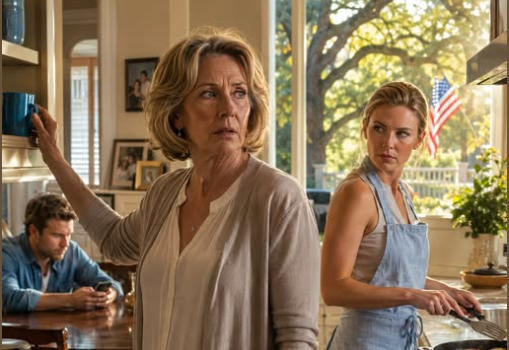
I told him about Jackson’s failed construction business.
About Tiffany insisting they only needed “a few weeks.”
About the baby, Grace.
About the furniture that had mysteriously disappeared into storage without my permission.
About Thomas’s leather chair being hauled into the garage because it carried what Tiffany called “negative widow energy.”
About my church friends no longer feeling welcome.
About waking every morning inside my own home feeling like an unwanted visitor.
Finally, I described breakfast.
David remained silent for several seconds.
“Lydia,” he finally said, “whose name is on the deed?”
“Mine.”
“Only yours?”
“Thomas transferred everything to me after his heart attack twelve years ago.
After he passed, nothing changed.”
“The property is mortgage-free?”
“It has been for almost fifteen years.”
“And your son contributes nothing toward ownership?”
“They buy groceries occasionally.”
David sighed.
“You don’t have a legal problem.”
“I don’t?”
“You have a family problem.”
I closed my eyes.
“I was afraid you’d say that.”
“But family problems sometimes require legal solutions.”
He continued speaking in the calm voice that had won countless cases before difficult judges.
“If they’re living there with your permission, they’re guesTS. If you withdraw that permission, they must leave.
Texas law requires proper notice, but that doesn’t mean you must continue allowing yourself to be mistreated.”
I stared at Thomas’s framed photograph sitting beside the lamp.
His smile looked exactly as it had the day we celebrated paying off the mortgage.
David spoke again.
“Before we discuss paperwork, I want to ask one question.”
“I’m listening.”
“What would Thomas tell you to do?”
The answer arrived before I even thought about it.
“He’d tell me kindness isn’t the same as surrender.”
David chuckled softly.
“That’s exactly what I expected.”
By the end of the call, we had a plan.
Not one based on revenge.
One based on dignity.
That afternoon, while Tiffany pushed Grace through the neighborhood in an expensive stroller she had insisted they “desperately needed,” I quietly walked through every room of the house with my phone.
I photographed everything.
The antique china cabinet.
Thomas’s military medals.
The grandfather clock.
My jewelry box.
The dining table.
The family albums.
Not because I feared they would steal them.
Because David had taught me long ago that memories fade, but evidence remains.
Then I began making another list.
Every utility bill.
Every tax payment.
Every insurance policy.
Every repair invoice.
Thirty-four years of homeownership.
Every single expense had been mine or Thomas’s.
Jackson’s name appeared nowhere.
That evening they ordered expensive takeout.
Nobody asked if I wanted dinner.
I warmed a bowl of soup and ate quietly on the back porch.
The Texas air smelled of fresh-cut grass.
The same porch where Thomas had proposed building a swing after Jackson was born.
The swing was still there.
Only now no one sat beside me.
The following morning, David arrived at exactly eight-thirty.
He had retired from daily courtroom practice, but he still wore immaculate navy suiTS.
When Tiffany opened the front door, she smiled politely.
“Can I help you?”
“I believe so.”
He handed her a business card.
“My name is David Henderson.”
Her smile faded.
“I’m here to speak with the homeowner.”
“I’m the lady of the house.”
“No,” David replied gently.
“You’re not.”
I stepped into the foyer.
“Good morning, David.”
“Good morning, Lydia.”
Jackson appeared behind Tiffany.
“Mom?”
David opened his leather briefcase.
Inside were several neatly organized folders.
“I’ve prepared a simple occupancy termination notice.”
Jackson frowned.
“What?”
“Lydia has decided your temporary stay has ended.”
Silence.
Tiffany laughed.
“That’s ridiculous.”
David looked directly at her.
“No, Mrs. Carter.”
“My name is Tiffany Carter.”
“No.”
His voice remained perfectly calm.
“You married Jackson Carter.
This property belongs exclusively to Mrs. Lydia Carter.”
Jackson’s face turned pale.
“Mom…what is this?”
I finally answered.
“This is me establishing a boundary.”
Tiffany crossed her arms.
“You can’t throw a family with a baby onto the street.”
“I didn’t.”
“What?”
“You did.”
She blinked.
“I offered you shelter.”
“I offered you love.”
“I offered you patience.”
“You responded by treating me like a burden inside my own home.”
Jackson rubbed his forehead.
“Mom, we were just trying to make the house work for everyone.”
I shook my head.
 Five Years After My Husband’s Funeral, I Found Him Alive With Another Family—But My Investigation Revealed A Truth That Changed Everything Forever
 My Mother-in-Law Gave Me a Black Notebook of Cruel Rules on My Wedding Night, But She Never Expected Her Own Rules Would Expose Her Hidden Secrets
“No.”
“You were making the house work for yourselves.”
David handed Jackson an envelope.
“You have thirty days.”
Tiffany exploded.
“This is elder abuse!”
David smiled politely.
“No.”
“Elder abuse would be forcing an elderly widow to surrender control of her own property.”
Her mouth snapped shut.
For the first time in months, the house became quiet.
Not peaceful.
Tense.
That evening Jackson knocked on my bedroom door.
“Can we talk?”
I nodded.
He looked exhausted.
“When Dad died…I thought you’d always be okay.”
“I wasn’t.”
“I know.”
“No, Jackson.”
I looked into his eyes.
“You never asked.”
He lowered his head.
“I got overwhelmed.”
“I know.”
“I was trying to protect my family.”
I answered softly.
“I was your family first.”
Those words seemed to hit him harder than anything else.
Three days later I discovered something unexpected.
Grace.
She had begun crawling.
While Tiffany scrolled through social media on the couch, Grace slowly crawled toward Thomas’s old leather chair in the garage.
She reached up with both tiny hands and laughed.
Children recognize warmth adults often reject.
I carried the chair back inside.
Tiffany protested immediately.
“I thought we agreed that chair—”
“No.”
I interrupted gently.
“We never agreed.”
“I remained silent.”
“There is a difference.”
The chair stayed.
A week later another surprise arrived.
Jackson came home carrying several framed photographs.
He silently rehung every family picture Tiffany had taken down.
One by one.
Without saying a word.
When he finished, he stood before the portrait of Thomas.
“I’m sorry, Dad.”
He whispered it so quietly he probably thought I hadn’t heard.
But I did.
Near the end of the thirty days, Jackson approached me again.
“Tiffany found an apartment.”
I nodded.
“We move Saturday.”
He hesitated.
“I don’t think our marriage is doing very well.”
I wasn’t surprised.
People who constantly seek control often struggle when someone finally says no.
“I’m sorry,” I replied honestly.
“So am I.”
Moving day arrived beneath a bright Texas sky.
Professional movers loaded furniture into a rental truck.
This time they asked permission before touching anything.
The nursery became a guest room again.
The kitchen counters slowly reappeared beneath years of familiar memories.
When the last box disappeared, Grace reached toward me from Tiffany’s arms.
Without thinking, Tiffany handed her over.
Perhaps for the first time, she understood that love could not be demanded.
Only earned.
Grace wrapped tiny fingers around mine.
I kissed her forehead.
“You’ll always be welcome here.”
I looked at both of them.
“All of you.”
Jackson’s eyes filled with tears.
“Even after this?”
“Especially after this.”
Tiffany stared at me.
“I owe you an apology.”
“You do.”
She swallowed.
“I forgot this wasn’t just a house.”
“No.”
I smiled sadly.
“You forgot it was someone’s life.”
Six months passed.
The silence inside the house no longer felt lonely.
It felt restful.
I invited my church friends back for Sunday lunches.
Thomas’s chair returned to its familiar corner beside the fireplace.
His blue coffee mug once again sat beside the coffeemaker every morning.
One autumn afternoon, Jackson called.
Not because he needed money.
Not because something had gone wrong.
Simply because he wanted to know whether I would like company.
He arrived alone with Grace.
She ran straight toward my kitchen.
“Grandma! Pancakes!”
I laughed.
“Of course.”
She climbed onto the same counter where her father had once sat decades earlier, swinging her little legs against the cabinet doors.
I reached for my grandmother’s cast-iron skillet.
This time, Jackson quietly handed me the wooden spatula before I even asked.
“I remembered,” he said.
I smiled.
“So did I.”
As butter melted across the old black pan, sunlight streamed through the kitchen window and settled across Thomas’s blue coffee mug.
For a moment, it felt as though he were still sitting at the table, smiling quietly at everything unfolding before him.
People often believe ownership is proven by a signature on a deed.
Thomas had taught me something far greater.
A home does not belong to the loudest voice.
It belongs to the hands that built it with sacrifice, the hearts that filled it with love, and the people who understand that respect is the strongest foundation any family will ever have.
And from that morning forward, no one ever asked me to leave my own kitchen again.