
For the first time in twelve years, I saw fear in Grant Mercer’s eyes.
Not anger.
Not arrogance.
Fear.
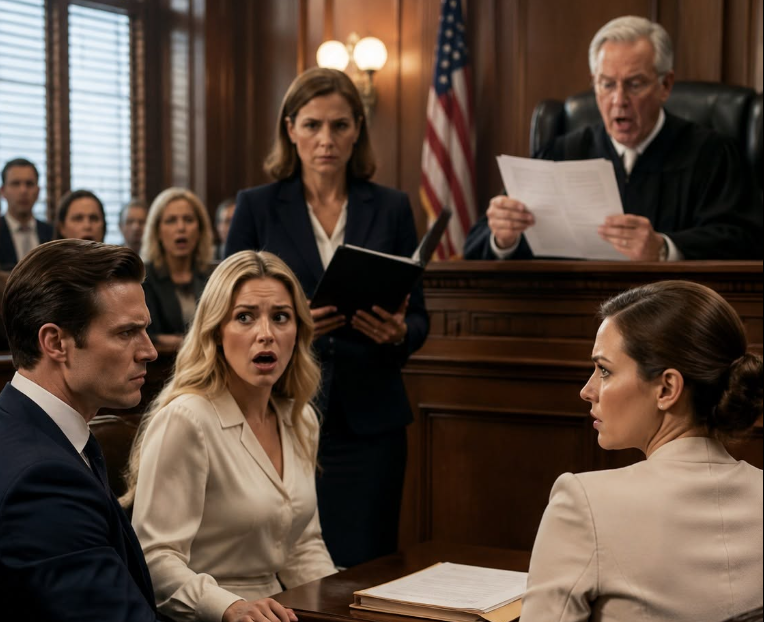
The courtroom became completely silent.
Judge Whitmore placed the letter on the table in front of him and looked over his glasses at Grant.
“Mr. Mercer,” he said calmly, “before we continue, I think you should understand something.”
Grant straightened his posture.
“I’m sure whatever is in that letter has been taken out of context,” he said quickly.
The judge almost smiled.
“That is usually what people say when they realize context matters.”
Vanessa shifted in her chair.
Her confidence from moments earlier was gone.
The woman who had walked into court wearing a designer suit and a victorious expression suddenly looked like someone who had just discovered the ground beneath her was unstable.
Grant’s attorney leaned forward.
“Your Honor, we object to anything submitted at the last minute without proper review.”
Judge Whitmore looked at the document again.
“This was submitted according to court procedure.
Your client had every opportunity to review the filings.”
The attorney hesitated.
Then the judge continued.
“However, I understand your concern.
Which is why I will summarize the contents before making any decisions.”
I sat quietly beside Lena.
My hands were folded in my lap.
For years, Grant had mistaken my silence for weakness.
He had no idea how carefully I had been watching.
How carefully I had been collecting.
The letter was not a confession.
It was not a desperate plea.
It was a timeline.
A timeline of everything Grant had tried to erase.
Twelve years earlier, when Grant and I met, Mercer Dynamics was not a famous company.
It was a small office above a coffee shop with six employees and unpaid bills stacked beside the printer.
Grant had vision.
I had the technology.
Together, we created something valuable.
The fraud-detection system that became the foundation of Mercer Dynamics was built from my research.
My algorithms.
My patenTS.
My years of work.
But when investors arrived, Grant realized something.
The world listened differently when a confident man stood in front of a microphone.
So I stepped aside.
At first, I thought it was temporary.
I thought we were building a future together.
When journalists asked about the company’s success, Grant would say:
“I always knew I had the instincts to recognize a market opportunity.”
He never said:
“My wife created the technology that made this company possible.”
I ignored it.
Because I loved him.
Because we were married.
Because I believed marriage meant protecting each other.
Then our son was born too early.
We lost him before we could bring him home.
That moment changed everything.
I stopped caring about awards.
I stopped caring about interviews.
I stopped caring about being recognized.
I was grieving.
And while I was grieving, Grant was rewriting history.
He removed my name from company documenTS.
He transferred my shares into accounts I had never approved.
He convinced people I was unstable because I cried too often after losing our child.
Then Vanessa appeared.
At first, she was “just an employee.”
Then she became “the person who understood him.”
Then she became the woman sitting beside him in my place.
The final humiliation came three months before the divorce filing.
I arrived at Mercer Dynamics and my security badge stopped working.
The receptionist looked embarrassed.
“I’m sorry, Mrs. Mercer.
Your access has been revoked.”
I thought it was a mistake.
Then two security officers approached.
Not because I had done anything wrong.
Because Grant wanted me removed quietly.
From the company I helped create.
As I walked out, I looked through the glass wall of my old office.
Vanessa was sitting behind my desk.
My desk.
The one where I wrote the first lines of code that built their fortune.
She was drinking coffee from a white mug.
The same mug with our son’s name printed on it.
That was the moment something inside me finally stopped breaking.
And started rebuilding.
Judge Whitmore finished reading the letter.
He looked directly at Grant.
“Mr. Mercer, did you personally sign the transfer documents regarding your wife’s original intellectual property rights?”
Grant’s face tightened.
“I… I don’t understand the question.”
“You understand perfectly.”
The judge turned a page.
“These documents show that several company assets were transferred after Mrs. Mercer’s emotional withdrawal following the death of your child.”
Grant swallowed.
“My wife was not involved in the business at that time.”
Lena finally looked up.
“That is incorrect.”
She stood.
“Your Honor, the sealed letter includes copies of original development records, patent registrations, investor communications, and internal company messages.”
She placed another folder on the table.
“Mrs. Mercer was not merely a spouse of the founder.
She was a co-creator of the technology that generated the company’s current valuation.”
The courtroom remained silent.
Grant’s attorney opened the folder.
His expression changed almost immediately.
Because he knew.
Everyone knew.
The truth was no longer hidden.
Vanessa suddenly spoke.
“This is ridiculous.”
Everyone looked at her.
She forced a laugh.
 MY HUSBAND THREW HOT COFFEE AT ME OVER MY BANK CARD—BUT THE DOCUMENT I LEFT BENEATH MY WEDDING RING EXPOSED THE LIFE HE HID FOR YEARS FROM EVERYONE ELSE
 They Called Her a Failure for Fifteen Years—Until Grandma’s Secret Code Exposed a Family Betrayal, a Hidden Fortune, and the Daughter Whose Real Job Saved Them All That Night
“Even if she helped in the beginning, Grant built the company.
He made the decisions.
He led the team.”
Judge Whitmore stared at her.
“Ms.
Collins, are you aware that you are not a party to this divorce?”
She stopped.
“I was only saying—”
“You were saying a great deal earlier about what Mrs. Mercer deserved.”
Vanessa’s face turned pale.
The judge continued.
“Perhaps you should be careful when discussing someone’s contribution when the evidence suggests you benefited from that contribution yourself.”
Grant looked at Vanessa.
For the first time, there was no affection in his expression.
Only panic.
Because he realized something.
Vanessa was not just his affair partner.
She was now a witness.
And witnesses could not always protect people.
The next document the judge reviewed was the one that made Grant completely lose his confidence.
It was a financial report.
Lena explained:
“After filing for divorce, Mr. Mercer moved company funds through several private entities.
He claimed these were unrelated investmenTS.”
The judge raised an eyebrow.
“Are they?”
“No, Your Honor.”
Lena opened another file.
“They are connected accounts created specifically to hide marital asseTS.”
Grant immediately leaned forward.
“That is false.”
Judge Whitmore looked at him.
“Mr. Mercer, I suggest you allow your attorney to speak.”
Grant closed his mouth.
But his face had already revealed everything.
The hearing lasted four more hours.
Every accusation Grant had made against me collapsed.
The claim that I contributed nothing.
Rejected.
The claim that I was entitled to only a small settlement.
Rejected.
The claim that the company’s value belonged entirely to him.
Rejected.
By the end of the hearing, Judge Whitmore removed his glasses and looked tired.
But there was something else in his expression.
Disappointment.
“Mr. Mercer,” he said, “success does not give anyone permission to rewrite history.”
Grant stared at the table.
The man who once believed money could control every situation had nothing left to say.
The judge continued:
“The court recognizes Mrs. Mercer’s ownership interest in the intellectual property and related asseTS. Further financial review will determine the full division of marital property.”
Then he paused.
“And based on the evidence presented today, the court finds that transparency will be required regarding all company-related transfers.”
Grant’s attorney looked down.
Because they both understood.
The investigation would uncover everything.
Outside the courthouse, reporters waited.
Grant walked ahead with Vanessa beside him.
But this time, nobody rushed toward them.
Nobody asked him about his genius.
Nobody called him a visionary.
They asked questions.
Hard questions.
“Mr. Mercer, did your wife create the original technology behind your company?”
“Were company assets transferred before the divorce?”
“Did you remove your wife from the company she helped build?”
Grant ignored them.
For the first time, he looked like a man who had lost control of his own story.
I stood on the courthouse steps with Lena.
The sunlight felt different.
Not because my life was suddenly perfect.
It wasn’t.
A courtroom victory could not bring back my son.
It could not erase twelve years of being forgotten.
It could not repair the years I spent believing love meant disappearing.
But it gave me something I had not had in a long time.
My voice.
Lena smiled.
“You know what my favorite part was?”
I looked at her.
“The judge laughing?”
She shook her head.
“No.”
She looked toward the courthouse doors.
“Your husband thought your letter was a desperate attempt to save yourself.”
She smiled.
“But it was proof that you had been saving yourself all along.”
I looked down at the copy of the letter in my hand.
At the bottom of the final page, I had written one sentence.
A sentence I never planned to say out loud.
But now I finally understood its meaning.
“The person who builds something valuable should never have to beg for recognition from someone who benefited from it.”
Months later, Mercer Dynamics changed.
The company survived.
But Grant was no longer the untouchable businessman everyone admired.
The truth had a way of reaching people.
My patents were restored.
My name returned to the company records.
And more importantly, I returned to myself.
I started a foundation in memory of my son, helping families who experienced loss during childbirth.
I never wanted another mother to feel invisible during the hardest moment of her life.
Sometimes people think revenge means watching someone fall.
I learned something different.
The greatest victory is not seeing someone else lose.
It is finally standing tall after someone spent years trying to convince you that you were nothing.
Grant once told me:
“You’ll never touch my money again.”
He was right about one thing.
I didn’t need to touch his money.
I reclaimed what was already mine.
My work.
My name.
My dignity.
And the life I almost forgot I deserved.