
Detective Lena Ortiz arrived twenty minutes later.
She was older than the last time I had seen her in court, but her eyes were the same.
Sharp.
Patient.
Impossible to fool.
She entered the private dining room the restaurant manager had offered us, looked at the sealed container on the table, then looked at me.
“Margaret,” she said quietly.
“Tell me exactly what happened.”
I did.
Every word.
Every detail.
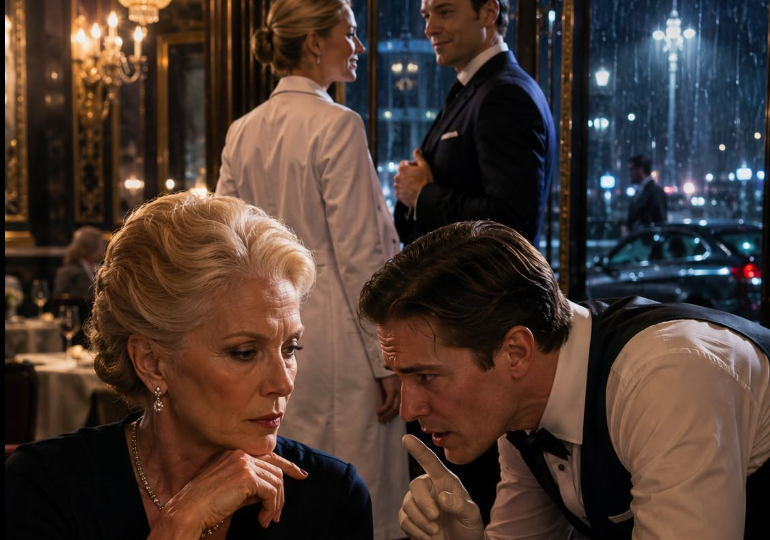
The strange drink.
The whispered warning.
The conversation I overheard.
The power-of-attorney documents Evan had placed in front of me that morning.
Lena did not interrupt once.
When I finished, she opened the container carefully and examined the contenTS.
“Did you drink any of it?”
“One sip.”
Her expression changed slightly.
“Did you feel anything afterward?”
“No.”
“Good.”
She looked relieved.
“But Margaret, you did the right thing by stopping immediately.”
I gave a small smile.
“For thirty-two years, I taught people that evidence speaks louder than excuses.”
Lena nodded.
“And tonight, you became your own evidence.”
The restaurant manager returned with Daniel.
The young waiter still looked nervous.
“I’m sorry,” he said.
“I didn’t know if I should say anything.
I almost convinced myself I imagined it.”
I looked at him.
“You saved my life.”
He shook his head.
“I just did what was right.”
“No,” I replied softly.
“You did what was difficult.”
That was something many people forgot.
Doing the right thing was easy when there was no risk.
The real test came when speaking up could cost you something.
Daniel had risked his job because he trusted a stranger more than my own family.
And that truth hurt more than I expected.
The next morning, I woke up before sunrise.
For years, I had started my days with coffee, newspapers, and quiet.
But that morning, the silence felt different.
It was not peaceful.
It was the silence before a storm.
On my kitchen table sat the folder Evan had brought me.
The power-of-attorney papers.
The ones he claimed were “just for emergencies.”
I opened them again.
This time, I was not a mother reading her daughter’s husband’s request.
I was a forensic scientist analyzing a document.
The details jumped out immediately.
The wording.
The rushed signatures.
The strange clauses.
The parts hidden in legal language that gave Evan almost complete control over my accounts, my property, and my medical decisions.
It was not protection.
It was ownership.
My hands trembled slightly.
Not because I was afraid.
Because I finally understood.
My daughter had not been slowly becoming distant.
She had been preparing to remove me from my own life.
At 9:03 a.m., my phone rang.
Claire.
I stared at her name for several seconds before answering.
“Good morning, sweetheart.”
Her voice sounded warm.
Too warm.
“Mom, how are you feeling?”
“I slept well.”
A pause.
“That’s good.”
Another pause.
“Did you… remember what we talked about yesterday?”
I walked toward the window.
The same window where I had watched Claire ride her bicycle as a child.
Where I had stood when her father died.
Where I had cried alone after losing the man I loved.
“Yes,” I said.
“I remember everything.”
Her breathing changed.
Only slightly.
But I noticed.
Thirty-two years studying human behavior had taught me something:
People could control their words.
They could control their smiles.
But they struggled to control the silence between them.
“Mom,” she said carefully, “you know Evan only wants to help.”
“Does he?”
“Yes.”
“He wants to help me manage my finances?”
“Yes.”
“Like he wanted to help me finish my wine last night?”
Silence.
A long one.
Then:
“What do you mean?”
I smiled sadly.
There it was.
The first crack.
“The waiter told me what happened.”
Nothing.
Not even breathing.
Then Claire whispered:
“Mom…”
I ended the call.
Not because I was angry.
Because I needed her to sit with the silence she had created.
Two hours later, Evan arrived at my house.
He did not knock immediately.
He stood outside my door for almost a full minute.
Watching.
Calculating.
Then he pressed the bell.
I opened the door.
He smiled.
The same charming smile he used at business meetings.
The same smile that fooled everyone except people who knew what to look for.
“Margaret,” he said.
“We need to talk.”
“I agree.”
He stepped inside.
“I heard there was some confusion last night.”
“Confusion?”
“Yes.
About the drink.”
I said nothing.
His eyes moved around the room.
Looking for something.
A folder.
A phone.
Evidence.
He thought like someone who had something to hide.
 My Parents Ignored My Nine Calls While I Fought for My Life in a Hospital Bed.
They Chose My Sister’s Housewarming Instead.
By the Time They Finally Walked Into My Room, Everything They Expected to Inherit Had Already Disappeared Forever
 My Daughter Came Home Injured on Her Wedding Night After Refusing to Give Away Her Home—But Her New Family Never Expected the Quiet Father They Had Dismissed to Become Their Greatest Reckoning
“You know,” he said, sitting down, “people your age sometimes misunderstand situations.”
There it was.
The sentence I had been waiting for.
Not an apology.
Not concern.
A reminder of my age.
I folded my hands.
“My age?”
He sighed.
“I’m not trying to offend you.”
“But you are.”
“Margaret, you’re alone.
You lost your husband.
You’ve been struggling.”
I almost laughed.
Struggling?
I had spent decades walking into courtrooms where people lied directly to my face.
I had examined evidence from cases everyone thought were impossible.
I had identified truths that powerful people wanted buried.
And this man thought loneliness made me weak.
“You believe I am easy to control,” I said.
His expression froze.
Only for a second.
But enough.
“I don’t know what you mean.”
“Yes, you do.”
I stood and walked to the cabinet.
Inside was a small recorder.
I placed it on the table.
Evan’s face changed.
“This is a misunderstanding,” he said quickly.
“No.”
I looked directly at him.
“This is a pattern.”
The police investigation moved faster than they expected.
The sealed drink was tested.
The results confirmed that it contained a substance that could cause serious medical complications when combined with certain medications.
The restaurant security footage was reviewed.
It showed Evan speaking privately with another employee.
It showed the moment he approached the drink.
It showed Daniel noticing something was wrong.
And it showed Claire watching the entire situation from across the restaurant before leaving.
She had not been unaware.
She had been waiting.
That was the part that hurt the most.
Not Evan.
Claire.
My daughter.
The little girl who used to hold my hand crossing the street.
The child I stayed awake with during thunderstorms.
The woman I defended when everyone else told me she was selfish.
I wanted an explanation.
I wanted a reason that would make it hurt less.
But sometimes the truth did not arrive with a satisfying answer.
Sometimes it simply arrived.
Three weeks later, Claire came to my house.
She looked different.
Not physically.
Emotionally.
The confidence was gone.
The perfect smile was gone.
She stood at my door holding an old photograph.
One from when she was eight years old.
“You kept this,” she whispered.
I looked at the picture.
Claire sitting on my shoulders during a summer festival.
Both of us laughing.
Before life became complicated.
Before money became more important than love.
“I kept everything,” I said.
Her eyes filled with tears.
“Mom…”
I waited.
“I was scared.”
I said nothing.
“Evan convinced me you were getting older.
He said you needed someone to protect you.”
I looked at her.
“And when did protection become taking everything I had?”
She cried.
“I don’t know.”
That answer was honest.
And somehow, that made it worse.
Because sometimes people do terrible things not because they are forced.
But because they choose convenience over courage.
“I miss my mother,” Claire whispered.
I looked away.
“I miss my daughter.”
The words hurt both of us.
But they were true.
Months passed.
The case eventually went to court.
Evan faced the consequences of his actions.
The truth came out piece by piece.
The financial documenTS.
The conversations.
The plans.
The lies.
And through it all, I never stopped being Margaret Whitmore.
Not a victim.
Not a helpless widow.
Not an old woman someone could dismiss.
A woman who survived.
A woman who paid attention.
A woman who knew that the smallest detail could reveal the biggest truth.
One year later, I returned to the same restaurant.
The manager greeted me warmly.
Daniel was still working there.
When he saw me, he smiled.
“I’m glad you came back.”
I smiled.
“So am I.”
We sat at a table near the window.
The same place where everything had changed.
Daniel placed a glass of water in front of me.
“Don’t worry,” he joked.
“I poured it myself.”
For the first time in a long time, I laughed.
A real laugh.
The kind I thought I had lost.
I looked outside at the city lighTS.
My life had changed.
My family had changed.
But I had learned something important.
Age does not make a person powerless.
Experience makes them dangerous to anyone who underestimates them.
And sometimes the person everyone thinks is the easiest to deceive…
is the one who has spent a lifetime learning how people lie.
I raised my glass of water.
Not to revenge.
Not to anger.
But to a second chance.
Because the greatest victory was not proving someone else was wrong.
It was remembering who you were all along.