
For several seconds, nobody moved.
Even the reporters stopped taking photographs.
Jason stared at the scars across my arms and shoulders as though they had appeared for the first time.
But he knew every one of them.
He knew which hospital had treated me.
He knew which doctor he had paid to keep quiet.
He knew which accident reports had been altered and which household employees had suddenly received generous severance packages before disappearing from our lives.
Most of all, he knew why I had always worn long sleeves.
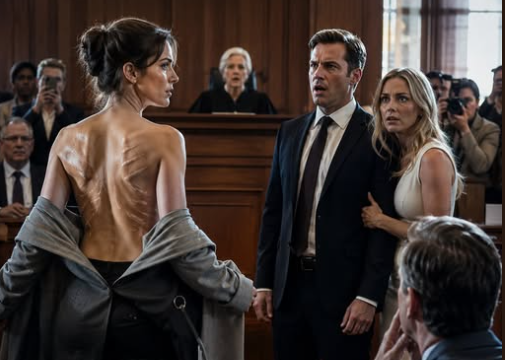
Judge Eleanor Whitmore slowly removed her glasses.
“Mrs. Mitchell,” she said, choosing each word carefully, “are you alleging that these injuries were caused by your husband?”
Jason’s attorney, Richard Hale, shot to his feet.
“Your Honor, this is an improper theatrical display designed to prejudice the court.
We are here to divide marital assets, not to hear unsupported accusations.”
My attorney remained seated.
Daniel Brooks was fifty-four, silver-haired, calm under pressure, and almost impossible to intimidate.
Before entering private practice, he had spent nearly two decades prosecuting financial crimes and corporate corruption.
He never raised his voice unless he had already won.
“Mr. Hale is correct about one thing,” Daniel said.
“This court was originally scheduled to address only the dissolution of the marriage and distribution of asseTS.”
He opened the leather folder in front of him.
“But approximately forty-eight hours ago, we obtained evidence suggesting that the financial records submitted by Mr. Mitchell’s legal team are fraudulent.
We also received evidence of witness intimidation, falsified medical reports, coercive control, and the unlawful transfer of marital asseTS.”
The wrinkle on Jason’s forehead deepened.
Richard Hale turned toward him.
“What is he talking about?”
Jason did not answer.
Daniel continued.
“Because those allegations may involve criminal conduct, we have already provided copies of the evidence to the district attorney’s office.”
A murmur spread through the courtroom.
Jason leaned close to his lawyer and hissed something I could not hear.
Richard’s face changed immediately.
The judge struck her gavel.
“Order.”
The whispers faded.
Judge Whitmore looked at me again.
“Mrs. Mitchell, you may put your coat back on.”
I did, fastening the front buttons with steady hands.
There had been a time when exposing those scars would have left me trembling.
For years, I had believed they were symbols of my weakness.
That morning, they became evidence that I had survived.
Daniel stood.
“Your Honor, we request permission to call an emergency witness.”
Richard objected before Daniel had even finished speaking.
“This is outrageous.
There was no witness disclosed on the final list.”
“The witness was afraid for her life,” Daniel replied.
“She contacted my office only after Mr. Mitchell publicly declared that my client had fabricated her allegations.”
Jason suddenly looked toward the courtroom doors.
That was when I knew he understood.
The doors opened.
An elderly woman entered with a court officer beside her.
Jason’s mouth fell open.
Madison took one step away from him.
The woman walking toward the witness stand was Rosa Alvarez, the housekeeper who had worked in our mansion for nearly twelve years.
Officially, Rosa had resigned four years earlier and moved to Arizona to care for her sister.
That was the story Jason told everyone.
The truth was that Rosa had witnessed one of his worst nighTS.
She had seen him throw me against the glass cabinet in the dining room after I questioned a missing transfer from our joint investment account.
She had found me unconscious on the floor.
She had called an ambulance, but Jason had taken the phone from her and ordered his private driver to take me to a clinic owned by one of Mitchell Medical Technologies’ subsidiaries.
By sunrise, Rosa had been forced to sign a nondisclosure agreement.
By noon, she had been removed from the house.
Jason had believed fear would keep her silent forever.
Rosa looked smaller than I remembered.
Her dark hair had turned almost completely gray, and her hands shook as she took the oath.
But when she saw me, her eyes filled with tears.
“I am sorry, Mrs. Mitchell,” she whispered.
“You have nothing to apologize for,” I said.
Daniel approached the witness stand.
“Ms.
Alvarez, did you work for Jason and Iris Mitchell?”
“Yes.”
“For how long?”
“Almost twelve years.”
“Why did your employment end?”
Rosa looked at Jason.
He stared back with a warning in his eyes.
She inhaled slowly.
“Because I saw what he did to his wife.”
The courtroom became silent again.
Richard objected.
The judge overruled him.
Daniel asked Rosa to explain.
She described the dining room.
The broken cabinet.
The bloodless but frightening scene.
The driver who had carried me to the car.
The clinic administrator who had instructed staff to write that I had fallen down a staircase.
She described Jason placing a document in front of her the next morning.
“He told me that if I signed it, he would give me enough money to start over,” Rosa said.
“If I refused, he said my son would lose his job at Mitchell Medical and that immigration authorities might begin asking questions about members of my family.”
“Did you sign?”
“Yes.”
“Did Mr. Mitchell pay you?”
“Yes.”
“How much?”
“One hundred thousand dollars.”
Madison’s head turned sharply toward Jason.
Apparently, there were secrets he had not shared even with her.
Daniel displayed a copy of the payment record on the courtroom monitor.
The money had not come from Jason’s personal account.
It had come from a charitable fund established by Mitchell Medical Technologies to provide medical equipment to low-income clinics.
He had used charity money to purchase silence.
Richard rose again.
“Your Honor, there is no proof that this transfer was connected to any alleged incident.”
Daniel nodded.
“That is why we have the attached audio recording.”
For the first time, Jason stood.
“No.”
His voice echoed through the courtroom.
Judge Whitmore’s expression hardened.
“Sit down, Mr. Mitchell.”
Jason remained frozen.
“Mr. Mitchell,” she repeated, “sit down.”
He slowly lowered himself into his chair.
Daniel gave a flash drive to the clerk.
The speakers crackled.
Then Jason’s voice filled the courtroom.
It was younger, but unmistakable.
“You didn’t see anything, Rosa.
Iris fell.”
Rosa’s recorded voice answered.
“She did not fall.
I saw you push her.”
“You saw my wife lose her balance.”
“She was not moving when I found her.”
“You have a son who works in my company, don’t you?”
A pause followed.
Then Jason continued.
“Sign the agreement, take the money, and go somewhere quiet.
That is the best thing you can do for your family.”
The recording ended.
No one looked at me anymore.
Every eye in the room was fixed on Jason.
His attorney leaned toward him.
“Did you know that recording existed?”
Jason shook his head slowly.
Rosa wiped her eyes.
“I recorded him because I thought something worse would happen one day,” she said.
“I thought Mrs. Mitchell might disappear, and everyone would believe whatever he told them.”
Those words struck deeper than I expected.
For years, I had wondered why Rosa had left without saying goodbye.
I had thought she had abandoned me.
In reality, she had preserved the first piece of evidence that might one day save my life.
Judge Whitmore called a recess and ordered everyone to remain available.
Jason stood immediately.
“Iris.”
I turned away.
He moved around the table, but two court officers stepped between us.
His voice dropped.
“You have no idea what you’re doing.”
I looked directly at him.
“That sentence used to frighten me.”
His jaw tightened.
“It should.”
Daniel placed himself beside me.
“Threatening a represented party inside a courtroom is an unusually poor strategy.”
Jason ignored him.
“You think Rosa changes anything? She took the money.
She signed the agreement.
She is just as guilty.”
Rosa heard him.
She stopped near the witness-room door and turned around.
“No, Mr. Mitchell,” she said.
“I was afraid.
There is a difference.”
Jason laughed bitterly.
“The world does not care about the difference.”
“I do,” I said.
So did the judge.
When the hearing resumed forty minutes later, Judge Whitmore issued an immediate temporary order freezing all assets associated with Jason, me, Mitchell Medical Technologies, and twelve recently created holding companies.
Jason’s confidence finally broke.
“You can’t freeze the company,” he said.
“Thousands of employees depend on it.”
“Then perhaps,” the judge replied, “you should have considered those employees before allegedly using corporate funds to hide marital asseTS.”
Richard Hale requested another recess.
The judge denied it.
Daniel then introduced the financial evidence.
During the previous three years, Jason had transferred nearly sixty-eight million dollars from Mitchell Medical Technologies into shell companies controlled by Madison’s brother, Trevor Brooks.
Madison stiffened.
“I don’t know anything about that,” she whispered.
Jason glanced at her.
That glance told the entire courtroom she knew enough.
The transfers had been labeled consulting fees, acquisition expenses, and international research partnerships.
None of the companies had employees.
None had offices.
Several were registered to mailboxes in Nevada and Delaware.
The final company, Northstar Biomedical Holdings, had been incorporated only six days before I filed for divorce.
According to the documents Jason submitted to the court, Northstar had purchased Mitchell Medical Technologies from him for an amount far below its market value.
The buyer was listed as an anonymous foreign trust.
Daniel clicked to the next document.
The beneficial owner of that trust was Madison Brooks.
Reporters began typing furiously.
Madison stared at the screen.
“I didn’t sign that.”
Jason said nothing.
Her attorney was not present because she had entered the courtroom believing she was only there to watch Jason humiliate me.
Now she was sitting beside a man who had placed stolen assets in her name.
She turned to him.
“What did you do?”
Jason lowered his voice.
“Not here.”
“What did you do, Jason?”
“Madison, be quiet.”
The judge struck her gavel.
“Ms.
Brooks, you will not interrupt the proceedings.”
Madison looked toward the judge.
“Your Honor, I swear I didn’t know about any trust.”
Richard Hale closed his eyes for a moment.
Every word she spoke was making things worse.
Daniel returned to our table and opened a second folder.
“The anonymous trust was only one part of the scheme,” he said.
“Mr. Mitchell also submitted a postnuptial agreement stating that Mrs. Mitchell voluntarily surrendered her interest in the company six years ago.”
He held up the document.
“Mrs. Mitchell denies signing it.”
Richard Hale stood.
“She signed it in the presence of two witnesses and a licensed notary.”
“One witness is Mr. Mitchell’s former chief financial officer.
The other is Madison Brooks.”
Madison’s face drained of color.
“I never witnessed anything.”
Jason grabbed her wrist beneath the table.
She pulled away.
Daniel displayed an enlarged image of the signature.
It looked almost identical to mine.
Almost.
But whoever had copied it had made one small mistake.
For years, I signed my legal name as Iris Anne Mitchell.
The forged document used Iris Ann Mitchell.
Jason had always assumed my middle name was spelled without the final e.
He had been wrong for ten years.
Daniel placed my birth certificate, passport, tax filings, and original incorporation paperwork on the monitor.
Every authentic document contained the correct spelling.
Judge Whitmore studied the forged agreement.
“Who prepared this document?” she asked.
Richard Hale did not answer immediately.
Finally, he said, “It was provided to my office by Mr. Mitchell.”
The judge turned toward Jason.
He looked trapped for the first time.
But Jason had survived many dangerous moments by attacking before anyone could attack him.
“This is all Iris’s plan,” he said.
“She has been unstable for years.
She manipulates people.
She has been collecting documents because she wanted to take the company from me.”
Daniel’s expression remained calm.
“From you?”
Jason realized his mistake too late.
Daniel walked toward the monitor.
“Let us discuss who created Mitchell Medical Technologies.”
He displayed a photograph taken fourteen years earlier.
I was twenty-seven, standing in a tiny rented laboratory beside two engineers and a prototype diagnostic scanner built from secondhand parTS.
Jason was not in the photograph.
Because I had not met him yet.
I had been a biomedical systems researcher at a public university when my mother died after a rural clinic failed to detect complications that could have been treated if the clinic had possessed better equipment.
I spent the next three years developing a portable scanner designed for underfunded hospitals.
My patent became the foundation of Mitchell Medical Technologies.
Jason joined the company eighteen months after it was founded.
At the time, he was a charismatic sales executive with significant debt and no medical background.
I fell in love with his confidence.
He told investors the story better than I did.
He turned my invention into a company worth billions.
Then, slowly, he turned the company into his identity.
He convinced me to step away from public leadership because he said the pressure was damaging my health.
He placed loyal friends on the board.
He moved intellectual property into new subsidiaries.
He changed passwords, isolated me from employees, and told everyone that I was emotionally fragile.
Eventually, the world forgot I had built the company.
I nearly forgot too.
Daniel displayed the original patent registration.
Inventor: Dr. Iris Anne Carter.
Jason’s attorney looked at him in disbelief.
“You told me the patent was acquired before the marriage.”
“It was,” Jason said.
Daniel nodded.
“That part is true.
Mrs. Mitchell created the patent before the marriage.
She also placed it in a protected family trust before she met Mr. Mitchell.”
The courtroom erupted in whispers.
Jason’s head snapped toward me.
I held his gaze.
The company, the mansion, and the vehicles may have been registered in Jason’s name.
But the technology behind the company had never belonged to him.
Years earlier, my father had insisted that I protect my work.
At the time, I thought he was being overly cautious.
He had created the Carter Innovation Trust and transferred the foundational patents into it.
Mitchell Medical Technologies received a renewable license to use them.
The license could be revoked if the company engaged in fraud, criminal misconduct, or activity that threatened patient safety.
Jason had known about the trust when we married.
What he did not know was that my father had amended it after witnessing Jason’s behavior toward me.
The amendment appointed an independent board and gave me the right to trigger an emergency review.
I had triggered that review six months earlier.
The license was scheduled to be suspended at midnight.
Without it, Mitchell Medical Technologies could no longer legally manufacture or sell its most profitable devices.
Jason stared at me as if I had become a stranger.
“You would destroy the company just to punish me?”
“No,” I said.
“I am protecting it from you.”
Daniel introduced the emergency restructuring agreement.
If approved by the court and the independent patent trustees, a new management team would take control of the company’s medical operations.
Employees would keep their jobs.
Hospitals would continue receiving equipment.
Existing patients and clients would not be affected.
Only Jason and the executives involved in the fraudulent transfers would lose authority.
Jason stood again.
“This is my company!”
His voice cracked.
Judge Whitmore pointed toward his chair.
“Sit down.”
“I built it!”
“You commercialized technology created by your wife,” the judge said.
“Those are not the same thing.”
Jason looked around the courtroom, searching for someone who still believed him.
His gaze finally landed on Madison.
She moved farther away from him.
The judge announced that the divorce hearing would be postponed pending an investigation into the authenticity of the financial disclosures and postnuptial agreement.
She also ordered Jason to surrender his passport.
That was when two investigators from the district attorney’s financial crimes unit entered the courtroom.
They did not arrest him.
Not yet.
They handed him a subpoena.
But Jason reacted as if they had placed handcuffs around his wrisTS.
Outside the courthouse, reporters crowded around the steps.
Daniel guided me through a side exit, but Jason reached the corridor before the door closed.
“Iris!”
I stopped.
Daniel advised me to keep walking.
I turned anyway.
Jason stood twenty feet away, surrounded by attorneys and court officers.
Madison was no longer beside him.
He looked smaller without her.
Without the company.
Without the audience he controlled.
“You planned this,” he said.
“For monThS.”
His eyes narrowed.
“You lied to me.”
“No, Jason.
I stopped telling you the truth because you used every truth I gave you as a weapon.”
“I could have fixed things.”
“You had ten years.”
He stepped forward.
A court officer blocked him.
Jason lowered his voice.
“I know things about you too.”
I almost laughed.
That had always been his final weapon: the suggestion that somewhere, in some locked drawer, he possessed a secret capable of destroying me.
But after surviving him, I no longer feared drawers.
“Then tell them,” I said.
“Tell everyone.”
He stared at me.
I waited.
Nothing came.
Because Jason’s greatest power had never been information.
It was my fear of what information might exist.
Once I stopped being afraid, he had nothing.
I walked out of the courthouse without looking back.
But the case was only beginning.
PART 3: THE WOMAN IN THE WHITE DRESS
Madison disappeared for three days.
Her apartment was empty.
Her phone was turned off.
Her social media accounts vanished overnight.
Jason publicly claimed she had gone to stay with relatives.
The investigators did not believe him.
Neither did I.
On the fourth morning, Daniel called me before sunrise.
“She contacted the district attorney.”
I sat up in bed.
“Madison?”
“She wants immunity.”
“For what?”
“That is what we are about to learn.”
By then, I was living in a small furnished apartment overlooking the river.
The court had granted me temporary access to the mansion, but I could not bring myself to return.
The mansion had twenty-three rooms, limestone floors, custom furniture, and enough space to make loneliness echo.
Jason had chosen nearly everything inside it.
He preferred rooms designed to impress visitors rather than comfort the people living there.
My apartment had one bedroom, a narrow kitchen, and a fire escape covered in rust.
For the first time in years, I slept through the night.
At nine that morning, Daniel and I entered the district attorney’s office through a secured garage.
Madison sat in a conference room with two attorneys.
She was not wearing white.
She wore jeans, a dark sweater, and no makeup.
Without the polished image she maintained beside Jason, she looked younger than thirty-two.
She also looked terrified.
I sat across from her.
For nearly a minute, neither of us spoke.
Finally, she said, “I didn’t know he was hurting you.”
I felt nothing at first.
Then anger rose slowly.
“You knew he was married.”
“Yes.”
“You entered my home.”
She looked down.
“Yes.”
“You wore my jewelry.”
Her face tightened.
“He said it belonged to him.”
“You slept in my bedroom.”
“He said you had moved into the guest wing because you hated him.”
“I moved into the guest wing because he locked me there for two days.”
Madison’s eyes lifted.
The silence between us changed.
One of her attorneys placed a hand near her file.
“We are not asking Mrs. Mitchell to forgive Ms.
Brooks.
We are here because Ms.
Brooks possesses evidence relevant to several ongoing investigations.”
I looked at Madison.
“What evidence?”
She reached into a bag and removed a small black phone.
“I found this in Jason’s private safe.”
Daniel did not touch it.
“Has law enforcement made a forensic copy?”
“Yes,” her attorney said.
Madison pushed the phone toward the center of the table.
“Jason had several phones.
He told me this one was used for international clienTS. After court, I went to the penthouse he rented for me.
Men were already there removing files.
One of them told me Jason said I should leave the country for a while.”
“Who were the men?” Daniel asked.
“I don’t know.
Security contractors, maybe.
I became frightened, so I went to his office.
I knew the safe combination.”
She looked at me.
“It was your birthday.”
Of course it was.
For ten years, Jason had used my birthday as the code to protect his secreTS.
Madison continued.
“The phone had messages between Jason, Dr. Samuel Keene, and several executives.
They discussed patient reports, device failures, and money transferred through the charity.”
I felt cold.
Dr. Samuel Keene was the director of clinical compliance at Mitchell Medical Technologies.
“What kind of device failures?” I asked.
Madison hesitated.
“The portable cardiac monitors.”
I stopped breathing for a second.
Two years earlier, Mitchell Medical had launched a compact cardiac monitoring system for small hospitals.
The device was profitable, widely advertised, and based partly on technology from my original patent.
I had raised concerns about testing procedures before Jason removed my remaining operational authority.
He told the board my objections were caused by anxiety.
“How many failures?” I asked.
Madison shook her head.
“I don’t know.”
One of the investigators answered.
“At least seventeen documented cases were concealed internally.
We are checking whether any patient injuries or deaths were connected.”
My hands tightened beneath the table.
Jason had not merely stolen money.
He may have placed patients in danger to protect quarterly earnings.
Madison began crying.
“I thought he was moving money because of the divorce.
I thought he wanted to hide assets from you.
I didn’t understand what the accounts were used for.”
“You signed documents,” I said.
“He told me they were investmenTS.”
“You signed my name.”
Her eyes widened.
“I never signed your name.”
“You were listed as a witness on the postnuptial agreement.”
“I had never seen that document before court.”
Daniel studied her.
“Did Jason ever ask you to practice Mrs. Mitchell’s signature?”
Madison looked confused.
“No.”
“Did he have access to your electronic signature?”
“Yes.
His assistant did too.”
“Which assistant?”
“Emily Ross.”
The name surprised me.
Emily had worked for Jason for eight years.
She organized his travel, maintained his calendar, and controlled access to his private office.
She had also been kind to me in small, hidden ways.
When Jason cancelled my driver, Emily quietly arranged transportation.
When my phone stopped working, she left a prepaid device in my desk.
Once, after Jason shattered a vase beside me, Emily entered the room and stood there until he walked away.
I had not heard from her since filing for divorce.
“Where is Emily now?” I asked.
Madison looked toward the investigators.
“No one knows.”
That afternoon, authorities executed search warrants at Mitchell Medical Technologies, Jason’s private penthouse, and three storage facilities.
The story became national news.
Headlines focused on the scars, the alleged forged agreement, and the spectacular collapse of a billionaire executive’s divorce strategy.
But beneath the public spectacle, investigators were uncovering something far more serious.
Patient safety reports had been altered.
Internal emails had been deleted.
Doctors who questioned device performance had been offered consulting contracTS.
At least two employees who threatened to contact federal regulators had been dismissed and later sued into bankruptcy for violating confidentiality agreemenTS.
Jason had built a system that rewarded silence and punished truth.
I understood that system because I had lived inside it.
Three nights after meeting Madison, I received an email from an unknown address.
There was no subject line.
The message contained only six words.
ASK WHO SIGNED THE CLINIC REPORTS.
Attached was a photograph.
It showed a page from my medical file.
The file described the night Rosa found me in the dining room.
Diagnosis: injuries consistent with an accidental fall.
Physician: Dr. Samuel Keene.
Witness authorization: Iris Mitchell.
The signature was not mine.
At the bottom of the photograph, someone had written a storage-unit number.
Daniel immediately contacted investigators.
The unit was registered under a company linked to Emily Ross.
Inside, they found twenty-two boxes of documenTS.
There were copies of internal safety complaints, financial ledgers, hospital records, recordings of executive meetings, and photographs of injuries I did not remember anyone taking.
There was also a sealed envelope addressed to me.
Inside was a handwritten letter from Emily.
Iris,
If you are reading this, I was finally brave enough to leave or Jason discovered what I was doing.
I need you to know that I saw more than I admitted.
I watched him isolate you.
I watched executives laugh when he described you as unstable.
I changed schedules so you would not be alone with him when he was angry.
Sometimes it worked.
Sometimes it did not.
I began copying documents after the clinic report was altered.
Dr. Keene signed it, but Jason’s chief of staff ordered the changes.
The company has hidden device failures and illegal payments for years.
I stayed because I believed I could protect people from inside.
Maybe that was courage.
Maybe it was cowardice.
I no longer know.
The original files are in these boxes.
Do not trust anyone on the current board.
There is one more thing.
Your father knew.
I read the final sentence again.
My father had died five years earlier.
He had suffered a heart attack while traveling alone.
At least, that was what I had been told.
Daniel read the letter in silence.
“What does she mean?” he asked.
“I don’t know.”
But somewhere deep inside me, an old memory stirred.
Two weeks before my father’s death, he had called and asked to meet privately.
Jason was in the room when the call came.
I told my father I was too busy.
He sounded disappointed.
Then he said, “Iris, there are things about your company you need to see for yourself.”
I promised to call him the following week.
I never did.
After his death, Jason handled most of the arrangemenTS. He told me my father’s hotel room contained nothing important.
The grief had overwhelmed me.
I never questioned him.
Until now.
PART 4: THE FINAL MESSAGE FROM MY FATHER
My father, Dr. Thomas Carter, had never trusted easy success.
He grew up above a hardware store in a small Ohio town and became an engineer after serving as a hospital maintenance technician.
He believed every important machine should be repairable, every contract should be readable, and every powerful person should be questioned.
When Mitchell Medical Technologies began expanding, he attended board meetings as an informal adviser.
Jason treated him politely in public.
In private, he called him outdated.
My father disliked the company’s growing emphasis on luxury offices, political connections, and aggressive sales targeTS.
“Medical companies are not fashion houses,” he once told Jason.
“The product either protects a life or it does not.”
Jason never forgot the insult.
Daniel arranged for us to review my father’s archived trust records.
The files were held by a law firm in Cleveland.
Inside a secured cabinet, we found an unopened package addressed to me.
The attorney responsible for the file had retired.
His replacement assumed I had already received a copy.
Jason had signed the receipt for the original package five years earlier.
He never gave it to me.
The package contained a letter, a flash drive, and an amendment to the patent trust.
My father’s letter began with an apology.
My dear Iris,
I should have spoken sooner.
I told myself that your marriage was private and that you would come to me when you were ready.
But silence does not protect people.
It protects the person creating the fear.
I have seen Jason’s temper.
I have seen how you become quiet when he enters a room.
I have seen the explanations you give for injuries that do not match the truth in your eyes.
You are my daughter, but you are also an adult, and I cannot force you to leave.
What I can do is preserve the choices he is trying to take from you.
Over the past year, I reviewed financial and testing records connected to Mitchell Medical Technologies.
I found irregularities that may involve fraud and dangerous product decisions.
I confronted Jason privately.
He denied wrongdoing and threatened to remove me from all company matters.
I have placed copies of my findings on the enclosed drive.
I also amended the Carter Innovation Trust.
The patents will remain protected regardless of any document Jason persuades or forces you to sign.
You may believe leaving him will destroy everything you built.
It will not.
You are the inventor.
You are the mind behind the work.
You can build again.
Please remember this: A home is not the place where your name appears on a deed.
A home is the place where you are allowed to exist without fear.
Love,
Dad
I pressed the letter against my chest and cried harder than I had cried at his funeral.
For five years, I had believed my father died disappointed in me.
Now I knew he had seen me clearly.
The flash drive contained a recorded meeting between my father and Jason.
The date was three weeks before my father’s death.
Jason sounded impatient.
“You are interfering in a company you do not understand.”
My father answered calmly.
“I understand the testing reporTS.”
“You stole confidential documenTS.”
“I reviewed records connected to patents owned by my family trust.”
“You are trying to turn Iris against me.”
“Iris does not need my help to recognize what you are.”
A chair scraped across the floor.
Jason’s voice became colder.
“Be careful, Thomas.”
“Is that a threat?”
“It is advice.
You are an older man with a heart condition.
Stress is dangerous.”
The recording ended.
The district attorney could not prove Jason had caused my father’s death.
Medical records confirmed that my father’s heart attack was consistent with natural causes.
But investigators proved that Jason had entered my father’s hotel room before the authorities notified me.
Security footage from the hotel archives showed him leaving with a leather briefcase.
He had taken the trust documents and hidden the evidence.
It was not murder.
But it was another theft.
Another truth buried beneath his confidence that no one would challenge him.
The trust amendment gave me leverage, but my father’s files gave investigators a timeline.
They showed that the concealed device problems began nearly six years earlier.
Jason had pressured engineers to reduce testing periods because a competitor was preparing a similar product.
When early prototypes produced inconsistent readings, Dr. Keene recommended delaying the launch.
Jason overruled him.
Later, when field reports raised concerns, he authorized settlements requiring strict confidentiality.
Several executives participated.
The board was not merely careless.
It had been corrupted.
Federal regulators announced an investigation.
The stock price collapsed.
Thousands of employees feared losing their jobs.
For two days, I watched financial commentators describe Mitchell Medical Technologies as a company on the edge of destruction.
I could have walked away.
Part of me wanted to.
The company had become the place where Jason controlled me.
Its hallways carried memories of doors closing, meetings I was excluded from, and employees lowering their eyes when I passed.
But then I received a letter from a nurse in Montana.
Her clinic used one of the original scanners I designed.
She wrote that the device had helped doctors detect a dangerous pregnancy complication in time to save a young mother.
The next day, an emergency physician from Mississippi contacted me.
He described using our equipment after a tornado damaged his hospital.
Hundreds of messages followed.
Not every product was defective.
Not every employee was corrupt.
Thousands of engineers, technicians, nurses, service workers, and researchers had dedicated their careers to helping people.
Jason had used their work as a shield for his greed.
I would not let his downfall become theirs.
I met with the independent trustees and federal regulators.
We created a plan.
Mitchell Medical Technologies would enter supervised restructuring.
Every questionable device would be recalled and independently tested.
Hospitals would receive replacements at no cost.
Employees who reported misconduct would be protected.
Executive bonuses would be suspended.
A victim compensation fund would be created using assets recovered from the shell companies.
The company would also be renamed.
Mitchell Medical Technologies would become Carter Health Systems.
When Daniel asked whether I wanted to serve as chief executive, I said no.
I did not want to replace Jason’s kingdom with my own.
Instead, I agreed to become chair of an independent ethics and innovation council with authority over patient safety.
The new chief executive would be Dr. Lena Patel, a respected biomedical engineer who had resigned three years earlier after Jason ignored her testing concerns.
She accepted on one condition.
“No private elevators,” she said.
I smiled.
Jason had installed a private elevator so executives would not have to share space with ordinary employees.
“We’ll remove it,” I said.
“And turn the executive dining room into an employee childcare center.”
“Agreed.”
For the first time since entering the courtroom, I felt I was doing more than destroying what Jason had built.
I was reclaiming what he had stolen from everyone.
PART 5: JASON’S LAST OFFER
Jason requested to see me.
 As My Father’s Funeral Ended, a Cemetery Caretaker Handed Me a Brass Key and Revealed the Impossible Truth—What I Found Inside Storage Unit 17 Exposed a Secret My Family Had Protected for Twenty Years
 Before I became Minh’s wife, I was a trial lawyer
Daniel advised against it.
The district attorney advised against it.
My therapist advised against it.
I agreed anyway, but only under controlled conditions.
We met in a conference room at Daniel’s office.
Two security officers remained outside.
The meeting was recorded, and Jason’s attorney sat beside him.
Jason looked different.
He still wore an expensive suit, but the suit no longer seemed to belong to him.
His face was pale, his eyes tired, and there was a slight tremor in his right hand.
Several banks had frozen his accounTS.
The company had removed him from all operations.
The mansion was under court control.
Madison was cooperating with investigators.
Three former executives had accepted plea agreemenTS.
For the first time in his adult life, Jason could not purchase certainty.
He waited until our attorneys finished speaking.
Then he looked at me.
“You renamed the company.”
“Yes.”
“You erased me.”
“No.
Your actions erased you.”
He leaned back.
“You always hated that people respected me.”
“I wanted to respect you.”
“You did.”
“I feared you.
You mistook that for respect.”
His jaw tightened.
For a moment, I saw the familiar expression that once warned me a room was about to become dangerous.
Then he remembered the cameras.
“I loved you,” he said.
I had imagined those words many times.
During the marriage, I waited for him to say them after every cruel argument and every morning when he acted as though nothing had happened.
Now they sounded like a business claim.
“No,” I replied.
“You loved being necessary to me.”
“I gave you everything.”
“You took my work, my friends, my confidence, and ten years of my life.”
“I made your invention successful.”
“And I thanked you by making you my partner.
You repaid me by making me your property.”
His attorney shifted uncomfortably.
Jason lowered his voice.
“We can still settle this privately.”
Daniel almost smiled.
Jason continued.
“I will admit the asset transfers were improper.
I will surrender the house, the cars, and a reasonable portion of the investmenTS. In return, you support a civil resolution and state publicly that the injuries were caused by accidents during a difficult marriage.”
I studied him.
Even now, he believed reality could be negotiated.
“What about the device failures?”
“The company will handle them.”
“What about Rosa?”
“She took money.”
“What about Emily?”
His expression changed.
“You found her?”
“Not yet.”
He looked down.
It was only a fraction of a second, but Daniel noticed it too.
“You know where she is,” I said.
“No.”
“You are lying.”
Jason’s attorney placed a hand on his arm.
“My client will not answer questions unrelated to settlement.”
I stood.
The meeting was over.
Jason rose too.
“Iris, wait.”
I moved toward the door.
“I can give you something you want,” he said.
I stopped.
“What?”
“The truth about Emily.”
His attorney whispered angrily, but Jason ignored him.
“She contacted me after court.
She wanted money.”
I turned around.
“For what?”
“To disappear.”
“Where is she?”
“I don’t know.
But I know where she was supposed to go.”
Daniel said, “This conversation is being recorded.”
Jason looked at him.
“I am aware.”
He gave us the name of a motel two hours north of the city.
Investigators arrived there that afternoon.
They found Emily alive.
She had been hiding under a false name.
She had not contacted Jason for money.
Jason had contacted her.
He offered her five million dollars to leave the country and sign a statement claiming she had fabricated the documents in the storage unit.
When she refused, two men began following her.
She fled.
The recorded phone calls became evidence of witness tampering.
Jason’s attempt to control the meeting with me had created another charge against him.
But Emily brought something even more important.
She had preserved the original server backups from Mitchell Medical Technologies.
Those backups showed exactly who altered the clinical reporTS.
They also showed that Madison had not signed the false postnuptial agreement.
Emily had been ordered to attach Madison’s electronic signature without her knowledge.
The instruction came directly from Jason.
Madison was still responsible for helping conceal assets and accepting property purchased with company funds.
But the most serious forgery charge belonged to Jason alone.
When investigators confronted him with the server evidence, his legal team began discussing a plea agreement.
Jason refused.
He insisted on going to trial.
He believed a jury would see him as a brilliant businessman targeted by a bitter wife, ambitious prosecutors, disloyal employees, and an opportunistic mistress.
He believed charm had saved him before.
He assumed it would save him again.
PART 6: THE TRIAL
The criminal trial began nine months after the divorce hearing.
By then, the divorce itself had been finalized.
The court invalidated the forged postnuptial agreement and determined that Jason had concealed and dissipated marital asseTS.
I was awarded the mansion, but I sold it.
Part of the proceeds went into the patient compensation fund.
The rest established safe transitional housing for people leaving coercive or unsafe relationships.
I kept none of the cars.
I kept my father’s old pickup truck, which had been sitting in storage for years.
It smelled faintly of engine oil and peppermint.
That was enough.
Jason faced charges involving financial fraud, forgery, witness tampering, obstruction, misuse of charitable funds, and falsification of regulatory records.
The allegations related to my injuries were handled separately because of legal time limits and evidentiary issues.
Some people were angry that he was not charged for every cruel act.
I understood their frustration.
But justice is not always a perfect mirror of harm.
Sometimes the law can punish only what can be proved under strict rules.
My scars told the truth.
Rosa’s recording told the truth.
The altered clinic reports told the truth.
Even when every truth did not become a separate charge, together they destroyed the fiction Jason had created.
The prosecution called forty-three witnesses.
Engineers described being pressured to approve incomplete testing.
Doctors described reports that disappeared.
Former executives admitted receiving bonuses for meeting launch deadlines.
Rosa played her recording.
Emily explained the hidden server backups.
Madison testified for nearly two days.
When she entered the courtroom, she did not look at me.
Jason’s attorney attacked her credibility.
He called her a willing participant in the affair.
She agreed.
He called her materialistic.
She admitted accepting gifTS.
He suggested she turned against Jason only to save herself.
She looked at the jury.
“That is partly true,” she said.
“I was afraid of going to prison.
But being afraid for myself does not make the documents false.”
The answer damaged Jason more than denial would have.
Madison did not ask the jury to see her as innocent.
She asked them to examine the evidence.
The most difficult moment came when I took the stand.
Jason sat at the defense table only a few yards away.
I wore a dark blue suit with sleeves that ended at my wrisTS.
I did not expose my scars again.
I no longer needed to.
The prosecutor asked how I met Jason.
I described the early years.
He had been funny, attentive, ambitious, and endlessly supportive.
When investors ignored me, he demanded they listen.
When I became overwhelmed, he took over presentations.
At first, his control felt like protection.
That was what made it so dangerous.
The changes came gradually.
He criticized my clothes before public evenTS.
He told me certain friends were jealous.
He encouraged me to reduce contact with my father.
He created arguments before important meetings so I arrived distracted and quiet.
Afterward, he comforted me and said I was lucky he understood my emotional difficulties.
The jury listened closely.
The prosecutor asked about the first physical incident.
Jason’s attorney objected.
The judge allowed limited testimony because it explained later falsified records and witness conduct.
I described a night when Jason grabbed my arm hard enough to leave marks.
The next morning, he brought flowers.
He cried.
He said stress had changed him.
He promised it would never happen again.
For a while, it did not.
Then the promises became part of the pattern.
The defense attorney approached me on cross-examination.
“Dr. Carter, you are now one of the most powerful figures in Carter Health Systems, correct?”
“I chair the independent ethics council.”
“You control patents worth billions.”
“The trust controls them.”
“You benefited financially from Mr. Mitchell’s removal.”
“I recovered assets he attempted to hide.”
“You sold the marital home.”
“Yes.”
“You received significant media attention.”
“I did not request it.”
He held up an article featuring my photograph.
“But you participated in interviews.”
“Only after the company restructuring, to explain the safety reforms.”
He paced slowly.
“Would it be fair to say that you wanted revenge?”
I considered lying.
I could have said no.
Instead, I answered honestly.
“Yes.”
A murmur moved through the courtroom.
The defense attorney smiled.
“Thank you.”
“But wanting revenge is not the same as fabricating evidence.”
His smile faded.
“I wanted him to feel as powerless as he made me feel.
I wanted him to lose everything.
Those feelings were real.”
I turned toward the jury.
“Then I realized that revenge would keep him at the center of my life.
So I stopped building my future around his punishment.
I gave the evidence to people whose job was to examine it.
The documents, recordings, transfers, and server records do not become false because I was angry.”
The prosecutor asked one final question on redirect.
“Dr. Carter, why did you reveal your scars during the divorce hearing?”
I looked toward Jason.
He did not meet my eyes.
“Because he had spent years making me ashamed of what he did.
I wanted the shame to return to the person who caused it.”
The prosecution rested.
Jason chose to testify.
His attorneys reportedly advised him not to.
But Jason believed no story was complete until he controlled the ending.
He described himself as the visionary who transformed a small patent into an international medical company.
He admitted moving funds but claimed it was part of an emergency strategy to protect corporate assets during an unstable divorce.
He admitted paying Rosa but described it as severance.
He admitted contacting Emily but said he feared she was stealing confidential information.
He blamed Dr. Keene for the altered safety reporTS.
He blamed Madison for the shell companies.
He blamed his accountants for the charity transfers.
He blamed me for provoking arguments and misinterpreting his actions.
For nearly three hours, he blamed everyone.
Then the prosecutor stood.
She was a quiet woman named Aisha Grant who had spent most of the trial allowing witnesses and documents to speak for themselves.
She approached Jason holding no notes.
“Mr. Mitchell, is there anyone in this case whose actions were your responsibility?”
Jason stared at her.
“I have acknowledged mistakes.”
“That was not my question.”
“I was the chief executive.
Obviously, I accept general responsibility.”
“General responsibility for which specific act?”
“My leadership may have been too aggressive.”
“Did you forge your wife’s signature?”
“No.”
“Did you instruct Emily Ross to attach Madison Brooks’ electronic signature to the agreement?”
“No.”
The prosecutor displayed an internal message recovered from the server.
Jason’s account had sent Emily the document with the instruction:
Add M.B.
witness authorization.
Use stored signature.
Iris copy is in archive folder.
Jason claimed someone else used his account.
The prosecutor displayed building-security footage showing him entering his office three minutes before the message was sent and leaving two minutes afterward.
He claimed the time records could be inaccurate.
She displayed a second message in which he told the chief financial officer:
Once the agreement is filed, Iris has no leverage.
Jason claimed he meant a different agreement.
The prosecutor continued patiently.
Each denial created another contradiction.
Finally, she played the recording of his conversation with Rosa.
“You have a son who works in my company, don’t you?”
When the recording ended, she looked at him.
“Was that your voice?”
“Yes.”
“Were you threatening her son?”
“No.”
“What did you mean?”
“I was reminding her that her accusations could affect many people.”
“Did you pay her using charitable funds?”
“I did not personally authorize the account.”
Aisha displayed his approval code.
Jason blamed a finance employee.
She displayed a message from Jason instructing the employee to classify the payment as community medical outreach.
The courtroom was completely still.
The prosecutor returned to the lectern.
“You built your career by turning other people’s work into your achievement and your decisions into their fault, didn’t you?”
“Objection,” his attorney said.
“Sustained.”
But the jury had heard it.
Jason looked toward me.
For the first time, I did not see anger in his face.
I saw fear.
Not fear of prison.
Fear of being understood.
His entire life depended on controlling how people saw him.
Now twelve strangers had watched every layer of his story fall apart.
The jury deliberated for two days.
They found him guilty on nearly every major count.
Jason remained motionless as the verdicts were read.
Madison cried quietly behind the prosecution table.
Rosa held her son’s hand.
Emily stared at the floor.
I felt no triumph.
I felt something quieter.
An ending.
PART 7: THE SENTENCE
At sentencing, several people delivered impact statemenTS.
Families spoke about medical devices that produced unreliable readings.
Employees described losing careers after raising concerns.
Rosa described living for years with the fear that Jason would harm her family.
Emily explained what it meant to spend eight years documenting wrongdoing while pretending to remain loyal.
Madison did not speak.
I almost did not either.
I had already testified.
The public knew my story.
But the night before sentencing, I reread my father’s letter.
Silence does not protect people.
It protects the person creating the fear.
So I stood before the court one final time.
Jason sat beside his attorneys in a dark suit.
He looked older than fifty.
I placed my statement on the podium but did not read from it.
“For years, I believed justice would mean watching Jason lose everything,” I began.
“His company, his money, his home, his reputation, and his freedom.”
Jason looked at me.
“I believed his suffering would return something to me.
But pain is not a currency.
His pain cannot refund my years.
It cannot erase my scars or give my father another phone call.”
The courtroom remained silent.
“What justice can do is interrupt a pattern.
It can tell frightened employees that documents matter.
It can tell patients that profit does not outrank safety.
It can tell witnesses like Rosa and Emily that fear does not make them weak.”
I took a breath.
“And it can tell people living in homes controlled by intimidation that wealth, reputation, and legal paperwork do not transform cruelty into love.”
Jason’s face remained unreadable.
“I do not ask the court to punish him because I hate him.
I ask the court to protect the people he still believes are less important than his ambition.”
When I returned to my seat, Jason requested permission to speak.
The judge granted it.
He stood slowly.
For a moment, I thought he might apologize.
Instead, he said, “I built something extraordinary.
Thousands of people benefited from my decisions.
The prosecution reduced my life to a collection of mistakes made during impossible circumstances.”
The judge watched him carefully.
Jason continued.
“My wife wanted control of the company.
She achieved that by presenting herself as a victim.”
A quiet gasp moved through the room.
His attorney closed his eyes.
Jason turned toward me.
“You won, Iris.
I hope it was worth destroying everything.”
Judge Whitmore had presided over the divorce hearing, but a federal judge named Harold Bennett handled the criminal sentencing.
He looked down at Jason.
“Mr. Mitchell, your final statement demonstrates why a substantial sentence is necessary.”
Jason turned back toward him.
“You continue to describe every deliberate action as a mistake and every consequence as someone else’s decision.
You did not merely steal money.
You corrupted medical oversight, intimidated witnesses, falsified legal records, and endangered public trust.”
The judge sentenced him to twenty-two years in federal prison.
He also ordered restitution, asset forfeiture, and permanent exclusion from leadership positions in federally regulated healthcare companies.
Jason did not look at me as officers led him away.
That was our final moment in the same room.
The man who once told me I would beg on the streets left the courtroom with nothing he could control.
But his sentence was not the end of the story.
For me, the real ending began afterward.
PART 8: BUILDING SOMETHING DIFFERENT
Carter Health Systems survived.
The first year was painful.
Revenue fell.
Several divisions closed.
Hundreds of contracts required renegotiation.
The new leadership team published every independent safety review, including the embarrassing ones.
We recalled products before regulators ordered us to.
We established a confidential reporting system managed by an outside nonprofit.
Employees who raised safety concerns received legal protection.
Executive compensation became partly dependent on patient outcomes and workforce retention rather than sales alone.
Some investors complained that the company had become too cautious.
Dr. Lena Patel responded during an annual meeting.
“We manufacture medical technology.
Caution is not a weakness in our business.
It is the product.”
The statement became our new guiding principle.
The private executive elevator was removed.
The executive dining room became the Thomas Carter Childcare Center.
Rosa attended the opening ceremony.
Her granddaughter was among the first children enrolled.
Emily accepted a role leading corporate accountability training, but only after taking several months away from work.
Madison pleaded guilty to lesser financial charges connected to assets she knowingly accepted after learning they were hidden from the divorce court.
She received probation, community service, and an order to return nearly everything Jason had given her.
She later completed a degree in forensic accounting.
Three years after the trial, she sent me a letter.
I am not asking you to forgive me.
I used to believe only cruel people caused harm.
Now I understand that selfish people, frightened people, and people who choose not to ask questions can also become part of someone else’s cruelty.
I am sorry for every room I entered knowing it belonged to you.
I did not answer immediately.
Forgiveness had become complicated for me.
People often spoke about forgiveness as though it were a key required to unlock healing.
I did not believe that anymore.
I could heal without declaring everything acceptable.
I could release anger without inviting someone back into my life.
Eventually, I sent Madison a brief response.
I hope you use what happened to become honest before honesty becomes expensive.
She wrote back only once.
I will.
I never heard from her again.
The mansion was converted into the first Carter House, a temporary residence for individuals and families rebuilding after financial and domestic control.
The grand ballroom became a legal clinic.
Jason’s private office became a children’s reading room.
The wine cellar became secure document storage.
The bedroom where I once slept behind a locked door was divided into two bright apartments with windows facing the garden.
During the opening tour, a woman named Kayla stood in the doorway of one apartment holding the hand of her six-year-old son.
She had arrived with two suitcases and less than two hundred dollars.
“Are you sure we can stay here?” she asked.
“Yes.”
“For how long?”
“Long enough to make a safe plan.”
Her eyes filled with tears.
“My husband says everything belongs to him.”
The words struck me with the force of a memory.
The company, the house, the cars.
Everything belongs to me now.
I knelt so I could speak at eye level with her son.
“There are people downstairs who can help your mother understand what belongs to whom,” I said.
“Tonight, this room belongs to both of you.”
Kayla covered her mouth and cried.
That moment meant more to me than the verdict.
Jason lost his mansion.
But the true justice was not that he lost it.
It was that the place he used to display power became shelter for people escaping it.
PART 9: THE VISIT
Five years after the sentencing, I received a letter from Jason.
Prison staff had inspected it before delivery.
His handwriting had changed.
The confident sweeping lines had become smaller and uneven.
Iris,
I have written many versions of this letter.
Most were angry.
Some blamed you.
A few tried to explain.
I now understand that explanations are not apologies.
I do not expect forgiveness.
I want to say that I remember the first laboratory.
I remember you sleeping beside the prototype because you were afraid the cooling system would fail.
I remember the first clinic that used your scanner.
I spent years telling myself I created the company because I could not accept that I had been invited into something extraordinary that already existed before me.
I wanted your brilliance, but I also resented it.
So I made you smaller.
I do not know whether I loved you.
I know that I wanted to possess everything I admired.
I am sorry.
Jason
I read the letter twice.
Then I placed it in a drawer.
For several weeks, I considered visiting him.
Not because I wanted reconciliation.
Not because I believed one letter repaired ten years.
I wanted to know whether his apology was real.
My therapist asked me a simple question.
“What would knowing change?”
I had no answer.
If he was sincere, the past would remain.
If he was manipulating me, the past would remain.
His transformation, if it existed, belonged to him.
My freedom no longer depended on understanding him.
I did not visit.
I also did not destroy the letter.
Some apologies arrive too late to rebuild a relationship but early enough to confirm that the truth finally reached the person who denied it.
That was enough.
PART 10: THE GIRL IN THE LABORATORY
Ten years after I removed my coat in court, I stood inside a new research center at Carter Health Systems.
The building looked nothing like Jason’s headquarters.
There was no marble lobby.
No private elevator.
No portraits of executives.
The ground floor contained open workshops where students, nurses, engineers, and technicians could test affordable medical devices.
On one wall hung the original portable scanner I had built before meeting Jason.
Its casing was scratched.
Several buttons were mismatched.
A label beneath it read:
THE FIRST CARTER PORTABLE DIAGNOSTIC PROTOTYPE
BUILT BY Dr. IRIS ANNE CARTER AND HER RESEARCH TEAM
CREATED TO BRING EARLY DIAGNOSIS TO UNDERSERVED COMMUNITIES
I stared at my full name.
For years, the world knew the invention as Jason Mitchell’s vision.
Now the label did not erase him out of spite.
It restored the people who had been erased before.
My two original engineers, Peter Lang and Naomi Chen, attended the opening.
Their names appeared beside mine.
So did the names of the nurses and rural physicians who tested early versions.
Success was never one man’s story.
That had been Jason’s greatest lie.
A group of scholarship students entered the laboratory.
One of them, a seventeen-year-old girl named Maya, remained behind after the tour.
She wore oversized glasses and carried a notebook filled with sketches.
“Dr. Carter,” she said, “can I ask you something?”
“Of course.”
“Were you afraid when you testified?”
“Yes.”
“But you looked calm in the videos.”
“Looking calm and feeling calm are very different things.”
She nodded.
“My stepfather says I’m too sensitive to become an engineer.”
I looked at the notebook in her hands.
“Why does he say that?”
“Because I get upset when things are unfair.”
I smiled.
“That may become one of your greatest strengThS.”
She looked uncertain.
“Engineers need precision,” I continued.
“But the best ones also care deeply about what happens when a system fails.
Sensitivity helps you notice the human cost of a bad design.”
Maya looked toward the old scanner.
“Did your husband really think he could take all of this from you?”
“Yes.”
“How did you stop him?”
The question carried more weight than she knew.
I could have told her about the lawyers, witnesses, trusts, forensic accountants, and federal investigators.
Instead, I gave her the answer I wished someone had given me when I was younger.
“I stopped believing that his confidence was proof he was right.”
Maya wrote the sentence in her notebook.
Later that evening, after the guests left, I remained alone beside the prototype.
The research center windows overlooked the city.
Somewhere beyond those lights, Carter House was helping thirty-two families begin again.
Rosa was retired and living near her grandchildren.
Emily had become one of the country’s leading advocates for corporate whistleblowers.
Dr. Patel continued running the company with relentless honesty.
The patient compensation fund had supported hundreds of families.
The recalled cardiac monitor had been redesigned by an independent team and released only after three years of public testing.
And I had returned to research.
Not full-time.
Not as the young woman who slept beside unstable machines and forgot to eat.
I worked slowly now.
I took walks.
I answered friends when they called.
I wore sleeveless dresses when I felt like it and coats when I was cold.
My scars remained.
Some had faded.
Others never would.
For years, I thought healing meant reaching a morning when I would look in the mirror and no longer see them.
Healing turned out to be different.
It meant seeing them without hearing Jason’s voice.
It meant remembering the courtroom without remembering humiliation first.
It meant understanding that survival was not the most interesting thing about me.
I was still an inventor.
A daughter.
A friend.
A mentor.
A woman capable of building a life that did not revolve around the person who tried to destroy it.
Before leaving the laboratory, I opened the final drawer of the old workbench.
Inside was the gray coat I had worn to the divorce hearing.
I kept it not as a symbol of pain, but as a reminder of the moment I stopped hiding.
I ran my fingers across the fabric.
Then I closed the drawer.
Outside, rain had begun falling softly over the city.
A driver waited near the entrance, but I chose to walk.
Ten years earlier, Jason had promised I would end up begging on the streeTS.
He had imagined the street as a place of shame.
That night, I walked beneath the rain without fear, carrying no bodyguard, no expensive jewelry, and no need to prove that I had won.
People passed beneath umbrellas.
Cars moved through the wet intersections.
Light reflected across the pavement.
For the first time in my life, the world did not feel like a courtroom waiting for me to defend my existence.
It simply felt open.
My father had written that a home was a place where a person could exist without fear.
I finally understood that he had not been speaking only about buildings.
Home was the life I had rebuilt inside myself.
And no deed, forged signature, bank account, company title, or cruel man could ever take it from me again.
EPILOGUE: WHAT THE COURTROOM REMEMBERED
Years later, people still remembered the photograph of me standing beside the plaintiff’s table after removing my coat.
Some called it the moment a billionaire fell.
Others called it the beginning of one of the largest healthcare fraud investigations of the decade.
But that photograph never captured the most important part.
It captured my scars.
It did not capture Rosa deciding to return.
It did not capture Emily copying files late at night.
It did not capture my father protecting the patents before I understood why.
It did not capture the investigators following paper trails, the engineers admitting mistakes, the nurses writing letters, or the families who refused to remain silent.
Jason’s power did not collapse because one woman dramatically exposed the truth.
It collapsed because many frightened people finally placed their pieces of the truth together.
That became the lesson we engraved near the entrance of Carter House:
COURAGE DOES NOT ALWAYS ARRIVE WITHOUT FEAR.
SOMETIMES COURAGE IS SIMPLY THE MOMENT FEAR STOPS MAKING THE DECISIONS.
On the anniversary of the house’s opening, Kayla returned with her son.
She had completed a nursing program and rented an apartment of her own.
Her son, now taller and endlessly curious, wanted to become a doctor.
Kayla hugged me in the garden.
“I used to think you saved us,” she said.
“You saved yourself.”
“You opened the door.”
I looked toward the house.
Families moved behind the windows.
Children played near the fountain Jason had imported from Italy because he thought it made the mansion appear European.
Now the fountain was surrounded by brightly colored toys.
“Someone opened a door for me too,” I said.
“Who?”
I thought about Rosa.
Emily.
Daniel.
My father.
Even Madison, whose fear had finally forced her to hand over the hidden phone.
“More people than I understood at the time.”
That afternoon, I received a message from the prison.
Jason had died after a brief illness.
The news surprised me, though I had not seen him in more than a decade.
I sat alone in my office and waited for grief, relief, anger, or satisfaction.
What came was sadness.
Not for the marriage we had.
For the man he might have become and the lives he damaged instead.
I did not attend his burial.
I sent no flowers.
I simply opened the drawer containing his apology and read it one final time.
Then I placed my father’s letter beside it.
One letter came from a man who saw my strength before I could see it.
The other came from a man who recognized the truth only after losing the power to avoid it.
I kept my father’s letter.
I destroyed Jason’s.
Not because I hated him.
Because I no longer needed his apology to prove what happened.
The truth had survived him.
That evening, I walked through Carter House before closing.
A new resident stood in the entrance wearing a long coat despite the warm weather.
She held herself carefully, as though every movement had been practiced to avoid drawing attention.
Her eyes moved toward the exiTS.
I recognized that habit.
A counselor approached her gently, but the woman looked at me.
“Are you Dr. Carter?”
“Yes.”
She swallowed.
“My husband says no one will believe me.”
I walked closer but left enough space between us for her to feel safe.
“I believe you.”
Her face crumpled.
The counselor took her bag.
The woman began to remove her coat, then stopped.
“You do not have to show anyone anything tonight,” I said.
“You are already allowed to stay.”
She nodded through tears.
As she followed the counselor upstairs, I understood why the ending of my story had never truly belonged in a courtroom.
A verdict can punish.
A sentence can remove power.
Money can be recovered.
Property can be returned.
But the deepest form of justice is creating a world where the next frightened person does not have to expose every scar before someone believes her.
That became the work of the rest of my life.
Jason had once stood beside his mistress and declared that I would own nothing.
He was wrong.
I owned my name.
I owned my voice.
I owned the work my mind had created.
I owned my choices.
I owned every morning that began without fear.
And when I finally understood those things, I discovered something even more important:
Freedom was never the house, the cars, the company, or the money.
Freedom was the moment I stopped asking permission to belong to myself.