
My father’s hands began trembling before I even said the name.
For ten years, I had imagined this moment in a hundred different ways.
Sometimes, in my mind, he slammed the door.
Sometimes my mother pulled me into her arms and begged forgiveness.
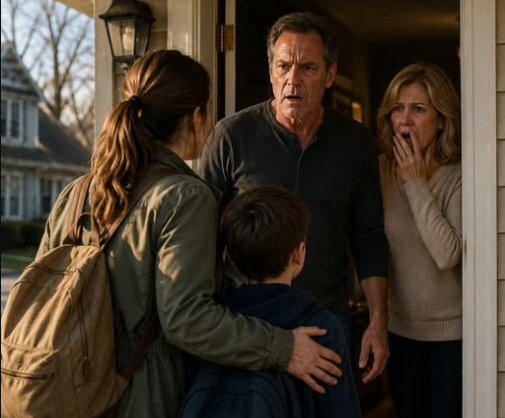
Sometimes they looked at Leo and somehow understood everything without forcing me to explain.
But standing on that porch, with the late-afternoon sun casting long shadows across the faded wooden boards, I realized there was no gentle way to break a truth that had already destroyed so much.
Leo moved closer to me.
His small shoulder pressed against my arm.
“Mom?” he whispered.
I reached down and took his hand.
My father’s eyes stayed fixed on my son.
There was fear in his expression now.
Not anger.
Not confusion.
Recognition.
Leo had my dark hair and my mother’s deep brown eyes, but the shape of his jaw, the narrow bridge of his nose, and the small crooked bend in his left eyebrow belonged to someone else.
Someone my parents knew very well.
My mother gripped the doorframe.
“Emma,” she whispered.
“Who was his father?”
I looked directly at her.
“Raymond Hale.”
The name fell between us like a piece of glass.
My mother made a sound that barely escaped her throat.
My father stumbled backward as if I had struck him.
“No.”
His answer came immediately.
Too quickly.
“No,” he repeated.
“That’s not possible.”
Leo looked from him to me.
“Who’s Raymond Hale?”
I tightened my grip on his hand.
My mother’s face had gone completely white.
Raymond Hale had not been a stranger.
He had been my father’s closest friend for nearly twenty-five years.
He had eaten Thanksgiving dinner at our table.
He had helped teach me how to ride a bicycle.
He had brought me birthday gifts, attended my school concerts, and insisted that I call him Uncle Ray.
When my father lost his job during my sophomore year of high school, Raymond had helped him find another one.
When my grandmother died, Raymond had stood beside my father at the funeral.
Our families had vacationed together.
My parents had trusted him with the keys to our house.
They had trusted him with me.
My father shook his head.
“Raymond would never—”
“He did.”
“No.”
“He did, Dad.”
“Stop saying that.”
His voice rose sharply, and Leo flinched.
I immediately stepped between them.
“Don’t raise your voice in front of my son.”
My father stared at me.
For a moment, he looked exactly as he had ten years earlier—angry, frightened, desperate to control a situation he did not understand.
Then his shoulders dropped.
“I’m sorry,” he said quietly.
It was the first apology he had ever given me.
But it was ten years too late to soften what came next.
My mother opened the screen door.
“Please come inside.”
I hesitated.
The living room looked almost unchanged.
The same brown recliner sat near the window.
The same family photographs lined the mantel.
A newer television had replaced the old one, and the walls had been painted pale gray, but the room still carried the memories of the last night I had stood there.
I could still hear my father shouting.
I could still see my mother crying behind the screen door.
I could still feel the weight of the duffel bag cutting into my shoulder as I stepped off the porch with nineteen dollars in my wallet and nowhere to sleep.
Leo looked up at me.
“It’s okay, Mom.”
He thought he was reassuring me.
My ten-year-old son was trying to give me courage to enter the house where my own parents had abandoned me.
I swallowed the ache in my throat.
Then I stepped inside.
THE MAN THEY TRUSTED
My mother sat on the edge of the sofa.
My father remained standing.
Leo stayed close to my side as I lowered myself into the chair across from them.
For several seconds, nobody spoke.
The clock in the hallway ticked loudly.
My father finally broke the silence.
“Raymond was in Cincinnati when you became pregnant.”
“He told you he was in Cincinnati.”
My mother stared at me.
“What does that mean?”
“He came back three days early.”
My father’s face tightened.
“How would you know that?”
“Because he came here.”
My mother’s breathing changed.
I saw the exact moment a memory surfaced.
“Your father and I were visiting Aunt Susan,” she whispered.
I nodded.
It had been a Saturday night in early October.
My parents had driven two hours away to celebrate my aunt’s fiftieth birthday.
I had been invited, but I told them I was sick and wanted to stay home.
I had not been sick.
I had been exhausted from working the evening shift at a grocery store and studying for a chemistry exam.
At around nine, someone knocked on the back door.
It was Raymond.
He said he had returned from his trip early and noticed my bedroom light while driving past.
He carried a paper bag containing soup and medicine.
He acted concerned.
Kind.
Familiar.
I let him inside because he had entered our home hundreds of times.
I never thought I needed to fear a man whose photograph was hanging on our wall.
“I don’t want Leo hearing the details,” I said.
My mother nodded quickly.
“We can send him upstairs.”
“No.”
The word came from Leo.
All three adults turned toward him.
He stood straight, though his hand was still locked around mine.
“I don’t want to go upstairs in a house I don’t know.”
My father closed his eyes briefly.
The sentence hurt him.
It was supposed to.
This should have been a house Leo recognized.
There should have been birthday photographs of him on the mantel.
He should have known which stair creaked and where his grandmother kept the cookies.
Instead, it was a stranger’s house.
My mother wiped her eyes.
“You’re right,” she told him.
“You don’t have to go anywhere.”
I looked at Leo.
“There are parts of this story that are meant for adulTS.”
He studied my face.
“Is it about something bad that happened to you?”
“Yes.”
“Because of Raymond?”
“Yes.”
“Is he my father?”
I had answered that question before.
Not with Raymond’s name, but with enough truth for a child to understand.
I had told Leo that his biological father was someone who had caused harm, that none of it had been Leo’s fault, and that a person’s beginnings did not decide the person he would become.
But hearing a name made everything feel more real.
“Yes,” I said gently.
“Raymond was your biological father.”
Leo’s chin trembled.
“Did you love him?”
“No.”
My mother covered her mouth.
Leo looked down at the floor.
“Did he love you?”
“No, sweetheart.”
“Then why did you have me?”
The question broke something inside the room.
My father turned away.
My mother began crying silently.
I moved from the chair and knelt in front of my son.
“Look at me.”
He reluctantly raised his eyes.
“I didn’t choose what Raymond did.
But when I learned you were growing inside me, I knew that you were not what he had done.
You were innocent.
You were mine.
Keeping you was my choice, and I have never regretted you for one second.”
“Not even when we were poor?”
“Not even then.”
“Not even when you cried in the bathroom because the electricity got turned off?”
My heart stopped.
I had not known he remembered that.
He had been five.
It was winter, and I had been short on the utility bill after his asthma medication increased in price.
I had locked myself in the bathroom so he would not see me break down.
“I wasn’t crying because of you,” I said.
“I was crying because I wished I could give you more.”
He searched my eyes.
Then he nodded.
“Okay.”
I pulled him into my arms.
He held on tightly.
Over his shoulder, I saw my father sit down in the recliner as though his legs could no longer support him.
WHY I COULD NOT SPEAK
My mother brought Leo a glass of lemonade and found an old deck of cards in the kitchen.
He sat at the dining table where I could still see him through the doorway.
He did not play.
He arranged the cards into careful rows, listening without appearing to listen.
I returned to the living room.
My father leaned forward, elbows on his knees.
“Why didn’t you tell us?”
There it was.
The question every victim is eventually asked.
Why didn’t you say something?
Why didn’t you fight harder?
Why didn’t you report it immediately?
Why didn’t you trust us?
Questions that placed responsibility on the frightened person rather than the person who caused the fear.
I had spent years learning that silence could be a survival response.
But I had also spent years wishing I had found a way to speak.
“I tried.”
My father looked up.
“When?”
“The morning after it happened.”
My mother frowned.
“You didn’t say anything.”
“I came into your bedroom while you were unpacking.”
Her eyes shifted toward the hallway as if she could see the scene from ten years earlier.
I had stood in the doorway, wearing the same clothes from the night before.
My mother had been pulling dresses from a suitcase.
My father was in the shower.
I had opened my mouth twice, but no words came.
Then the telephone rang.
Raymond was on the other end.
He told my mother he had returned from Cincinnati late and wanted to invite our family to dinner.
My mother laughed with him.
Before hanging up, she had said, “I don’t know what we’d do without you, Ray.”
I remembered standing there, hearing those words.
I remembered realizing that if I accused him, I would not simply be accusing a man.
I would be accusing someone my parents considered family.
“You looked like you hadn’t slept,” my mother whispered.
“I hadn’t.”
“I asked if you were all right.”
“And I said I was tired.”
She stared at her hands.
“Why didn’t you tell me?”
“Because Raymond called before I could.
Because I heard how warmly you spoke to him.
Because he told me nobody would believe me.”
My father’s jaw clenched.
“He threatened you?”
“Yes.”
“What did he say?”
“He said you would believe him over me.
He said you owed him your job.
He said if I destroyed his family, he would destroy ours.”
My father stood and began pacing.
“I would have killed him.”
“Maybe that’s another reason I stayed silent.”
He stopped.
“You thought I would go after him?”
“You threw your pregnant daughter out of the house in less than an hour.
I had no idea what you were capable of doing if you learned the truth.”
My words landed hard.
He sat down again.
My mother wiped her cheeks.
“But you told someone eventually.”
“Yes.”
“Who?”
“A nurse.”
Three weeks after learning I was pregnant, I had gone to a small clinic alone.
I had no plan.
I did not know whether I was going to ask for medical care, counseling, or simply a place to sit where nobody knew me.
A nurse named Teresa found me crying in the restroom.
She did not demand answers.
She did not tell me what decision to make.
She sat on the floor beside me and asked one simple question.
“Are you safe at home?”
I said I did not know.
That answer changed my life.
Teresa brought in a counselor.
The counselor contacted a victim advocate.
The advocate explained my choices and helped me create a safety plan.
At first, I refused to name Raymond.
I was still terrified.
Then I discovered I was pregnant.
I realized the truth would eventually become impossible to hide.
I also realized the pregnancy might preserve evidence Raymond believed would disappear.
“The day I told you I was pregnant,” I said, “I had already spoken to an investigator.”
My father stared.
“You went to the police before you came to us?”
“I met with a detective, but I hadn’t formally named Raymond yet.”
“Why not?”
“Because I wanted to know whether my parents would stand beside me.”
My mother’s face crumpled.
I continued before I lost the strength.
“I thought maybe you’d ask if I was safe.
I thought maybe you’d notice how scared I was.
I thought you might say that whatever had happened, I was still your daughter.”
My father looked toward the floor.
“Instead, I gave you an ultimatum.”
“Yes.”
“And when you wouldn’t do what I demanded, I threw you out.”
“Yes.”
My mother whispered, “And I let him.”
I looked at her.
“Yes.”
There were no comforting lies left.
THE NIGHT I DISAPPEARED
My parents had always believed that I left Ohio shortly after they threw me out.
That was not exactly true.
For the first four nights, I slept in my car behind a twenty-four-hour grocery store.
I kept the doors locked and placed my duffel bag across my lap.
During the day, I attended classes and worked as though nothing had happened.
At night, I ate crackers and drank water from the store’s restroom.
On the fifth morning, Teresa found me asleep in the clinic parking lot.
She took me to a shelter in Columbus.
The shelter director, Mrs. Alvarez, gave me a small room with a narrow bed, a dresser, and a window facing a brick wall.
To me, it looked like a palace.
For the first time since leaving home, I slept without gripping my car keys between my fingers.
With the advocate beside me, I formally identified Raymond.
Detective Lena Morris listened to my statement for nearly four hours.
She believed me.
That did not mean the case was easy.
Raymond denied everything.
He claimed I was confused, angry, and unstable.
He suggested I had become pregnant by a college student and invented the accusation to protect myself from my strict parenTS.
His attorney pointed out that I had waited several weeks to name him.
There was no security footage.
No witness had seen him enter our home.
He had used the back door and parked two streets away.
But there was one thing Raymond had not anticipated.
He had sent me messages.
Not apologies.
Warnings.
He told me to “forget the misunderstanding.”
He reminded me how much my father depended on him.
He wrote that if I tried to blame him for my “bad decisions,” my parents would lose everything.
I had deleted the messages in panic.
Detective Morris recovered them.
Still, the prosecutor warned me that the case might not move forward until Leo was born and a legal paternity test could be completed.
“Is that why you said we would all regret it?” my mother asked.
“Partly.”
If I had ended the pregnancy, there would have been no paternity test.
No undeniable biological connection.
Raymond would have called me a liar.
My parents, after the way they reacted, might have believed him.
He would have remained in our lives, invited into our home, trusted around other young women.
But there was another reason.
One I had never told anyone except the prosecutor.
“Raymond had done it before,” I said.
My father looked up sharply.
“What?”
“Detective Morris found another complaint.”
My mother pressed her fingers against her lips.
“A girl named Hannah had reported him six years earlier.”
My father shook his head.
“No one ever told us.”
“Hannah’s family moved away.
The case was closed because there wasn’t enough evidence.
Raymond said she was troubled and had become obsessed with him.”
My mother suddenly stood.
“The Millers.”
I nodded.
She remembered.
Everyone in town remembered when David and Susan Miller abruptly sold their home and moved to Indiana.
Their daughter Hannah had been sixteen.
Raymond told people she had accused a teacher of something inappropriate and her parents were embarrassed.
He had controlled the story before anyone heard the truth.
My mother sank back onto the couch.
“Oh, God.”
“Hannah agreed to speak to investigators again after I came forward.”
My father’s voice was barely audible.
“Were there others?”
“Eventually, yes.”
The silence expanded.
Four women testified.
Two had been teenagers when Raymond targeted them.
One had been employed by his company.
Another had been the daughter of a family friend.
His pattern was always the same.
He chose someone unlikely to be believed.
He made himself essential to the people around her.
Then he used that trust as a weapon.
My father gripped the arms of his chair.
“How long has he been in prison?”
“Seven years.”
My mother stared at me.
“Seven years?”
“Yes.”
“How did we not know?”
“The early proceedings were sealed because of the ages involved.
The public reports used initials.
Raymond’s family told everyone he was transferred overseas for business, then later that he had moved after a financial dispute.”
My father’s expression changed.
“He called me.”
My skin went cold.
“When?”
“After you left.
He called from what he said was a hotel in Canada.”
Of course he had.
Raymond had probably wanted to know what I had told them.
“What did he say?”
My father looked sick.
“He said he’d heard you had run away after getting pregnant.
He said we had done the right thing by refusing to encourage irresponsible behavior.”
My mother began sobbing.
My father did not.
He sat completely still, trapped inside the realization that the man who harmed his daughter had congratulated him for abandoning her.
“And I thanked him,” my father whispered.
THE LETTER ON THE TABLE
My eyes moved toward the dining room.
A large white envelope rested beside a stack of mail.
The return address belonged to the Ohio Parole Board.
My heartbeat quickened.
“That’s why I came now.”
My father followed my gaze.
“You know about the letter?”
“I know Raymond is eligible for a hearing.”
My parents exchanged a look.
My mother stood, walked to the table, and brought the envelope into the living room.
It had already been opened.
Inside was a request for a character statement.
My father had known Raymond for decades.
Raymond’s attorney had apparently submitted his name as someone who could speak about Raymond’s behavior before the conviction.
My father’s hands tightened around the paper.
“He wrote to me last month.”
“Raymond did?”
“Yes.”
“What did he say?”
“He claimed he had been falsely accused.
He said he couldn’t reveal details because the court had sealed parts of the case.
He said the accusations came from people seeking money.”
“And you believed him?”
My father did not answer.
That was answer enough.
A fresh wave of anger rose through me.
Even after ten years, even after losing his daughter, he had still trusted Raymond’s word.
My father must have seen the fury in my face.
“I didn’t write the statement.”
“But you considered it.”
“Yes.”
“Why?”
“Because he was my friend.”
“I was your daughter.”
The words came out louder than I intended.
Leo looked toward us from the dining table.
I lowered my voice.
“I was your daughter, but when I stood in this room terrified and pregnant, you didn’t ask who had hurt me.
You demanded a name so you could decide who deserved blame.
When I couldn’t give you one, you blamed me.”
“I know.”
“No, you’re only beginning to know.”
My father folded the letter slowly.
“I thought I was teaching you responsibility.”
“You were protecting your pride.”
He closed his eyes.
“Yes.”
His admission did not erase anything.
But it kept me from standing and leaving.
My mother reached for my hand.
I pulled away before she could touch me.
Pain crossed her face.
I had dreamed of her holding me for ten years.
Now that she was finally trying, my body remembered the screen door between us.
“I’m sorry,” she whispered.
“I know you are.”
“Can you ever forgive me?”
“I don’t know.”
She nodded through her tears.
It was the first correct response she had given me.
She did not demand forgiveness.
She did not say she had suffered too.
She did not ask me to comfort her.
She simply accepted that regret did not entitle her to immediate healing.
My father looked at the parole letter again.
“I’ll tell them the truth.”
“What truth?”
“That I cannot support his release.”
“That is not enough.”
“What else do you want me to say?”
“I want you to tell them how he used your friendship to access our home.
I want you to explain that he contacted you after I disappeared and reinforced your belief that I deserved to be abandoned.
I want you to admit that his manipulation helped isolate me.”
My father’s face tightened with shame.
“I’ll do it.”
“And I want you to read the case file before the hearing.”
He looked at me.
“I brought a copy.”
From my bag, I removed a thick blue folder.
My mother stared at it.
Inside were court summaries, recovered messages, the paternity report, and parts of the sentencing record I was legally allowed to share.
I placed it on the coffee table.
My father looked at the folder as though it contained something alive.
“You don’t have to read every detail tonight,” I said.
“But you don’t get to make another decision based on Raymond’s version of the truth.”
My father reached for it.
His fingers stopped before touching the cover.
Then Leo spoke from the dining room.
“Grandpa?”
My father turned.
It was the first time Leo had called him that.
My father’s expression broke.
“Yes?”
“Are you going to help the bad man?”
“No.”
His answer was immediate.
Leo studied him.
“Did you know he was bad before today?”
“No.”
“Did Mom try to tell you?”
My father swallowed.
“Yes.”
“But you didn’t listen?”
“No.”
Leo looked down at the cards.
Then he said the sentence that changed the atmosphere in the room.
“Mom still came back, so maybe you should listen now.”
My father lowered his head.
For the first time in my life, I saw him cry.
A NIGHT UNDER THE SAME ROOF
My mother asked us to stay.
My first instinct was to refuse.
The hotel room was already paid for.
It was safe, neutral, and free of memories.
But a storm was moving across the county, and the rain had begun striking the windows in hard, slanted sheeTS.
Leo was exhausted.
He had spent eight hours in a car and another hour absorbing truths no child should have needed to carry.
“We can stay one night,” I said.
My mother nodded as if I had given her something precious.
She prepared the spare bedroom.
It had once been mine.
The walls had changed from pale blue to cream, but the closet door still had a tiny crescent-shaped scratch from when I moved my desk at sixteen.
My old bookshelf remained in the corner.
Most of my books were gone.
A framed photograph sat on the dresser.
It showed me at eighteen, wearing my high school graduation gown.
I picked it up.
“You kept this?” I asked when my mother appeared in the doorway.
“I kept everything.”
“Why?”
“Because getting rid of your things would have felt like admitting you were never coming home.”
I set the photograph down.
“You could have looked for me.”
“I did.”
“You sent three emails.”
“I called the college.”
“You called once, and they wouldn’t give you information.”
“I didn’t know where else to start.”
“You could have contacted the police.
You could have called hospitals or shelters.
You could have asked my friends.”
“I was ashamed.”
There it was again.
Pride.
Shame.
The emotions my parents protected even when doing so cost them their daughter.
My mother stepped into the room.
“Your father said you would come back when you realized how difficult life was.”
“And you believed him?”
“I wanted to.”
“Because it was easier than admitting I might be in danger.”
“Yes.”
I appreciated her honesty.
I hated the truth.
She touched the bedspread.
“Every Christmas, I wondered if you were warm.
Every birthday, I baked your favorite cake.”
“Why?”
“I don’t know.
Maybe I thought the act of baking it meant I was still your mother.”
“You were still my mother.
You just weren’t acting like one.”
She nodded.
“I understand that now.”
“No.
You understand the words.
Understanding what they cost will take longer.”
She looked toward the hallway.
“Does Leo know everything?”
“He knows enough.”
“Does he know Raymond is in prison?”
“Yes.”
“Does he hate him?”
“I don’t encourage Leo to hate anyone.
Hate attaches people to the person who hurt them.
I want my son free.”
My mother looked at me with something close to wonder.
“You raised him well.”
“I raised him alone.”
The reminder was deliberate.
She accepted it.
“Yes,” she whispered.
“You did.”
That night, Leo slept beside me.
The storm shook the windows.
At around two in the morning, I woke and found his eyes open.
“Can’t sleep?” I asked.
He shook his head.
I turned on the bedside lamp.
“What are you thinking about?”
“Raymond.”
My chest tightened.
“What about him?”
“Do I look like him?”
I considered lying.
But lies created shadows, and I had lived in shadows long enough.
“Some features are similar.”
“Does Grandpa think I look like him?”
“Probably.”
Leo pulled the blanket to his chin.
“What if I become like him?”
I turned fully toward him.
“You won’t.”
“How do you know?”
“Because being someone’s biological child doesn’t mean you inherit their choices.”
“But what if there’s something bad inside me?”
“There isn’t.”
“You don’t know that.”
“Yes, I do.”
“How?”
“Because I have watched you for ten years.”
I reminded him of the day he returned a lost wallet without touching the money inside.
I reminded him how he sat beside a new student at lunch because the boy was alone.
I reminded him how he carried injured birds to our neighbor, who volunteered at a wildlife center.
I reminded him that goodness was not a feeling hidden inside a person.
It was a pattern of choices.
“You choose kindness even when nobody rewards you,” I said.
“That tells me who you are.”
He was quiet.
“Did you ever hate me because I looked like him?”
“Never.”
“Did I remind you of what happened?”
“Sometimes your face reminded me that I survived.”
His eyes filled with tears.
I kissed his forehead.
“You are not the worst thing someone did to me, Leo.
You are the best thing I chose afterward.”
He moved closer and rested his head against my shoulder.
Within minutes, he was asleep.
I remained awake until dawn.
THE FILE
Downstairs, my father read the blue folder through the night.
I knew because I found him at the kitchen table at six in the morning.
The overhead light was on.
His coffee sat untouched.
The folder lay open before him.
My mother sat across from him, holding a tissue.
Neither had gone to bed.
My father looked twenty years older than he had the previous afternoon.
“I read the messages,” he said.
I nodded.
“He told you I would choose him.”
“Yes.”
“And then I did.”
“Yes.”
My father stared at the recovered message in which Raymond had written:
Your father owes me everything.
He knows what kind of girl you’ve become.
He will never risk his job or reputation for you.
Raymond had been wrong about one thing.
My father had not consciously chosen his job over me.
He had never been given the full choice.
But Raymond correctly understood my father’s pride, temper, and obsession with controlling appearances.
He knew exactly how my father would react to an unexplained pregnancy.
He had counted on it.
“I made it easy for him,” my father whispered.
“You made it easier.”
“I should have protected you.”
“Yes.”
“I failed.”
“Yes.”
Each answer hurt him.
I did not soften them.
An apology without full responsibility was only another method of escape.
My mother opened a section of the folder.
“Why is part of Hannah’s statement missing?”
“Because I didn’t have permission to share it.”
“Is she all right now?”
“She has a family.
She works with a support organization.”
“Have you met her?”
“Yes.”
Hannah had attended the sentencing.
She sat behind me in court.
When my voice failed during my statement, she placed her hand against my back.
After Raymond was sentenced, we stood together outside the courthouse.
Neither of us celebrated.
There was no joy in learning that the truth had finally become heavy enough for strangers to believe.
There was only relief.
And grief for the years he had taken.
My father closed the folder.
“I want to apologize to her.”
“That is her decision, not yours.”
“I understand.”
“You also need to understand that your guilt cannot become another burden for the people Raymond harmed.”
He frowned.
“What do you mean?”
“You don’t get to seek them out so they can tell you you’re not a bad person.
You don’t get to confess your failure and expect them to ease your conscience.”
He absorbed that.
“What am I supposed to do with the guilt?”
“Use it.”
“How?”
“Become the kind of man who listens when someone is afraid.
Admit publicly that you were wrong.
Stop protecting your reputation.”
He looked toward the dark kitchen window.
“I spent my entire life worrying about what people would think of this family.”
“And that nearly destroyed it.”
“Yes.”
My mother looked toward the stairs.
“What does Leo need from us?”
“Consistency.”
“We can do that.”
“You don’t know yet.”
Her face fell.
I continued.
“He doesn’t need gifts or dramatic promises.
He needs you to call when you say you’ll call.
He needs you to remember his school concert.
He needs you not to disappear when things become uncomfortable.”
“We won’t.”
“You did it to me.”
The room went quiet.
Then my father said, “She’s right.”
My mother looked at him.
“We have to earn this,” he said.
“We don’t get to announce that we’re grandparents and pretend the last ten years didn’t happen.”
I had never heard my father speak with such humility.
A small part of me wanted to trust it.
The larger part remained careful.
THE MAN IN THE PHOTOGRAPH
After breakfast, my father took Leo into the garage to show him an old woodworking bench.
I stood near the door, watching.
My father did not touch Leo without asking.
He did not overwhelm him with questions.
He showed him how to smooth a rough piece of pine with sandpaper.
Leo listened with cautious interest.
My mother joined me.
“He used to make things for you,” she said.
“I remember.”
There had been a bookshelf, a dollhouse, and a crooked wooden jewelry box that I once believed was the most beautiful object in the world.
“He kept the jewelry box,” she said.
“I don’t want it.”
“I understand.”
She looked into the garage.
“Your father blamed himself after you left.”
“He blamed me first.”
“Yes.”
“For how long?”
My mother hesitated.
“Too long.”
“How long?”
“Almost two years.”
The honesty hurt more than a lie would have.
“What changed?”
“He found your note.”
“What note?”
“The one behind your dresser.”
I frowned.
I did not remember leaving a note.
My mother went upstairs and returned with a folded piece of paper sealed inside a plastic sleeve.
The handwriting was mine.
I had written it the day before telling them about the pregnancy.
Mom and Dad,
Something happened to me.
I am trying to find the courage to explain it.
Please remember that I am still me.
Please believe me before you believe anyone else.
Emma.
I stared at the words.
“I thought I threw this away.”
“It must have slipped behind the dresser.”
My hands began trembling.
My father had found it while removing my old carpet.
By then I had disappeared completely.
My phone number no longer worked.
My friends did not know where I was.
The shelter kept my information confidential.
My parents had finally gone to the police, but because I was an adult and there was no evidence of immediate danger, they could do little more than record me as a missing person who might have left voluntarily.
“Why didn’t you keep searching?” I asked.
“We did,” my mother said.
“For how long?”
“Years.”
“You never found the court case?”
“We searched your name, not Raymond’s.
Your identity was protected in the reporTS. We hired a private investigator once, but your records had been restricted through the support program.”
The advocate had helped me relocate after Raymond’s attorney attempted to discover my address.
I changed my surname temporarily.
When Leo was born, the hospital followed security procedures.
My parents’ failure to find me had not been entirely due to a lack of effort.
But their first decision had created the distance every later effort failed to cross.
“We received a letter when Leo was almost two,” my mother said.
My stomach tightened.
“What letter?”
“It didn’t have a return address.”
She retrieved another paper from a drawer.
This one was typed.
Emma is safe.
She has given birth to a healthy boy.
Do not attempt to locate her.
When she is ready, she will decide whether contact is appropriate.
Teresa.
I recognized the nurse’s first name.
My mother pressed the letter to her chest.
“That was how we learned you had a son.”
I sat down.
Teresa had never told me she contacted them.
At first, anger rose.
Then I read the words again.
She had not revealed my location.
She had not invited them back into my life.
She had simply told two grieving parents that their daughter was alive.
That was exactly the kind of mercy Teresa would offer.
“After the letter,” my mother said, “your father built a crib.”
I looked toward the garage.
“What?”
“He didn’t know whether you would ever come home.
He built it anyway.”
“Where is it?”
“In the attic.”
I did not ask to see it.
Not yet.
THE CALL FROM RAYMOND’S FAMILY
We planned to leave after lunch.
Before we could, the house phone rang.
My father answered.
His expression changed immediately.
“Yes, this is Robert.”
He listened.
Then he looked at me.
“No, I will not be submitting a statement supporting his release.”
A pause.
My father’s face hardened.
“Because I now know the truth.”
Another pause.
“No.
Do not contact me again.”
He started to hang up.
A voice shouted loudly enough through the receiver that I heard a woman’s words.
“She’s lying to you!”
My father froze.
I stood.
“Who is it?”
He covered the receiver.
“Raymond’s daughter.”
Caroline Hale had been twenty-four when Raymond was arrested.
She had defended him from the beginning.
She attended every hearing, gave interviews suggesting the accusations were financially motivated, and cut off anyone who questioned her father.
At sentencing, she looked directly at me and mouthed, You destroyed my family.
I understood her pain.
I also understood that pain did not make her accusations true.
“Give me the phone,” I said.
My father hesitated.
“Emma—”
“Give it to me.”
He handed over the receiver.
“Caroline.”
Silence.
Then she spoke.
“I knew you’d come crawling back to them.”
“I didn’t come for you.”
“You’ve kept this performance going for ten years.”
“Your father was convicted after a full trial.”
“Because everyone felt sorry for you.”
“Four women testified.”
“Four liars.”
I closed my eyes.
I had no interest in debating reality with someone committed to denying it.
“Your father’s parole board requested my statement,” she said.
“I have every right to ask why you’re interfering.”
“I’m not interfering.
I’m participating in a legal process.”
“You already took ten years from him.”
“No.
His choices did that.”
“He is Leo’s father.”
The words made my entire body tense.
“How do you know my son’s name?”
Caroline went silent.
My father stepped closer.
I gripped the phone.
“How do you know his name?”
“My father told me.”
Raymond had not seen Leo.
He was prohibited from contacting us.
The paternity records were sealed.
Only a limited number of people knew my son’s first name.
“When did he tell you?”
“I don’t remember.”
“Yes, you do.”
“Maybe it was in the court documenTS.”
“It wasn’t.”
My heart pounded.
My parents watched me.
“Has Raymond received information about us?”
Caroline exhaled sharply.
 I Found My Daughter Kneeling in the Rain as Her Husband’s Family Laughed—They Thought They Owned Her Until Five Words Changed Their Lives Forever
 My Grandmother Sent $180,000 to Save Me and My Baby, but at Thanksgiving She Discovered Who Took It—and Why My Mother Had Stayed Silent for Years Behind Closed Family Doors
“You’re being dramatic.”
“Has he received photographs?”
She did not answer.
I lowered my voice.
“Caroline, listen carefully.
Any attempt to contact Leo violates the protective order.
If you have passed information, photographs, school records, or our address to Raymond, investigators need to know.”
“I haven’t done anything illegal.”
“That wasn’t my question.”
She hung up.
I immediately called Detective Morris.
She had retired three years earlier but remained in contact with the victim advocate’s office.
Within an hour, a current investigator called me back.
He asked whether Leo’s location had recently been shared online.
I had no public social media accounTS.
His school protected student information.
Only a small circle knew we were visiting Ohio.
Then Leo came into the room carrying my mother’s tablet.
“Mom, is this me?”
On the screen was a photograph from his school’s science fair.
It had been posted on the school district’s public website six months earlier.
His name appeared beneath it.
My stomach dropped.
The image could be found through a simple search.
Raymond’s family had been looking for him.
THE DECISION TO STAY
The investigator assured me there was no evidence of an immediate threat.
Raymond remained incarcerated.
His outgoing communication was monitored.
Still, the knowledge that he had searched for Leo made me feel exposed.
I wanted to drive home immediately.
But the parole hearing was four days away.
I had planned to provide my statement remotely.
Now I decided to attend in person.
My parents offered to let us remain at the house.
I refused.
We moved to a hotel with controlled access and notified local authorities of the protective order.
My father did not argue.
He booked a second room across the hall but did not tell me until afterward.
“You don’t need to stay here,” I said.
“I know.”
“Then why are you?”
“In case you need anything.”
“I needed you ten years ago.”
Pain crossed his face.
“I know.”
“You can’t repair that by standing guard in a hotel hallway.”
“No.”
“Then what are you doing?”
He considered the question.
“Something I should have done before.
I’m making myself available without demanding that you trust me.”
I had no response.
He handed me the second room key.
“If my presence makes you uncomfortable, I’ll leave.”
It did make me uncomfortable.
It also made me feel less alone.
“Stay,” I said.
That evening, my mother brought dinner.
She had packed sandwiches, fruit, soup, and Leo’s favorite chocolate cookies after asking him what he liked.
She also brought no toys, no expensive gifts, and no attempt to buy affection.
We ate at the small table in our hotel room.
Leo told them about school.
He described his science project involving water filtration.
My father listened carefully.
When Leo mentioned an upcoming regional competition, my father asked the date.
“November fourteenth,” Leo said.
My father wrote it down.
“Don’t promise you’ll come,” I warned.
He looked at me.
“I wasn’t going to promise without asking.”
That answer surprised me.
Leo glanced between us.
“You can come.”
My father smiled.
“I would like that.”
“But it’s three hours away.”
“I know.”
“And it starts at eight in the morning.”
“I’ll be early.”
Leo narrowed his eyes.
“Mom says people show you who they are by what they keep doing, not what they say once.”
My father nodded.
“Your mom is right.”
THE APOLOGY I HAD WAITED TEN YEARS TO HEAR
After Leo fell asleep, my parents and I sat in the adjoining room.
My father placed the unsigned parole letter on the table.
He had written his own statement.
“Will you read it?” he asked.
I took the pages.
He had not attempted to make himself look innocent.
He described his friendship with Raymond.
He admitted giving Raymond access to our home and family.
He explained his reaction to my pregnancy and his decision to throw me out.
He acknowledged that Raymond’s manipulation succeeded partly because of his own temper and rigid beliefs.
Then I reached the final paragraph.
I once believed protecting my family meant controlling it.
When my frightened daughter could not give me the explanation I demanded, I treated her fear as defiance.
Raymond Hale understood my weakness and used it.
My daughter and grandson survived without me, not because of me.
I cannot change the harm I caused, but I can refuse to help the man who benefited from it return to the community he harmed.
My vision blurred.
I placed the statement down.
“Don’t change it,” I said.
My father nodded.
My mother took a breath.
“I wrote something too.”
Her letter was shorter.
She described standing behind the screen door while I was forced from the house.
She admitted that she had wanted to run after me.
She also admitted why she did not.
“I was afraid your father would turn his anger toward me,” she said.
“That does not excuse it.”
“No.”
“I told myself I could call you the next morning.
Then I told myself you needed time.
Every excuse made the next one easier.”
She looked at me.
“I chose comfort when my child needed courage.”
The words struck the wound I had carried for a decade.
I had hated my father’s anger.
But my mother’s silence had hurt differently.
Some part of me had always believed she would open the door.
Even after I stepped off the porch, I had walked slowly toward my car.
I had waited to hear her call my name.
She never did.
“I watched the upstairs window from the driveway,” I said.
My mother began crying.
“I know.”
“How could you know?”
“Because I was standing behind the curtain.”
The room became very still.
“You watched me?”
“Yes.”
“And you still didn’t come outside?”
“I put my hand on the window.
I kept telling myself to move.
But I heard your father behind me, and I froze.”
I stood so quickly the chair scraped the floor.
My mother flinched.
“You watched your pregnant daughter get into a car with nowhere to go.”
“Yes.”
“I could have died.”
“I know.”
“You didn’t know I had money.
You didn’t know whether my phone worked.
You didn’t know whether I had anyone to call.”
“I know.”
“You let me drive away.”
“Yes.”
Her voice cracked.
“Yes, Emma.
I let you drive away.”
I turned toward the window, unable to look at her.
For ten years, I had wondered whether my mother realized how vulnerable I was that night.
Now I knew.
She had understood.
She had simply been too afraid to act.
“I’m not asking you to forgive me,” she said.
“I’m asking for the opportunity to spend whatever years I have left becoming someone who would open the door.”
I pressed my hand against my mouth.
My father spoke from behind me.
“I need to say something without defending myself.”
I did not turn.
“I was cruel,” he said.
“Not strict.
Not old-fashioned.
Cruel.
I used your dependence on me to force a decision about your body and your future.
When you refused, I removed your safety.
I told myself I was teaching you consequences, but I was punishing you for not surrendering control.”
I closed my eyes.
He continued.
“When you said we would all regret it, I thought you were threatening us.
You were warning us.”
“Yes.”
“I should have asked why.”
“Yes.”
“I should have listened.”
“Yes.”
“I am sorry, Emma.”
My shoulders shook.
It was the apology I had imagined.
But hearing it did not bring relief.
It brought grief.
Grief for the nineteen-year-old girl who had needed those words before the damage was done.
I turned around.
“I believe that you’re sorry.”
My father’s eyes filled with hope.
I stopped it before it grew.
“But believing your apology does not mean I trust you.”
“I understand.”
“Trust will depend on what you do when there is no crisis, no hearing, and no chance to look heroic.”
He nodded.
“I understand.”
“I won’t allow either of you to pressure Leo.
You don’t call yourselves his grandparents to other people without asking him what he’s comfortable with.
You don’t post his photographs.
You don’t discuss Raymond with him unless I’m present.”
“We agree,” my mother said.
“If you criticize how I raised him, we leave.”
“We won’t.”
“If you ever imply that he should be grateful you accepted him, contact ends.”
My father’s jaw tightened with emotion.
“He has nothing to prove to us.”
“Good.”
I picked up my coat.
“I need air.”
My mother did not follow.
Neither did my father.
For once, they let me leave without trying to control where I went.
THE HEARING
The parole hearing took place on a gray Thursday morning.
I wore a navy suit.
My hands shook while I fastened the buttons, just as they had when I held the pregnancy test ten years earlier.
But I was not nineteen anymore.
I had completed college.
I had earned a degree in accounting while raising a child and working two jobs.
I had built a career managing finances for a nonprofit organization that helped families in crisis.
I had created a home where Leo never wondered whether love could be revoked.
I had survived the night Raymond entered my life.
I had survived the morning my parents forced me out.
I had survived years when survival itself felt like a full-time occupation.
Detective Morris met us outside the hearing room.
She had silver in her hair now.
When she saw Leo’s photograph on my phone, she smiled.
“He has your eyes.”
“He has my stubbornness too.”
“That saved both of you.”
My parents arrived together.
My father carried no folder.
He had memorized his statement.
My mother wore the small silver necklace I had given her for Mother’s Day when I was twelve.
She did not mention it.
Caroline Hale sat on the opposite side of the waiting area.
She stared at me with open hostility.
Her mother sat beside her, looking much older than I remembered.
When the doors opened, we entered separately.
Raymond appeared through a video screen from the correctional facility.
Time had changed him.
His hair was mostly gray.
His face was thinner.
But his voice remained calm and confident.
He spoke about rehabilitation.
He described himself as a mentor to younger inmates.
He said he had accepted responsibility for “poor judgment” while continuing to deny the central facts of his conviction.
He called the case a tragedy for “everyone involved.”
He never used my name.
He never used the word harm.
He never acknowledged Leo.
Caroline spoke first.
She described him as a loving father and grandfather who had missed important family milestones.
Her pain was real.
I did not doubt that Raymond had been kind to her.
People who cause harm are rarely cruel every minute of every day.
That complexity often protects them.
Then my father stood.
Raymond’s expression changed when he saw him.
For a brief second, the confident mask slipped.
My father began.
“My name is Robert Carter.
For twenty-five years, I considered Raymond Hale my closest friend.”
Raymond leaned toward the camera.
“Robert, you know me.”
My father stopped.
The hearing officer warned Raymond not to interrupt.
My father continued.
“I believed I knew him.
I trusted him inside my home and around my daughter.
When my nineteen-year-old daughter became pregnant and was too frightened to name the father, I demanded that she end the pregnancy or leave my house.”
Raymond looked away.
“I threw her out,” my father said.
“I did not ask whether she was safe.
I did not ask whether someone had hurt her.
I made her fear look like guilt because that was easier than questioning my own judgment.”
The room was silent.
“After she disappeared, Raymond contacted me.
He praised my decision.
I now understand that he was encouraging the isolation of the person he had harmed.”
Caroline shook her head.
“That’s not true.”
The officer ordered her to remain silent.
My father looked at Raymond through the screen.
“You told my daughter I would believe you instead of her.”
Raymond’s expression hardened.
“For many years,” my father said, “you were right.”
My mother began crying.
My father’s voice shook but did not break.
“I cannot undo what I did.
I cannot recover the first ten years of my grandson’s life.
But I can tell this board that Raymond Hale used trust as access, friendship as protection, and my pride as a weapon against my own child.”
Raymond leaned forward.
“She manipulated you, Robert.”
My father looked directly at him.
“No.
You did.”
The hearing officer muted Raymond’s microphone.
My father completed his statement and sat down.
Then it was my turn.
I walked to the table.
I had prepared six pages.
I used less than two.
“My name is Emma Carter,” I began.
“Ten years ago, Raymond Hale told me that nobody would believe me because everyone knew what a good man he was.”
I looked at the screen.
“He was correct about how difficult the truth would be.
He was wrong about whether I would survive telling it.”
Raymond stared back at me.
“When I discovered I was pregnant, I faced a decision no frightened nineteen-year-old should face alone.
My parents reacted with fear and anger.
Their response isolated me exactly as Raymond predicted.”
My father lowered his head.
“I kept my son.
A legal paternity test later became part of the evidence considered in the case.
My son is now ten years old.
He is intelligent, compassionate, and deeply loved.”
I took a breath.
“He is also not responsible for Raymond Hale’s choices.”
The board members listened without expression.
“Recently, Raymond obtained information about my son.
That discovery confirms my concern that his interest is not accountability.
It is access.
A person who continues to describe deliberate harm as poor judgment has not demonstrated meaningful responsibility.”
Raymond’s face darkened.
“I do not ask the board to make a decision based on revenge.
Revenge has never raised my child, paid our rent, completed my education, or helped me heal.
I ask the board to consider whether a person can be safely released while still minimizing the conduct that brought him here.”
I folded my statement.
“The last time Raymond saw me, I was a terrified young woman.
Today he sees the life he failed to destroy.”
I returned to my seat.
My mother reached toward me, then stopped before touching my hand.
She waited.
I turned my palm upward.
She placed her hand over mine.
It was not forgiveness.
But it was the first bridge.
THE DECISION
The board did not announce its decision immediately.
We waited for nearly three hours.
During that time, Caroline approached us.
My father stepped between her and me.
I touched his arm.
“I can speak for myself.”
He moved aside.
Caroline’s eyes were red.
“You think you won,” she said.
“This was never a competition.”
“My father lost ten years.”
“So did I.”
“You got to raise his son.”
“My son is not a prize your father lost.”
“He asks about Leo.”
“He has no right to.”
“He wants to write to him.”
“No.”
“You can’t keep them apart forever.”
“Yes, I can.”
“He’s his father.”
“He is a biological connection.
He has never parented Leo.
He has never protected him, comforted him, or earned a place in his life.”
Caroline’s mother came closer.
“Please,” she whispered.
“She’s upset.”
“So am I.”
Caroline stared at my parenTS.
“You abandoned her.
Don’t stand there pretending you’re better than us.”
My father flinched.
I expected him to become defensive.
Instead, he said, “I did abandon her.”
Caroline blinked.
“I was wrong,” he continued.
“Emma does not need me to pretend otherwise.”
She looked unsettled.
People prepared for denial often do not know what to do with accountability.
Her mother took her arm.
As they turned away, Caroline looked back at me.
“He wasn’t always a monster.”
“I know,” I said.
That answer stopped her.
“He was my father,” she whispered.
“And I’m sorry for the father you believed you had.”
Her face crumpled.
For a second, I saw not an enemy but another daughter standing in the wreckage Raymond created.
Then she walked away.
The board’s decision arrived shortly before four.
Parole was denied.
Raymond would not be eligible for another review for several years.
I felt no triumph.
Only a slow release of breath.
My father closed his eyes.
My mother held my hand.
Detective Morris touched my shoulder.
Outside, the clouds had begun to separate.
A narrow line of sunlight cut across the courthouse steps.
WHAT LEO ASKED
Leo had spent the day with my aunt Susan, who knew only that we were attending an important hearing.
When we returned, he ran toward me.
“Are you okay?”
“I’m okay.”
“Is Raymond getting out?”
“No.”
His shoulders relaxed.
My parents stood several feet behind me.
Leo looked at them.
“Did Grandpa help?”
“Yes.”
Leo walked toward my father.
My father remained still.
“Mom said helping once doesn’t fix everything,” Leo said.
“She’s right.”
“But it’s better than not helping.”
“Yes.”
Leo considered him for a moment.
Then he held out his hand.
My father looked at it as though it were something sacred.
He shook it carefully.
“I’m Leo.”
My father’s eyes filled.
“I’m Robert.”
“I know.
You’re my grandpa.”
My father’s mouth trembled.
“Only if you want me to be.”
Leo nodded.
“But you have to come to the science competition.”
“I will.”
“And don’t say it unless you mean it.”
“I mean it.”
Leo looked at my mother.
She opened her arms slightly but did not step forward.
“Can I hug you?” she asked.
Leo glanced at me.
I nodded.
He hugged her.
My mother closed her eyes.
She did not hold him too tightly.
She did not cry loudly or make the moment about her.
She simply whispered, “Thank you.”
GOING HOME
We returned to our home two days later.
My parents did not ask us to stay longer.
They did not beg for immediate holiday invitations.
They did not pressure me to call every day.
My father sent one message when we arrived.
I’m glad you’re safe.
Thank you for allowing us to meet Leo.
I will give you whatever space you need.
My mother sent another.
I love you.
I know love without action failed you.
I hope to show it better from now on.
I did not answer immediately.
For three days, I returned to my normal routine.
I went to work.
I packed Leo’s lunch.
I washed laundry and paid bills.
On the fourth evening, I called my mother.
She answered on the first ring but said nothing for several seconds.
“Hello?” I said.
“I’m here.”
Her voice shook.
“I know.”
We spoke for eleven minutes.
We discussed Leo’s school schedule and the weather.
Nothing dramatic happened.
That was exactly what I needed.
Healing did not arrive as a grand speech.
It arrived through ordinary moments that did not end in punishment.
The following week, my father called.
“Can I ask you something?”
“You can ask.”
“I still have the college fund we started for you.”
I tensed.
“I don’t want money in exchange for forgiveness.”
“That isn’t why I’m mentioning it.”
“Then why?”
“Because it was always yours.
When you disappeared, I stopped contributing for several years.
Then I started again.”
“Why?”
“I hoped I might find you.”
I sat down.
“How much is in it?”
He named an amount large enough to change our lives.
“I don’t need it,” I said.
“I know.”
“I have a job.
We’re stable.”
“I know.”
“Then keep it.”
“I would like to transfer it to Leo’s education account.”
I hesitated.
“Only if there are no conditions.”
“None.”
“You don’t get control over where he goes to school.”
“I understand.”
“You don’t get to remind him that you paid.”
“I won’t.”
“And this does not buy access.”
“I know.”
I eventually accepted.
Not because money repaired the past.
It did not.
But refusing resources that could help Leo simply to prove I needed nothing from my parents would have been another form of pride.
I had seen what pride could destroy.
I would not let it make decisions for me.
THE FIRST VISIT
My parents came to visit six weeks later.
They stayed at a nearby hotel.
My father arrived at exactly ten in the morning, as agreed.
My mother brought homemade bread and asked before placing it in the kitchen.
They did not comment on the size of our house.
They did not criticize my neighborhood or furniture.
My father noticed a loose porch rail and offered to repair it.
I said no.
He accepted the answer.
The next morning, I changed my mind.
We fixed it together.
For two hours, we worked without discussing the past.
At one point, he handed me a screwdriver.
“You always held it in the wrong hand,” he said.
I looked at him.
He froze.
“I’m sorry.
That sounded critical.”
A laugh escaped me before I could stop it.
“You always said that when I helped you.”
“I did.”
“You were usually right.”
He smiled cautiously.
It was the first time we laughed together in more than ten years.
Inside, my mother helped Leo bake cookies.
When he spilled flour, she did not become irritated.
She showed him how to use a damp cloth to keep the powder from spreading.
I watched from the doorway.
She noticed me.
For a second, guilt crossed her face.
I knew what she was thinking.
She had missed his first word.
His first step.
His first day of school.
She had missed ten birthdays.
But grief could either poison the moments that remained or teach us to value them.
I stepped into the kitchen.
“Save some dough for me.”
Leo smiled.
“Grandma says you used to eat it raw.”
My mother looked alarmed.
“I hope that was okay to tell him.”
“It’s fine.”
“She said you once ate so much you got sick.”
“That part was unnecessary.”
Leo laughed.
My mother laughed too.
The sound felt unfamiliar.
Then it felt like home.
THE SCIENCE COMPETITION
On November fourteenth, Leo and I arrived at the school gymnasium at seven thirty in the morning.
My father was already there.
He stood outside holding two coffees and a cup of hot chocolate.
My mother stood beside him carrying a small folding chair.
“You came,” Leo said.
My father looked at his watch.
“I said I would.”
Leo tried not to appear impressed.
He failed.
His project won second place.
When his name was announced, my mother clapped so loudly that several people turned around.
I expected Leo to become embarrassed.
Instead, he grinned.
My father took photographs only after asking permission.
He did not post them.
That afternoon, while we ate lunch, Leo handed my father the red second-place ribbon.
“You can keep it.”
My father stared at him.
“Are you sure?”
“I have the certificate.”
My father accepted the ribbon with both hands.
“Thank you.”
Months later, I visited my parents’ house again.
The ribbon was framed beside my high school graduation photograph.
Not above it.
Not below it.
Beside it.
Two generations separated by ten missing years, finally occupying the same wall.
HANNAH’S ANSWER
My father eventually asked whether he could write a letter to Hannah.
I contacted her first.
She agreed to receive it but made no promise to respond.
My father’s letter was brief.
He apologized for believing Raymond’s story about her family.
He admitted repeating that story to others.
He did not ask for forgiveness.
He did not describe his own suffering.
He simply stated what he had done and what he intended to do differently.
Three months later, Hannah replied.
Her answer contained one paragraph.
I do not know whether I forgive you.
I appreciate that you did not ask me to make you feel better.
Use your voice now the way you should have used it then.
My father framed that letter too.
He began speaking at community workshops about listening to young people who disclose harm.
He never presented himself as an expert.
He introduced himself as a father who failed to listen.
Some people praised his honesty.
Others criticized him.
For the first time in his life, he did not allow public opinion to decide whether he would continue doing the right thing.
My mother volunteered at a family shelter.
She sorted donations, prepared rooms, and sometimes sat with women waiting for transportation.
She never told them that she understood exactly what they were going through.
She knew she did not.
She simply listened.
THE CRIB IN THE ATTIC
A year after our return, my parents asked us to spend Christmas in Ohio.
I almost refused.
Christmas carried too many memories.
But Leo wanted to go.
We arrived on December twenty-third.
The house was decorated simply.
On the mantel stood three stockings.
My parents had asked before adding ours.
On Christmas Eve, my father took me to the attic.
The unfinished crib stood beneath a white sheet.
He removed the covering.
The wood was oak.
The rails had been sanded smooth.
Small carved stars decorated the headboard.
“I started this after Teresa’s letter,” he said.
I ran my fingers across the wood.
“You didn’t know whether Leo was a boy or girl.”
“I didn’t.”
“You didn’t know his name.”
“No.”
“Why stars?”
“When you were little, you were afraid of the dark.
I put glow-in-the-dark stars on your ceiling.”
I remembered.
For years, I had fallen asleep beneath a plastic galaxy.
“I thought maybe your child might like stars too.”
My throat tightened.
“I was angry when I built it,” he admitted.
“Angry at myself.
Angry at you.
Angry at everything.
Some days I worked for hours.
Other days I couldn’t look at it.”
“Why did you keep it?”
“Because it was proof that somewhere beneath all my anger, I wanted you to come home.”
I stepped back.
“Wanting me home wasn’t enough.”
“I know.”
“You needed to make home safe.”
“I know.”
We stood beside the crib in silence.
Then an idea came to me.
The family shelter where my mother volunteered needed furniture for a newly renovated apartment.
“Would you donate it?” I asked.
My father looked surprised.
“To the shelter?”
“Yes.”
He considered the crib.
“I built it for Leo.”
“He never needed it.”
My father lowered his gaze.
“No.”
“But another baby might.”
He nodded.
Together, we carried it downstairs.
A week later, the crib was placed in a small apartment prepared for a young mother and her newborn daughter.
My father repaired the final rail before delivering it.
He carved one more star into the headboard.
Then he let it go.
THE QUESTION OF FORGIVENESS
People often imagine forgiveness as a door.
Closed one moment.
Open the next.
That was not how it happened for me.
Forgiveness was more like a house rebuilt after a fire.
Some rooms were repaired quickly.
Others remained unsafe for years.
Certain objects could never be replaced.
The structure would always show where the damage occurred.
My father and I learned to speak without shouting.
My mother learned not to use tears to end difficult conversations.
I learned that maintaining boundaries did not mean I was cruel.
Sometimes I trusted them.
Sometimes an old memory returned and I pulled away.
When that happened, they did not accuse me of punishing them.
They waited.
Two years after our reunion, my father asked the question directly.
“Have you forgiven us?”
We were sitting on the porch.
The same porch.
Its boards had been replaced, but I still knew the exact place where my duffel bag had rested against my leg.
“I don’t know,” I answered.
He nodded.
“That’s fair.”
“I no longer want you to suffer.”
“Is that forgiveness?”
“Maybe part of it.”
“Do you trust me?”
“More than I did.”
He accepted that too.
“What do you need from me?”
“Keep being who you’ve become.”
“I will.”
I looked at him.
“You can’t promise that as one decision.
You have to choose it repeatedly.”
“Then I’ll choose it repeatedly.”
LEO’S THIRTEENTH BIRTHDAY
On Leo’s thirteenth birthday, he asked to read the letter I had written before telling my parents about the pregnancy.
The one found behind my dresser.
I hesitated.
Then I handed it to him.
He read the three lines twice.
Please remember that I am still me.
Please believe me before you believe anyone else.
He folded it carefully.
“Did you think they would believe you?”
“I hoped they would.”
“Do you think they would now?”
I looked toward the backyard.
My father and mother were hanging lights for Leo’s birthday dinner.
My father was on a ladder.
My mother held the bottom and told him to stop leaning too far.
They looked older.
Softer.
Different.
“Yes,” I said.
“I think they would now.”
Leo nodded.
“Then maybe they learned.”
“They did.”
“Because of me?”
“No.”
He looked disappointed.
I smiled.
“You gave them a reason to look at what they lost.
But they had to choose to learn.”
He considered this.
“Do you regret coming back?”
I thought about the hearing.
The letters.
The science fair.
The crib.
The repaired porch rail.
The ordinary phone calls.
The apologies that did not demand answers.
“No,” I said.
“I don’t regret coming back.”
“Do you regret keeping me?”
“Never.”
He rolled his eyes.
“I knew you’d say that.”
“You keep asking.”
“I like hearing it.”
So I said it again.
“I have never regretted you.”
THE LAST LETTER FROM RAYMOND
When Leo was fifteen, a letter arrived from Raymond.
It was intercepted through the legal process before reaching us.
Raymond claimed he had changed.
He asked for an opportunity to communicate with Leo.
He wrote that every child deserved to know his father.
The victim advocate contacted me.
I read the letter once.
Then I gave Leo a choice.
“There’s a letter from Raymond,” I said.
He went still.
“Did you read it?”
“Yes.”
“Is he sorry?”
“He says he is.”
“That’s not what I asked.”
I had raised an observant child.
“He does not take full responsibility.”
Leo looked toward the window.
“Do I have to read it?”
“No.”
“Do you want me to?”
“This is your decision.”
“What would you do?”
“I can’t make this choice for you.”
He was quiet for a long time.
Then he said, “I don’t want a letter from someone who wants to be called my father but won’t say exactly what he did to my mother.”
Relief and sadness moved through me at once.
“Okay.”
“Can you tell him not to write again?”
“Yes.”
Through my attorney, I sent a brief response.
Leo does not consent to communication.
Do not contact him again.
There was no argument.
No explanation.
No invitation to negotiate.
A boundary did not require a debate.
TEN YEARS AFTER THE RETURN
Ten years after I knocked on my parents’ door, Leo graduated from college.
He studied environmental engineering.
My father sat in the front row beside my mother.
Both were older now.
My father walked with a cane.
My mother wore the silver necklace I had given her decades earlier.
When Leo crossed the stage, they stood.
My father clapped with the same hands that had once shaken at the sight of him.
After the ceremony, Leo adjusted his graduation cap and pulled all three of us into a photograph.
“Closer,” the photographer said.
My mother moved carefully toward me.
Our shoulders touched.
There had been a time when I could not bear her hand on mine.
Now I slipped my arm around her.
Not because the past had disappeared.
Because it no longer controlled every moment that followed.
My father looked at Leo.
“I’m proud of you.”
Leo smiled.
“I know.”
Those two words were the result of twenty years of consistent action.
My father had attended every science competition after the first.
He had remembered birthdays.
He had called without demanding answers.
He had listened when Leo spoke.
He had become someone whose love could be known rather than guessed.
After the ceremony, we returned to Ohio.
The house looked smaller than I remembered.
The neighborhood had changed.
The old recliner was gone.
But the porch remained.
That evening, Leo and I sat on the front steps.
“You know,” he said, “this is the first place you lost your family.”
I looked through the screen door.
My mother was arranging graduation photographs.
My father was arguing cheerfully with a coffee machine.
“It’s also where I found them again.”
Leo nodded.
“Not the same family.”
“No.”
“Better?”
I thought carefully.
“More honest.”
He leaned back on his hands.
“Grandpa once told me I saved this family.”
“You didn’t.”
“I know.
I told him that.”
I laughed.
“What did you say?”
“I said you saved it by coming back, and they saved it by becoming people worth returning to.”
I stared at my son.
“When did you become so wise?”
“Probably during the years we couldn’t afford cable.”
I laughed harder.
My parents came outside.
My father lowered himself into a chair.
My mother sat beside me on the steps.
For a while, none of us spoke.
We watched the sunset turn the Ohio sky orange and gold.
Twenty years earlier, I had left that porch believing I would never return.
I had been nineteen, pregnant, terrified, and convinced that losing my parents was the price of protecting my child.
I had warned them we would all regret what happened.
I was right.
My father regretted choosing control over compassion.
My mother regretted choosing silence over courage.
I regretted that fear stole ten years we could never recover.
But I never regretted Leo.
Not once.
He had not destroyed our family.
He had revealed what was already broken.
And when we finally faced the truth, he gave us a reason to build something stronger.
My father reached across the space between us.
He did not grab my hand.
He placed his palm upward on the wooden step and waited.
The gesture reminded me of the parole hearing, when my mother had waited for permission before touching me.
I looked at his open hand.
Then I placed mine inside it.
My mother covered both with hers.
Leo placed his hand on top.
Four hands rested together on the porch where I had once stood completely alone.
“I’m sorry it took us so long,” my father whispered.
I looked at my son.
Then at my mother.
Then at the house that had finally become safe enough to enter.
“So am I,” I said.
“But we’re here now.”
The screen door moved softly in the evening breeze.
No one was standing behind it.
No one was being sent away.
And this time, the door remained open.