
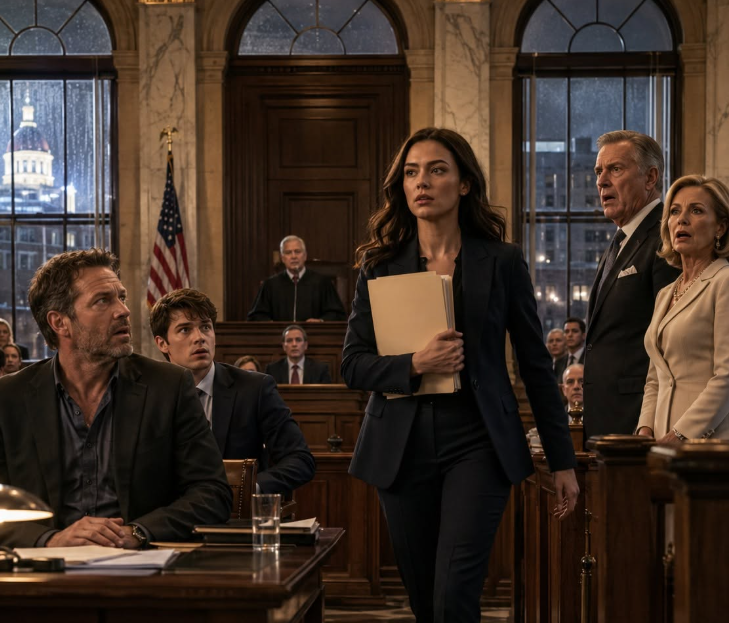
The courtroom was already full when Mason Calder walked in.
Reporters filled the back rows.
Investors whispered behind expensive suiTS. Lawyers shuffled documents across polished wooden tables as if paper alone could decide the fate of a man’s life.
At the center of it all sat Barton Kingsley.
He looked comfortable.
Too comfortable.
He wore a perfect charcoal suit, a silver watch that probably cost more than Mason’s first house, and the confident expression of a man who believed the ending had already been written.
Across from him, Mason sat quietly beside his attorney.
For the first time in thirty years, he looked tired.
Not defeated.
Never that.
But tired.
Because he was not afraid of losing money.
He had started with nothing.
He was afraid of losing the thing that money could never buy.
The family name he had built.
The company where thousands of workers trusted him.
The promise he made to a little girl in the rain.
Nobody gets left out in the rain.
The judge entered.
Everyone stood.
And then the hearing began.
Barton’s attorney spoke first.
“Your Honor, this case is not about emotions.
It is about corporate responsibility.
Mason Calder secretly transferred company assets into a private trust controlled by his adopted daughter, Willa Brooks Calder.
He violated his duties as CEO and placed personal attachment above shareholder interesTS.”
A screen behind them displayed documenTS.
Bank transfers.
Trust agreemenTS.
Financial records.
Everything appeared organized.
Everything appeared real.
The courtroom murmured.
Mason stared at the papers.
He had seen copies before.
But seeing them displayed like evidence against him felt different.
Like watching someone take a lifetime of sacrifice and turn it into a crime.
Barton leaned back.
He almost smiled.
The judge looked toward Mason’s attorney.
“Do you have a response?”
The attorney stood.
“We do, Your Honor.
But we would like to call our final witness.”
The courtroom doors opened.
Every head turned.
And Mason stopped breathing.
Because standing there was Willa.
Not the frightened nine-year-old girl beneath the bus depot awning.
Not the teenager sitting at the kitchen table with a highlighter in her hand.
Not the young woman who had cried when Mason sold his first truck to pay her tuition.
This woman wore a simple cream-colored suit.
Her hair was pulled back neatly.
She carried a leather folder against her chest.
But her eyes were the same.
The same watchful eyes from the rain.
The courtroom went silent.
Barton’s smile disappeared.
“Willa Brooks Calder,” the judge said.
“Please approach.”
She walked forward.
Every step was calm.
Every step was controlled.
Mason looked at her with disbelief.
“You came,” he whispered.
Willa looked at him.
“I told you something years ago.”
His eyes softened.
“What?”
She smiled faintly.
“You taught me that nobody should sign something they haven’t read until the very last word.”
For the first time that morning, Mason smiled.
A small one.
The kind only a father could give.
Barton immediately stood.
“Your Honor, this witness has a personal relationship with the defendant.
Her testimony is clearly biased.”
The judge looked over his glasses.
“Sit down, Mr. Kingsley.”
Barton slowly returned to his chair.
Willa took the witness stand.
The opposing attorney approached.
“Ms.
Calder, isn’t it true that your father created this trust specifically to transfer company wealth to you?”
Willa looked at the documents displayed behind him.
“No.”
“Are you saying these documents are fake?”
“No.”
The attorney smiled.
“Interesting.
Because they clearly show company assets moved into a trust connected to you.”
Willa nodded.
“They do.”
A wave of whispers moved through the room.
The attorney turned toward the jury.
“Then perhaps you can explain why.”
Willa opened the leather folder.
“I can.”
She removed a single document.
It was old.
Yellowed around the edges.
Unlike the others, it looked like it had been handled by human hands.
Not created in an office.
Not printed yesterday.
“Fifteen years ago,” Willa said, “before Calder Harbor and Rail became a billion-dollar company, my father discovered something.”
Barton’s face tightened.
“He discovered that several major logistics companies were intentionally creating delays in shipping routes to manipulate pricing.”
The courtroom quieted.
“They were losing money by pretending to protect information.
My father created a system that made transportation faster and cheaper.
But some executives did not want competition.
They wanted control.”
The judge leaned forward.
“Ms.
Calder, what does this have to do with the current case?”
“Everything.”
She held up the document.
“This is the original shareholder protection agreement created when Calder Harbor was still a small company.”
The opposing attorney laughed.
“An old agreement?”
“Yes.”
“Why should anyone care about a document from fifteen years ago?”
“Because it contains a clause that prevents any board member from forcing a hostile acquisition through fabricated misconduct.”
The courtroom exploded with whispers.
Barton’s attorney immediately objected.
“Speculation.”
Willa looked directly at him.
“No.
A verified legal agreement.”
 At My Mother-In-Law’s Backyard, They Laughed When She Said Nobody Would Miss Me — Months Later, My Name Filled A Ballroom And They Finally Understood My Worth
 My Husband Left Me at 38 Weeks Pregnant for Cancún With His Mother—When They Returned, Locked Doors, Frozen Cards, and Our Newborn Daughter Ended Their Cruel Game for Good
She placed the document on the table.
“My father never hid asseTS. He protected the company from people like you.”
The judge examined the paper.
“Where did you obtain this document?”
Willa looked toward Mason.
And for a moment, the courtroom disappeared.
“I spent three days searching through archived records.”
“Why?”
“Because I knew my father.”
Her voice became stronger.
“Everyone in this room sees a mechanic who built a company.
They see a man who got lucky.
They see someone who was too emotional because he adopted a child from the street.”
She paused.
“But I saw the man who sat beside me every night when I was afraid to sleep.
I saw the man who worked sixteen-hour days and still came home to help with homework.
I saw the man who taught me that paperwork could destroy innocent people if nobody understood it.”
Mason looked down.
His eyes filled.
Willa continued.
“So when I heard they were using contracts against him, I knew exactly what he would tell me.”
The judge asked quietly:
“What would he tell you?”
Willa looked at Mason.
“He would tell me to read everything.”
The room fell silent.
Then she turned back.
“And I did.”
The next hour changed everything.
Willa presented evidence showing that Barton Kingsley and Priscilla Van Dorne had secretly prepared the acquisition plan months before the accusations against Mason were filed.
The fraudulent documents were not created to expose wrongdoing.
They were created to manufacture it.
Emails revealed private conversations.
Financial records showed hidden paymenTS.
A consulting firm connected to Van Dorne had been paid millions to produce misleading evaluations of Calder Harbor and Rail.
The final piece was a recording.
Barton’s own voice.
Clear.
Cold.
Unmistakable.
“Calder is sentimental.
He’ll never fight his own board.
And if he does, the court will believe the story we create.
Nobody respects a man who adopts a street child and calls it leadership.”
The courtroom froze.
Mason closed his eyes.
Not because he was surprised.
Because hearing Willa described that way hurt more than losing the company ever could.
The judge looked toward Barton.
“Mr. Kingsley, do you have an explanation?”
For the first time, Barton looked small.
The confidence was gone.
The expensive suit suddenly looked like a costume.
“This is taken out of context.”
Willa shook her head.
“No.”
Everyone looked at her.
“It’s not.”
She held the recording.
“It is exactly who you are.”
The judge ruled that the evidence demonstrated deliberate fraud, breach of fiduciary duty, and an attempted illegal takeover.
Barton Kingsley was removed from the board immediately.
Priscilla Van Dorne’s company withdrew within days.
The lawsuit against Mason Calder collapsed.
But Mason did not celebrate.
Not at first.
After the hearing, he stood outside the courthouse watching people walk by.
Willa found him there.
“You won,” she said.
He smiled.
“No.”
She frowned.
“What do you mean?”
He looked at her.
“You won.”
Willa laughed softly.
“Dad, I only found paperwork.”
Mason shook his head.
“No.”
He looked toward the city streeTS.
“Fifteen years ago, I found a little girl in the rain.
Everyone else saw someone who needed saving.”
He looked back at her.
“But I was wrong.”
Willa’s eyes softened.
“You saved me.”
“No.”
Mason smiled.
“You saved yourself.
I just gave you a place to stand.”
For a moment, neither of them spoke.
Then Graham walked toward them.
He was older now, carrying the same calm strength as his father.
He hugged Mason.
“Still wearing that old jacket?”
Mason looked down at the faded canvas jacket.
“Works fine.”
Graham laughed.
“Dad, you own half the eastern seaboard.”
Mason shrugged.
“And this jacket kept me warm before any of that mattered.”
Years later, Calder Harbor and Rail changed forever.
Willa became the company’s chief legal officer.
Graham led operations.
Mason remained chairman, but he spent less time in offices and more time visiting workers, warehouses, and drivers.
The company created scholarships for children of port workers.
They built shelters near transportation hubs.
And every year, on the first rainy night of spring, Mason visited the old bus depot.
Not because he was trapped in the past.
Because he remembered.
He remembered a child everyone ignored.
He remembered a promise.
He remembered that sometimes the greatest investments are not made with money.
They are made with kindness.
One evening, Willa stood beside him under the same old awning where he found her.
“You know,” she said, “if you hadn’t stopped that night, my whole life would be different.”
Mason looked at the rain falling onto the pavement.
“Maybe.”
She smiled.
“No maybe.”
He turned toward her.
“You’re right.”
Then he looked at the city lighTS.
“Because sometimes one person deciding to care can change the future of an entire family.”
The rain kept falling.
But this time, nobody was standing alone beneath it.