
The three knocks came again.
Slow.
Heavy.
Deliberate.
Emily backed away from the door, holding Noah so tightly that the pale blue blanket gathered beneath her fingers.
“Who is it?” I asked.
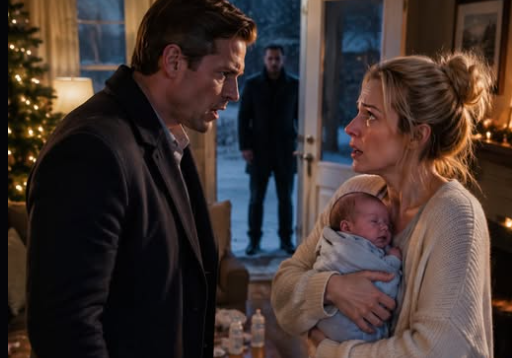
She shook her head, but the fear in her eyes told me she already knew.
“Emily.”
A woman’s voice came through the door.
Elegant.
Controlled.
Familiar.
Every muscle in my body went rigid.
My mother.
“Open the door,” Victoria Rowan called.
“We need to finish our conversation.”
I turned toward Emily.
“What conversation?”
She lowered her eyes.
The baby shifted against her chest, making a soft sound in his sleep.
“Gavin, please,” she whispered.
“Don’t open it.”
Another knock struck the wood.
“This is your final opportunity to handle this privately,” my mother said.
The words landed like ice in my stomach.
I crossed the living room before Emily could stop me and pulled open the door.
Victoria Rowan stood beneath the porch light in a long black coat, untouched by the snow gathering around her polished booTS. At sixty-two, she still carried herself like the entire world was a boardroom waiting for her decision.
Behind her stood Charles Denton, the Rowan family attorney, holding a leather briefcase.
A dark sedan waited at the curb with its engine running.
My mother’s expression changed when she saw me.
For the first time in my life, Victoria Rowan looked unprepared.
“Gavin,” she said.
“You weren’t supposed to be here.”
I stepped into the doorway, blocking her view of Emily and the baby.
“Apparently, there are many things I wasn’t supposed to know.”
She recovered quickly.
“This is a private matter.”
“It stopped being private when I found out I have a son.”
Charles looked down at the snow.
My mother did not blink.
“So she finally told you.”
The world went silent.
Even the Christmas music playing softly inside the house seemed to disappear.
“You knew?” I asked.
Victoria’s face remained calm.
“I knew there was a possibility.”
I stared at her.
“A possibility?”
“Emily contacted your office shortly after the divorce.
She claimed she was pregnant.
Considering the emotional circumstances, I believed it was necessary to verify the situation before allowing it to disrupt your life.”
Behind me, Emily spoke with a trembling voice.
“I never claimed anything.
I sent Gavin the doctor’s report.”
My mother looked past me.
“And you were told not to contact him again until the matter could be handled appropriately.”
I turned toward Emily.
“What did she send you?”
Emily’s eyes filled with tears.
“A letter from your legal department.”
Charles shifted uncomfortably.
My mother shot him a warning glance.
Emily continued.
“It said you did not believe the baby was yours.
It said that if I tried to contact you directly, your attorneys would file for full custody after the birth and use my financial situation against me.”
My throat closed.
“I never authorized that.”
“I know that now,” she said.
“But at the time, it had your company letterhead.
Your attorney’s signature.
Details about my medical appointments that I had only shared with your office.”
I looked at Charles.
His face had gone pale.
“Did you sign it?”
He opened his mouth, but my mother answered for him.
“I instructed him to protect the family.”
“No,” Charles said quietly.
“You instructed my assistant to place my digital signature on a document I had never reviewed.”
Victoria turned sharply.
“This is not the time.”
“It became the time five months ago,” he replied.
The anger inside me changed.
Until that moment, it had been wild and jealous, directed at an imaginary man I had convinced myself was inside Emily’s house.
Now it became cold.
Precise.
The same clarity that had built Rowan Technologies from a rented office into a global corporation settled over me.
Only this time, I was not protecting a company.
I was protecting my family.
“You intercepted her messages,” I said.
My mother folded her gloved hands.
“You were in the middle of the most important acquisition of your career.
You were already unstable after the divorce.
I was not going to let an unconfirmed pregnancy derail everything you had built.”
“She was my wife.”
“She was no longer your wife.”
“She was carrying my child.”
“We did not know that.”
“You made sure I never had the chance to find out.”
Victoria’s expression hardened.
“Think carefully, Gavin.
If you acknowledge this child without proper testing and legal protections, you expose yourself, the company, and every shareholder who depends on you.”
I almost laughed.
There I was, standing inside a warm little house on Christmas Eve, looking at the woman who had taught me that every human relationship was a liability to be managed.
For most of my life, I had believed her.
That belief had cost me my marriage.
It had nearly cost me my son.
“Noah is not an exposure,” I said.
“He is my child.”
“You have known about him for less than ten minutes.”
“And you have known about him for monThS.”
Her silence gave me my answer.
I stepped closer.
“How long?”
Victoria looked toward the street.
“How long have you known he was mine?”
“Gavin—”
“How long?”
Charles opened the briefcase and removed a thin folder.
“Three months,” he said.
My mother’s eyes flashed.
He handed the folder to me.
Inside was a private laboratory report.
The pages shook in my hands as I read them.
The report had been created using a prenatal sample Emily had provided during routine testing and genetic material taken from an old medical record of mine.
Probability of paternity: 99.99 percent.
The date at the top was September 28.
Three months earlier.
My mother had known.
While I spent nights alone in my penthouse, staring at old photographs and telling myself Emily had already forgotten me, Victoria had known my son was growing inside her.
While I buried myself in meetings and blamed Emily for not fighting harder for our marriage, my mother had known.
While Emily attended appointments alone, prepared a nursery alone, and faced childbirth believing I had rejected my own child, Victoria had known.
I closed the folder.
“What are you doing here tonight?”
My mother glanced at Noah.
“Emily refused the financial agreement.”
“What agreement?”
Emily nodded toward the leather briefcase.
“She offered me two million dollars to leave Washington, sign a permanent confidentiality agreement, and keep your name off Noah’s birth certificate.”
My breath caught.
“She said if I refused, she would prove I was unstable and take him from me.”
Victoria remained composed.
“I offered you security.”
“You offered me silence,” Emily replied.
“You had no job, limited savings, and no family nearby.”
“I had enough.”
“You were living in a house you could barely afford.”
“It was still my home.”
My mother looked at me.
“This emotional display changes nothing.
The agreement protects everyone.”
I walked onto the porch and pulled the door nearly closed behind me so the winter air would not reach Noah.
Then I faced the woman who had controlled nearly every decision I had made since childhood.
“You will leave Emily alone.”
Victoria’s eyes narrowed.
“You are upset.”
“You will destroy every copy of that agreement.
You will end all surveillance, stop every investigation, and provide Charles with a complete record of every message you intercepted.”
“You cannot order me—”
“As CEO, I can order an independent investigation into the misuse of Rowan Technologies employees, legal resources, and private data.”
For the first time, uncertainty entered her expression.
“You would damage your own company over this?”
“No.
I’m going to repair the damage you did while pretending to protect it.”
“Gavin, I am your mother.”
“And Noah is my son.”
The words struck both of us.
My whole life, she had used family as a reason to demand obedience.
Now I finally understood that love without respect was only control wearing a familiar face.
Charles closed his briefcase.
“I will cooperate with the investigation,” he said.
Victoria turned on him.
“You work for this family.”
“I work for the corporation,” he replied.
“And I should have stopped this sooner.”
My mother looked from Charles to me, searching for the version of her son who would have surrendered to avoid scandal.
That man no longer existed.
“Leave,” I said.
She walked down the steps without another word.
The sedan door opened.
She climbed inside, and moments later, the car disappeared through the falling snow.
Charles remained on the porch.
“I’m sorry,” he said.
“I should have contacted you directly.”
“Yes,” I replied.
“You should have.”
He nodded, accepting the answer.
“I’ll send you everything by morning.”
“No.
Send it to independent counsel.
You are suspended from all Rowan matters until the investigation is complete.”
Pain crossed his face, but he did not argue.
When he was gone, I closed the door and turned back toward Emily.
She stood in the same place, rocking Noah gently.
The anger that had carried me through the confrontation vanished.
All that remained was grief.
“I didn’t know,” I said.
“I know.”
“I swear to you, Emily, I never saw your messages.
I never received the medical report.
I never asked anyone to send that letter.”
“I believe you.”
Her answer should have relieved me.
It did not.
Because even if I had not known about Noah, I knew why she had believed the letter.
During our marriage, I had missed dinners, anniversaries, and weekends.
I had answered work calls while she tried to tell me she was lonely.
When she asked me to choose our marriage over another international expansion, I accused her of not understanding my responsibilities.
I had spent years teaching her that work would always come first.
My mother’s lie had succeeded because it sounded like something I might have done.
“I gave you every reason to believe it,” I whispered.
 My Parents Bought My Sister a $150,000 Yacht While Refusing My $5,000 Surgery—But One Phone Call Changed Everything and Revealed a Family Secret That Money Could Never Hide
 After My Mother-in-Law Pushed Me Down the Stairs, I Lost My Baby, Walked Away Forever, and Left My Husband One Final Message—What Happened Next Changed Every Life Involved Forever
Emily looked down at our son.
“You did.”
No accusation could have hurt more than the quiet truth.
I approached slowly.
“May I see him?”
She hesitated.
I deserved that hesitation.
Then she walked closer.
Noah’s face was smaller than my palm.
A few strands of dark hair rested against his forehead.
His nose looked like Emily’s, but the shape of his chin was unmistakably Rowan.
I reached out, then stopped.
My hands had signed billion-dollar contracTS. They had shaken hands with presidents, investors, and people whose approval once seemed important.
Now they trembled because I was afraid to touch a seven-day-old baby.
“Support his head,” Emily said softly.
She placed Noah in my arms.
The instant his weight settled against my chest, something inside me broke open.
He stirred, wrinkled his tiny face, and wrapped his fingers around mine.
I could not breathe.
“Hello, Noah,” I whispered.
His eyes opened.
Green.
Clear and curious.
He looked at me as though I had not missed anything.
As though I was not already late.
A tear fell onto the blue blanket.
“I’m your father,” I said.
“I’m sorry it took me so long to get here.”
Noah tightened his fingers around mine.
Then his face turned red and he began to cry.
Panic rushed through me.
“What did I do?”
Emily almost smiled.
“He’s hungry.”
“I can fix that.”
“It isn’t a server outage, Gavin.”
“I understand that.”
“You look terrified.”
“I am.”
For the first time that night, a small laugh escaped her.
It was tired and brief, but it was the most beautiful sound I had heard in monThS.
Emily prepared a bottle while I sat on the couch with Noah against my chest.
She showed me how to hold him, how to tilt the bottle, and how to pause when he needed to breathe.
I followed every instruction.
Halfway through the feeding, Noah’s eyes closed again.
I stared at him.
“Were you alone when he was born?”
Emily sat across from me.
“My friend Sarah was there.”
“But you wanted me there.”
Her eyes shifted toward the Christmas tree.
“I called your office when labor started.”
My chest tightened.
“What happened?”
“Your assistant said you were in Singapore and could not be disturbed.
She told me you had already made your position clear.”
I had been in Singapore.
But I had not been in a meeting.
I had been alone in a hotel suite, holding my phone and wondering whether calling Emily would make me look weak.
My pride had kept me silent while my son entered the world.
“I would have come home,” I said.
“I know that now.”
“I would have left everything.”
She met my eyes.
“That is what I needed you to understand when we were married.”
I lowered my head.
Noah slept peacefully in my arms while I faced the truth I had avoided for years.
My mother had hidden my child from me.
But she had not destroyed my marriage by herself.
I had done that long before, one neglected promise at a time.
“I can’t ask you to forgive me tonight,” I said.
“No.”
“I can’t ask you to trust me.”
“No.”
“But I am asking you to let me earn the right to be his father.”
Emily watched me for a long moment.
“Being his father is not about what you can buy him.”
“I know.”
“It means showing up when you are exhausted.
It means changing plans when he gets sick.
It means listening, even when what you hear makes you uncomfortable.”
“I know.”
“No, Gavin.
You are only beginning to know.”
She was right.
I looked down at Noah.
“Then let me begin.”
That Christmas Eve, I did not return to my penthouse.
I slept on Emily’s couch after insisting she take the bedroom.
At two in the morning, Noah cried, and I woke before she reached the hallway.
At four, I changed my first diaper incorrectly and had to start over.
At six, I burned the toast.
At seven, Emily came into the kitchen and found me holding Noah beside a crooked Christmas tree, quietly explaining that the silver ornament near the top was not positioned symmetrically.
“You are giving a newborn design advice,” she said.
“He seems interested.”
“He’s asleep.”
“He’s considering my proposal.”
She shook her head, but she was smiling.
It was not forgiveness.
It was not reconciliation.
But it was a beginning.
Later that morning, I called an emergency meeting of the independent directors of Rowan Technologies.
I disclosed everything.
My mother was removed from her position as board chair while the investigation proceeded.
Every employee involved in monitoring Emily or blocking her communications was placed on leave.
The company issued no dramatic public statement.
I refused to turn my family into a press strategy.
I also stepped away from daily operations for three monThS.
The financial news called it unexpected.
The business world called it reckless.
For the first time in my life, I did not care.
I attended parenting classes.
I learned how to install a car seat without calling an engineer.
I took the midnight feedings three nights a week.
I attended every medical appointment Emily allowed me to attend.
When Noah developed a fever at six weeks old, I spent the entire night beside his hospital crib without opening my laptop once.
I began therapy.
Not because it would help me win Emily back, but because I did not want Noah to grow up believing that love had to be earned through achievement.
My mother eventually admitted what she had done.
She claimed fear had guided her.
My father had abandoned us when I was young, and she had built her life around ensuring that no one could ever threaten the Rowan name again.
I understood her fear.
I did not excuse her choices.
For nearly a year, I saw her only in the presence of a family counselor.
She was not allowed contact with Noah until Emily and I agreed she understood our boundaries.
Consequences were not cruelty.
Sometimes they were the only way love could become safe.
Emily did not take me back quickly.
She watched.
She waited.
She saw me leave a shareholder dinner early because Noah had taken his first steps.
She saw me decline an overseas trip because it fell on his birthday.
She saw me apologize without following the apology with an excuse.
Eleven months after that Christmas Eve, I stood on her porch again.
Snow fell across the little blue house just as it had the year before.
This time, I did not pound on the door.
I knocked gently and waited.
When Emily opened it, she wore the same cream sweater.
Noah stood beside her, gripping the doorframe with one hand and a wooden toy airplane with the other.
“Da!” he shouted.
The sound nearly brought me to my knees.
I lifted him into my arms.
Then I looked at Emily.
“I brought dinner,” I said.
“And I promise I didn’t cook it.”
“That improves your chances of being invited inside.”
I smiled.
Before crossing the threshold, I reached into my coat pocket.
Emily’s expression changed.
“Gavin, if that is a ring—”
“It isn’t.”
I pulled out a small silver Christmas ornament.
It was shaped like a house.
Across the front were three engraved names.
Emily.
Gavin.
Noah.
Beneath them were the words:
HOME IS WHERE WE SHOW UP.
“I’m not asking you to forget what happened,” I said.
“I’m not asking you to go back to the marriage we had.”
She ran her thumb over the engraving.
“What are you asking?”
“For one honest dinner.
Then maybe another.
And someday, if I keep becoming the man I should have been, perhaps we can build something new.”
Her eyes filled with tears.
“You really stepped away from a board meeting for Noah’s first steps.”
“I would step away from ten.”
“You once told me nothing important could happen without being scheduled.”
“I was an idiot.”
“You were.”
“I am improving.”
“Slowly.”
Noah reached for the ornament and shouted something neither of us understood.
Emily laughed.
Then she stepped aside.
“Come in, Gavin.”
I crossed the threshold only after she invited me.
That detail mattered.
We hung the ornament together in the center of the tree.
Emily did not promise me forever that night.
She gave me something more valuable.
A chance to prove that forever was built from ordinary days, honest apologies, respected boundaries, and the decision to keep showing up.
The following summer, we renewed our vows in Emily’s backyard with twelve guests, no reporters, and Noah asleep in my arms through most of the ceremony.
My mother attended from the final row after months of counseling and a sincere apology to Emily.
She was no longer in control of Rowan Technologies, but for the first time, she was learning how to be part of a family without controlling it.
When it was my turn to speak, I did not promise Emily a perfect life.
I promised her my presence.
I promised to listen before solving.
I promised that our son would never have to compete with my ambition for my attention.
And I promised never again to confuse power with love.
Years later, whenever Noah asked about the little silver house ornament, Emily told him it represented his first Christmas.
I always corrected her.
“It represents my first Christmas,” I would say.
Because that was the night I finally understood what it meant to come home.
I had arrived at Emily’s door ready to expose the man I believed had stolen my place.
Instead, I discovered that no one had stolen it.
I had abandoned it.
And the greatest gift of my life was not being given that place back.
It was being allowed to earn it again.