
Then I looked at her husband.
“You were right about one thing, Daniel,” I said.
The sirens grew louder outside.
Red and blue light began flashing across the bedroom walls.
“This is a family matter.”
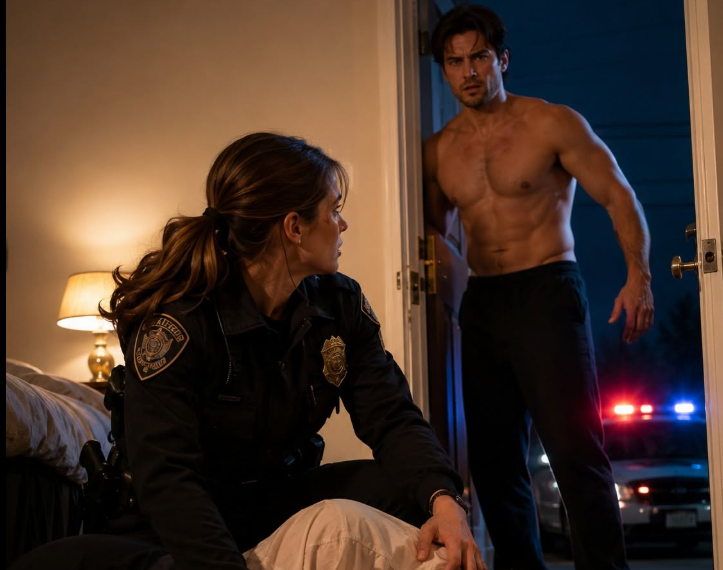
His mouth curved into a nervous smile.
I tightened my grip around Claire’s trembling hand.
“And my family is leaving this house tonight.”
Daniel stepped backward.
For the first time since I had known him, he looked uncertain.
Two uniformed officers entered the house seconds later, followed by paramedics.
Officer Reynolds reached the bedroom first.
He stopped when he saw Claire on the floor, then immediately called for the medical team.
I stood and raised both hands away from my weapon.
“I’m the reporting party,” I said.
“I’m also the victim’s twin sister.
I made physical contact with the suspect after he grabbed my arm and attempted to stop me from reaching her.”
Reynolds understood immediately.
“You’re off this scene,” he said quietly.
“I know.”
That was the hardest thing I had done all night.
Every part of me wanted to put Daniel in handcuffs myself.
I wanted him to feel the cold metal close around his wrisTS. I wanted him to understand that the woman he had frightened into silence had a sister who would never be silent again.
But I was too close to the case.
If I crossed one line, Daniel’s attorney could claim the arrest had been personal.
He could turn my anger into his defense.
So I stepped aside.
The paramedics knelt beside Claire and began checking her breathing, pulse, and injuries.
One of them asked her name.
“Claire Bennett,” she whispered.
Daniel immediately spoke over her.
“Her name is Claire Lawson.
She’s my wife.”
Claire’s visible eye opened.
“My name,” she said with sudden strength, “is Claire Bennett Lawson.”
The paramedic nodded.
“Claire, can you tell me what happened?”
Daniel moved toward them.
“She’s confused.
She took medication earlier.”
Officer Reynolds blocked him.
“Sir, step into the hallway.”
“This is my house.”
“Step into the hallway.”
Daniel looked at me as if I had caused the situation instead of revealing it.
“You planned this,” he said.
I stared back at him.
“At 3:07 in the morning?”
“You’ve hated me from the beginning.”
“No,” I said.
“I distrusted you from the beginning.
Tonight, you proved I should have trusted that feeling.”
Reynolds escorted him downstairs.
Another officer photographed the shattered lamp, the damaged wall, and the bedroom.
Every object told part of the story Daniel had hoped Claire would never tell.
As the paramedics carefully lifted her onto a stretcher, Claire refused to release my hand.
“Come with me,” she whispered.
“I’m right here.”
Her gaze shifted toward the nightstand.
“The drawer,” she said.
“What’s in the drawer?”
“Blue case.”
I opened the drawer and found a small blue eyeglass case beneath a pile of folded scarves.
Inside was not a pair of glasses.
There was a flash drive, a spare phone, and a tiny brass key.
I looked at Claire.
“Evidence,” she whispered.
“For when I was brave enough.”
My throat tightened.
“You were always brave.”
“No,” she said, her voice breaking.
“I was surviving.”
I placed the case into an evidence bag held open by Officer Patel.
I did not touch anything else.
Daniel had reached the bottom of the stairs when he saw it.
His entire expression changed.
“What did she give you?” he demanded.
No one answered him.
“That belongs to me!” he shouted.
“Everything in this house belongs to me!”
Claire heard him from the stretcher.
She closed her eye and whispered, “That’s what he always said.”
Officer Reynolds turned Daniel toward the wall and secured his wrisTS.
The metallic click echoed through the silent house.
Daniel looked over his shoulder at me.
“You think this proves anything?”
I walked beside Claire as the paramedics carried her toward the front door.
“No,” I said.
“I think Claire proves everything.”
Outside, neighbors stood behind curtains and half-open doors.
Daniel had worked hard to appear respectable.
He washed his car every Saturday, wore expensive suits, donated to community fundraisers, and smiled in every photograph.
People like Daniel depended on appearances.
They built their protection out of polished shoes, controlled voices, and the assumption that harm only looked dangerous when it happened in public.
But homes remembered.
Walls remembered.
Phones remembered.
And survivors remembered, even when they were still trying to find the courage to speak.
At the hospital, doctors found that Claire had suffered several serious but treatable injuries.
She would need time, follow-up care, and a safe place to recover, but she was expected to heal.
I sat beside her bed while the sky slowly changed from black to gray.
For hours, she said nothing.
I did not pressure her.
I simply stayed.
At 6:18 a.m., she finally spoke.
“The first time was eight months ago.”
I turned toward her.
“He apologized afterward,” she continued.
“He cried.
He said he was under pressure at work.
He bought me flowers and made dinner.”
I felt anger rising, but I kept my voice gentle.
“What happened next?”
“He started checking my phone.
Then my bank account.
Then my clothes.
He said married people didn’t need secreTS.”
She looked toward the hospital window.
“I thought control meant he cared where I was.
By the time I understood what it really was, he had convinced me I couldn’t manage anything without him.”
“You could have called me.”
“I wanted to.”
“Why didn’t you?”
“Because he told me what would happen.”
My heart stopped for a moment.
“What did he tell you?”
Claire looked at me.
“He said if I ever reported him, he would tell everyone you had coached me.
He said you would lose your badge for interfering in our marriage.
He knew exactly how to make me afraid for you.”
I leaned forward.
“Claire, listen to me.
Nothing you did caused this.
Nothing you said caused it.
You were trying to stay alive inside a situation designed to make you feel powerless.”
Tears slid down the side of her face.
“I kept waiting for the right moment to leave.”
“You found it.”
“No,” she whispered.
“The right moment almost came too late.”
I took her hand.
“But it came.”
Detective Lena Ortiz arrived shortly after sunrise.
She was assigned because my relationship to Claire created an obvious conflict.
Ortiz was calm, direct, and careful.
She asked permission before every question.
She made it clear Claire could pause at any time.
Claire told her everything.
She explained that Daniel had become increasingly controlling after she received a promotion at the architecture firm where she worked.
He resented her longer hours and accused her of trying to embarrass him by earning more money.
Then he began taking her paychecks.
He opened accounts in her name.
He isolated her from friends.
Whenever Claire attempted to leave, Daniel promised he would change.
When promises stopped working, he used fear.
The blue case contained months of documentation.
Photographs.
Audio recordings.
Copies of threatening messages.
Bank statements showing money transferred from Claire’s personal account into an account she had never authorized.
The spare phone held cloud backups Daniel did not know existed.
The brass key opened a rented storage locker.
Inside that locker, detectives found a suitcase packed with clothes, copies of Claire’s identification, emergency cash, and a handwritten journal.
On the first page, Claire had written:
IF SOMETHING HAPPENS TO ME, PLEASE BELIEVE THAT I TRIED TO LEAVE.
I read that sentence only once.
Once was enough.
Daniel spent the morning insisting Claire was unstable.
Then he claimed I had forced my way into the house without cause.
Then he said the injuries were accidental.
Then he said Claire had injured herself.
Every time the evidence contradicted him, his story changed.
What he did not know was that dispatch had recorded my emergency call before I arrived.
The call established that I had requested uniformed officers and medical assistance instead of attempting to handle the situation privately.
He also did not know that Claire’s disconnected call had remained active for several seconds longer than either of them realized.
The recording had captured his voice.
“You call your sister again,” he had said, “and you’ll regret it.”
Then came the crash.
That sentence destroyed the calm image he presented to investigators.
But it was not the biggest surprise.
At noon, Detective Ortiz returned to the hospital with a sealed folder.
 They Banished a Pregnant Marine Widow to the Freezing Garage—Hours Later, a Military Convoy Revealed the Truth They Never Saw Coming
 The Silent Shareholder Who Lost Everything and Won Her Future After Her Husband’s Public Betrayal, Revealing The Hidden Truth Behind Helios Dynamics While Choosing Grace Over Revenge and Finding Peace
“We found another name in the financial records,” she said.
Claire frowned.
“What name?”
“Rachel Moore.”
Claire became completely still.
Daniel had told us Rachel was an unstable former employee who had tried to damage his reputation after being dismissed from his company.
He had used her as proof that women sometimes invented accusations against successful men.
The truth was very different.
Rachel had been Daniel’s fiancée six years earlier.
She had filed a police report after an incident at their apartment, but she withdrew it two days later.
Without her cooperation and with little physical evidence, the case had gone nowhere.
Daniel later told everyone she had been dishonest and emotionally unstable.
Detective Ortiz contacted Rachel.
This time, Rachel agreed to speak.
She had saved old emails, photographs, and a voicemail in which Daniel threatened to ruin her career if she continued with the case.
For six years, Rachel had believed she was the only person he had treated that way.
When Ortiz told her about Claire, she cried.
Then she said, “Tell her I believe her.
And tell her I’m ready.”
Daniel’s attorney arrived that afternoon and attempted to portray the entire investigation as the result of an angry police officer protecting her sister.
That argument lasted until the prosecutor reviewed the recordings, financial documents, witness statements, and evidence collected by officers who had no personal relationship with me.
My involvement had ended the moment Reynolds arrived.
I had followed procedure.
Daniel had counted on my anger making me careless.
Instead, my training protected Claire twice—first when I answered her call, and again when I stepped back.
He was charged with multiple offenses, including assault, unlawful restraint, threats, and financial fraud.
The judge denied his request to return home.
For the first time in years, Claire slept without wondering whether footsteps in the hallway meant danger.
She stayed with me after leaving the hospital.
The first few weeks were harder than either of us expected.
Safety did not feel peaceful to her at first.
It felt unfamiliar.
She woke whenever the heating system clicked.
She apologized before using anything in my kitchen.
She asked permission to take a shower, open a window, or order food.
One evening, I found her standing in front of the refrigerator with tears in her eyes.
“What happened?” I asked.
“I drank the last orange juice.”
I waited.
She looked terrified.
That was when I understood how deeply Daniel’s control had reached.
It had not ended at the hospital.
It remained in the small decisions she had been punished for making.
I took my keys from the counter.
“Come on.”
“Where are we going?”
“To buy more orange juice.”
At the store, we bought six different kinds.
Claire laughed for the first time since that night.
It was a small laugh, but it was hers.
Three months later, the case went to court.
Daniel entered wearing a dark suit and the same expression he had worn at every family dinner—calm, confident, almost amused.
He expected Claire to be afraid of him.
She was afraid.
Courage was not the absence of fear.
Claire taught me that.
Courage was walking into the room while fear walked beside you.
Rachel testified first.
Then a forensic accountant explained how Daniel had created debt in Claire’s name while moving her earnings into private accounTS.
A digital specialist verified the recordings and messages.
Officer Reynolds described the scene exactly as he had found it.
Then Claire took the stand.
Daniel stared at her.
She did not look away.
His attorney asked why she had stayed.
Claire took a breath.
“Because leaving a controlling person is not as simple as walking through a door,” she said.
“First, you have to believe the door is real.
Then you have to believe you deserve what is on the other side.”
The courtroom became silent.
His attorney asked why she had collected evidence instead of calling the police earlier.
“Because I was afraid.”
“Afraid of what?”
Claire looked directly at Daniel.
“Afraid he would do exactly what he said he would do—make people question me instead of questioning him.”
The attorney began another question.
Claire continued.
“But I’m not afraid of being questioned anymore.”
Daniel’s expression finally cracked.
He leaned toward his attorney and whispered sharply.
The judge ordered him to remain quiet.
When the verdict was read, Claire held my hand.
Guilty.
Not on every charge, but on enough.
Enough for accountability.
Enough for protection.
Enough to make his carefully constructed image collapse under the weight of the truth.
Daniel was sentenced to prison and ordered to repay the money he had taken.
Claire received a long-term protective order and began the difficult process of rebuilding her finances and her life.
Outside the courthouse, reporters waited.
Claire had not planned to speak, but when she saw the cameras, she stopped.
“My husband used to say what happened inside our house was nobody else’s business,” she said.
“But privacy should protect a family’s peace.
It should never protect someone’s cruelty.”
Then she looked at the camera.
“To anyone waiting for the perfect moment to ask for help: you don’t have to have perfect evidence.
You don’t have to explain everything in one call.
Just say where you are.
Say you need help.
Let someone come.”
Her statement was broadcast that evening.
Within a week, the department received dozens of calls from people asking about local support services.
One call came from a woman who had been hiding emergency money inside a winter boot.
Another came from a college student worried about her mother.
A third came from a man who said he had spent years believing nobody would take him seriously.
Claire’s voice had traveled farther than Daniel’s threats ever could.
A year after the 3:07 a.m.
call, Claire moved into a small apartment overlooking a public garden.
She chose every piece of furniture herself.
The couch was yellow.
The kitchen walls were blue.
There were plants in every window and six containers of orange juice in the refrigerator.
On the anniversary of that night, she invited me to dinner.
As we sat on her balcony, she handed me a small framed photograph.
It showed us at eight years old, standing side by side in matching red coaTS. Claire was missing a front tooth.
I had one arm wrapped around her shoulders.
On the back, she had written:
YOU CAME WHEN I CALLED.
I swallowed hard.
“I should have seen it sooner,” I said.
Claire shook her head.
“He worked hard to make sure nobody saw.
That was his responsibility, not yours.”
“I still wish I had known.”
“I know.”
She reached across the table and took my hand.
“But you came.”
For a moment, neither of us spoke.
Below the balcony, people walked through the garden.
A child chased bubbles while his mother laughed.
Someone played music from an open window.
Ordinary life continued.
That was what Claire had wanted all along.
Not revenge.
Not headlines.
Not even an apology.
She wanted an ordinary morning without fear.
She wanted to choose her own clothes, spend her own money, and leave a glass on the counter without wondering what punishment it might bring.
She wanted her life back.
And slowly, choice by choice, she reclaimed it.
I still remember Daniel standing in that doorway, telling me it was just a family matter.
He had meant that no one outside the house had the right to interfere.
But he was wrong.
Being family did not give him ownership of Claire.
Marriage did not erase her voice.
A closed door did not place him beyond the law.
And silence was not consent.
That night, I arrived believing my badge would save my sister.
In the end, the badge was only one part of it.
The paramedics helped.
The responding officers helped.
The detectives helped.
Rachel helped.
The prosecutor helped.
But the person who truly changed everything was Claire.
She had hidden the phone.
She had saved the messages.
She had packed the suitcase.
And at 3:07 a.m., despite everything Daniel had done to make her feel powerless, she made one final choice.
She called.
The line went dead.
But her voice had already reached me.
And once the truth crossed that doorway, Daniel could never lock it inside again.