
No one offered a hand.
So I stopped waiting for one.
I pulled myself upright using the buffet cabinet, shifted my weight onto my right leg, and stood there until the room stopped spinning.
My left knee trembled beneath me, but I refused to let it fold again.
Fourteen people watched.
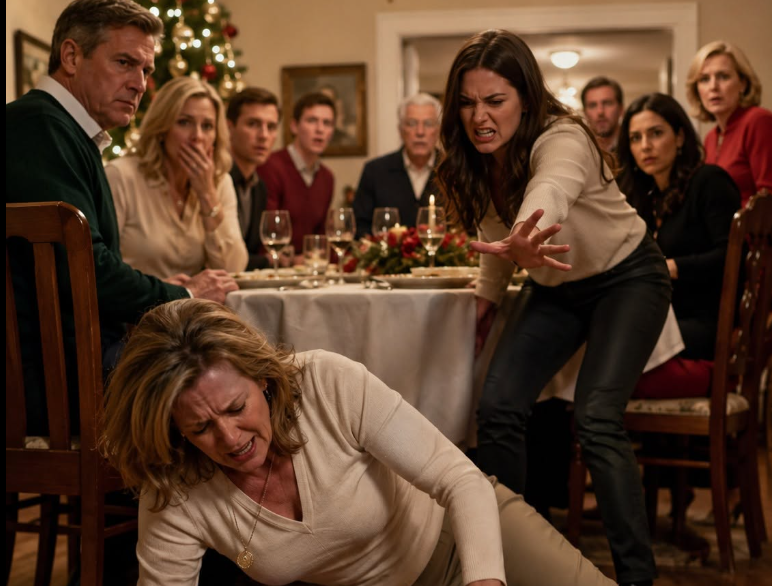
Some looked embarrassed.
Some looked uncomfortable.
A few looked annoyed, as though my pain had interrupted their dinner.
Mark finally glanced at me.
“Are you going to sit down?” he asked.
I looked at the chair beside him.
Denise was still sitting there.
Jenna stood behind her with her arms crossed, looking almost triumphant.
Something inside me became very quiet.
I had spent seven years trying to earn a place in that family.
I remembered birthdays, mailed cards, hosted reunions, paid for vacations, picked up prescriptions for Mark’s mother, and made meals whenever someone was sick.
I had listened to Jenna complain about her job for hours.
I had loaned her money when she fell behind on rent.
I had even helped her choose the cream coat she was wearing that night.
Yet there I was, standing on an injured knee while she occupied my home as if I were an unwanted guest.
I smiled.
It was not a cheerful smile.
It was the expression of a woman who had finally understood that love without respect was only unpaid labor.
“I won’t make a scene,” I said.
Mark appeared relieved.
“Good.”
I turned toward the hallway.
Behind me, his mother said, “Elaine, surely you’re not going to ruin Christmas over one misunderstanding.”
I stopped, but I did not turn around.
“A misunderstanding is using the wrong fork,” I said.
“What happened here was a decision.”
Then I walked away.
Every step sent a sharp ache through my leg.
I climbed the stairs slowly, using the railing and forcing myself not to look back.
In our bedroom, I closed the door and sat on the edge of the bed.
Downstairs, conversations gradually started again.
That was the part I would remember most.
Not Jenna’s hands against my shoulders.
Not Mark’s words.
The sound of fourteen people continuing Christmas dinner while I sat upstairs wondering whether my new knee had been damaged.
I pulled a small suitcase from the closet and packed enough clothing for three days.
I included my medication, phone charger, insurance card, and the folder containing the documents I had always kept separate from Mark’s papers.
Then I called my friend Ruth.
She answered on the second ring.
“Merry Christmas,” she said warmly.
My voice broke before I could respond.
Ruth did not ask me to calm down.
She did not tell me to think about the holiday.
She simply listened.
When I finished, she said, “Stay where you are.
I’m coming.”
Twenty minutes later, headlights swept across the bedroom wall.
I carried my suitcase downstairs one step at a time.
The family was eating pie.
Someone had cleaned the gravy from the floor.
My plate had been removed, and Jenna’s purse now rested on the chair I had intended to use.
Mark looked up.
“Where are you going?”
“To have my knee checked.”
He frowned.
“Now?”
“Yes, Mark.
Now.”
“You’re being dramatic.”
I reached the front door and looked at him for the last time as his wife.
“No,” I said quietly.
“I was dramatic when I believed this family might eventually care about me.
Tonight, I’m being practical.”
Ruth was waiting beside her car.
She took one look at the way I was walking and rushed toward me.
Unlike everyone inside my house, she offered me her hand.
At the urgent care clinic, X-rays showed that the replacement joint had not shifted, but the surrounding tissue was badly strained.
My wrist was sprained, my elbow was bruised, and the doctor ordered me to use a brace and a cane until I could see my orthopedic specialist.
A nurse named Caroline sat beside me while Ruth went to bring the car closer.
“Do you feel safe going home?” she asked.
The question was simple, but I could not answer immediately.
Home had always meant the place where I was safest.
I thought about the dining room.
Jenna’s shove.
Mark’s sigh.
Fourteen silent faces.
“No,” I finally said.
“I don’t.”
Caroline documented everything.
She photographed the bruising with my permission and gave me information about filing an incident report.
I almost refused.
Part of me still wanted to protect Mark from embarrassment and Jenna from consequences.
Then I remembered how they had protected me.
They had not.
The next morning, I filed the report.
I did not exaggerate.
I did not demand revenge.
I simply told the truth.
At 10:14 that evening, Mark finally called.
I watched his name appear on my screen and let it ring twice before answering.
“Where are you?” he asked.
“At Ruth’s.”
“You need to come home.
Mom is upset.”
I almost laughed.
“Your mother is upset?”
“She thinks you embarrassed everyone by leaving.”
“Your daughter pushed me to the floor.”
“She had been drinking.”
“That explains her behavior.
It does not excuse yours.”
There was silence.
Then Mark lowered his voice.
“Elaine, you know Jenna is protective of Denise.
You could have handled the situation better.”
I stared through Ruth’s living room window at the snow gathering along the curb.
“How should I have handled being shoved?”
“You could have let Denise keep the chair.”
“It was never about the chair.”
“It was Christmas.
Sometimes you make sacrifices for family.”
“I cooked for fourteen people with an artificial knee.
I welcomed your former wife into my home without notice.
I was pushed to the floor, and you told me not to make a scene.
Exactly which sacrifice was missing?”
Mark exhaled sharply.
“I’m not arguing about this over the phone.
Come home tomorrow, apologize to Jenna for escalating things, and we’ll move forward.”
That was when I realized he genuinely believed I would return.
For seven years, every conflict had ended the same way.
Mark withdrew affection until I apologized, even when I had done nothing wrong.
He called it keeping the peace.
In reality, I had been purchasing peace with pieces of myself.
“I won’t be coming home tomorrow,” I said.
“Then when?”
“You’ll hear from me.”
I ended the call.
The following morning, I contacted Monica Hale, the attorney who had prepared the agreement Mark and I signed before our wedding.
Monica remembered me immediately.
She met me at her office even though it was the week between Christmas and New Year’s.
I placed the medical report, photographs, incident number, and financial folder on her desk.
She read everything without interrupting.
When she finished, she folded her hands.
“Are you certain about ending the marriage?”
“Yes.”
“Then we proceed carefully.”
The house had belonged to me for eleven years before I met Mark.
I had purchased it with the proceeds from selling my parents’ property and had paid off the remaining mortgage before our wedding.
Our agreement clearly stated that the house would remain my separate property.
Mark had never contributed to the purchase price or major renovations.
The taxes, insurance, and maintenance came from my account.
Even the dining table where his family had humiliated me had been purchased before our marriage.
The only reason Mark behaved as if the home belonged to him was because I had allowed him to feel that it did.
Monica also reviewed our bank statemenTS.
That was when we discovered something else.
For nearly eighteen months, Mark had been making regular payments from our household account to Jenna.
Some were labeled groceries.
Others were described as emergency expenses.
The total was $21,600.
I remembered Jenna thanking her father for helping with a “small temporary problem,” but I had never agreed to support her indefinitely.
Mark had often criticized me for spending money on physical therapy, claiming we needed to reduce unnecessary expenses.
Apparently, helping me walk without pain was unnecessary.
Paying Jenna’s rent was not.
Monica advised me to transfer only the money that clearly belonged to me into my separate account, suspend access to my personal credit card, change my estate documents, and request temporary use of my home while the case moved forward.
Because of the documented physical incident and my medical condition, the court approved an emergency temporary order.
It did not determine the final outcome of the marriage.
It simply gave me the right to return to my home safely while Mark arranged somewhere else to stay.
On the third day, I received a message from Denise.
I almost deleted it.
Instead, I opened it.
I’m sorry.
I should have stood up.
I froze, and then I let Jenna pull me back into the chair.
There is no excuse.
I need you to know that I never asked for your seat.
A second message followed.
Jenna told me Mark had invited me.
She said you knew and were fine with it.
I didn’t realize you had been blindsided until I walked in.
Then she sent one final message.
I’m willing to give a statement about what happened.
I stared at the screen for a long time.
 MY HUSBAND THREW HOT COFFEE AT ME OVER MY BANK CARD—BUT THE DOCUMENT I LEFT BENEATH MY WEDDING RING EXPOSED THE LIFE HE HID FOR YEARS FROM EVERYONE ELSE
 My Parents Chose My Sister’s New House Over My Hospital Bed—So I Rewrote My Will Before They Arrived, And What They Lost That Night Changed Our Family Forever
Denise was not innocent.
She had watched me struggle to stand and had remained seated.
But unlike Mark, she was willing to admit what she had done.
I sent her Monica’s contact information.
Her statement confirmed every important detail.
Jenna had pushed me.
I had not threatened or touched anyone.
Mark had told me not to make a scene instead of checking whether I was hurt.
Denise also revealed that Jenna had planned the seating confrontation before arriving.
She had told her mother, “Tonight, Dad will remember where you belong.”
Denise claimed she thought Jenna meant something symbolic.
By the time she understood, it was too late.
Five days after Christmas, Mark called and left a message.
“Everyone is coming over at four.
We’re going to discuss what happened like adulTS. You need to be here.”
He still believed he was summoning me to a family meeting.
At exactly four o’clock, I returned to my house.
Ruth drove me because my knee was still stiff.
Monica accompanied us, along with a uniformed deputy assigned to keep the exchange calm.
Cars lined the street.
Mark had invited his mother, his sister, his brother, Jenna, and Denise.
He had gathered the same audience that had watched me fall.
Perhaps he believed public pressure would force me to apologize.
When I opened the front door, the living room became silent.
Mark stood near the fireplace.
His expression shifted when he saw the deputy.
“What is this?” he demanded.
I stepped inside with my cane in one hand and the temporary order in the other.
“This is me not making a scene.”
Monica handed Mark an envelope.
He looked down at the documenTS.
His face lost its color.
“You filed for divorce?”
“Yes.”
“Over a chair?”
“No.
Over the fact that your daughter put her hands on me and you were more worried about dinner than whether I could stand.”
Mark glanced toward his family.
“Elaine, we can talk privately.”
“You had five days to speak privately.
You used them to demand an apology.”
His mother rose from the sofa.
“This is extreme.”
I looked at her.
“When I was on the floor, you asked everyone to calm down.
You did not ask whether I was hurt.”
“I was trying to keep the family together.”
“A family held together by one person accepting disrespect is not together.”
Jenna stepped forward.
“You’re seriously throwing my father out of his own house?”
The deputy shifted slightly, but I remained calm.
“This house was mine before I met your father.
It is still mine.”
Jenna stared at Mark.
He said nothing.
She looked back at me.
“But he said you bought it together.”
“I never said that,” Mark muttered.
“You let us believe it,” I replied.
Mark unfolded the order, scanning the first page.
“You can’t expect me to leave today.”
“You have until tomorrow afternoon to collect your personal belongings.
The deputy is here so the process remains peaceful.
Monica has arranged for a neutral third party to supervise.”
“This is unbelievable.”
“No, Mark.
What was unbelievable was watching your wife struggle to stand while you continued eating.”
Denise rose from the chair near the window.
“I gave Elaine a statement,” she said.
Jenna spun toward her.
“What?”
“I told the truth.”
“You betrayed us!”
Denise’s expression changed.
“No, Jenna.
I protected you from consequences for too long.
That is not the same as loving you.”
For the first time since Christmas, Jenna looked uncertain.
Denise continued.
“You pushed a woman recovering from surgery because you wanted to recreate a family that ended twenty years ago.
Your father and I were unhappy long before Elaine existed.
She did not take your family from you.”
Jenna’s mouth opened, but no words came out.
Denise looked toward Mark.
“And you should have helped your wife.”
Mark’s shoulders dropped.
The room remained silent.
This time, the silence did not belong to them.
It belonged to the truth.
Mark followed me into the kitchen while Monica spoke with the deputy.
“Elaine,” he said quietly, “I made a mistake.”
“A mistake is forgetting an anniversary.”
“I handled it badly.”
“You revealed your priorities.”
“I was shocked.”
“So was I.
Yet I still managed not to abandon anyone on the floor.”
He rubbed his forehead.
“Seven years can’t end because of one bad night.”
“They didn’t.
That night only showed me what those seven years had become.”
His eyes moved around the kitchen.
The counters I had refinished.
The cabinets I had painted.
The shelves I had installed.
The home he had treated like his kingdom because I had mistaken generosity for partnership.
“Where am I supposed to go?” he asked.
It was the first practical question he had asked since Christmas.
It was also entirely about himself.
“You have a daughter you’ve supported for eighteen monThS. Perhaps she has a spare room.”
He looked toward the living room, where Jenna was crying into her mother’s shoulder.
For a moment, I felt the old impulse to rescue him.
To soften my words.
To reassure him.
Then my knee throbbed beneath the brace, and the impulse passed.
Mark moved out the following afternoon.
The divorce took eight monThS.
He argued at first, then negotiated when he understood the agreement was clear.
I kept my house and my retirement.
He kept his personal savings, vehicle, and belongings.
Jenna received community service, counseling, and an order to stay away from me for a period of time.
I did not ask for the harshest outcome.
I asked for accountability.
Three months after the divorce was finalized, I received a letter from her.
She did not ask for forgiveness.
She wrote that counseling had forced her to admit she had spent years blaming me because accepting the truth about her parents was harder.
She said she was ashamed.
I believed her.
I did not invite her back into my life, but I hoped she became someone who would never again confuse loyalty with cruelty.
Mark sent several messages during that first year.
Some were angry.
Some were nostalgic.
One simply said, I should have helped you up.
He was right.
But by then, I had learned to help myself.
The following Christmas, I hosted dinner again.
Not for fourteen people who expected to be served, but for six people who had shown up when I needed them.
Ruth brought mashed potatoes.
Monica brought pie.
Caroline, the nurse from urgent care, came with her husband after I invited them.
My orthopedic therapist joined us because his family lived overseas.
Even Denise stopped by briefly with a bottle of wine and a handwritten card.
We were not friends, but we had become two women who understood that silence can protect the wrong person.
Before dinner, I placed a new card beside the chair at the head of the table.
The name written on it was mine.
When everyone sat down, Ruth raised her glass.
“To Elaine,” she said.
“For finally taking her seat.”
I looked around the table.
No one was waiting for me to serve them.
No one expected me to disappear to keep the peace.
No one treated my kindness as weakness.
For years, I had believed belonging meant being useful enough that people would keep me.
I had been wrong.
Real belonging does not require you to earn your chair every day.
It does not demand silence when you are hurt.
It does not ask you to shrink so others can remain comfortable.
I lifted my glass and smiled.
Five days after I was pushed from my own Christmas table, my family learned whose house it was.
But the greater lesson was mine.
The house had always belonged to me.
My dignity did too.