
Owen stared at the photograph.
The young man wore a white engineer’s hard hat and a bright, unguarded smile.
One of his hands rested on Frank’s shoulder as though they were close friends rather than coworkers.
Hannah lowered herself beside her son.
“Yes,” she said softly.
“That man was your father.”
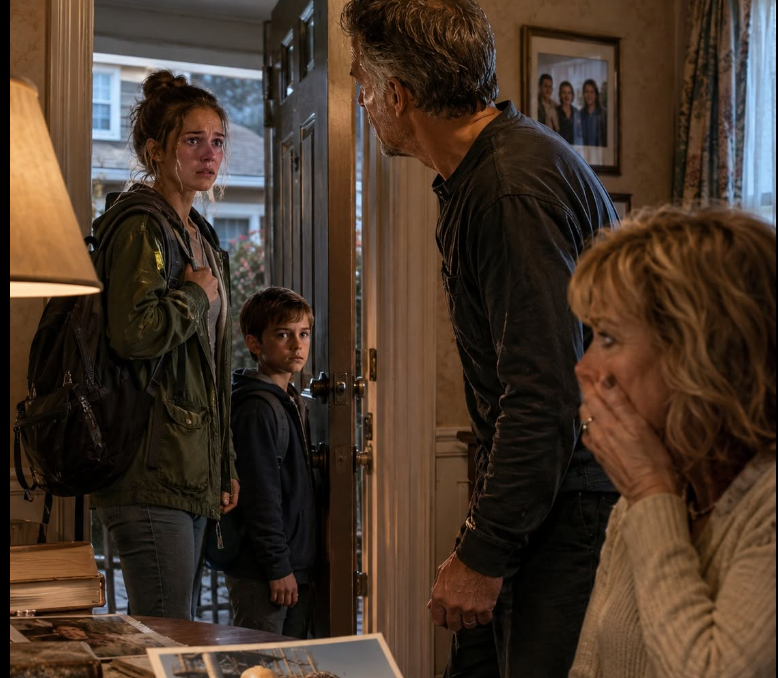
Diane gripped the edge of the table.
Frank did not move.
His face had lost all color.
“No,” he whispered.
“That’s Aaron Blake.”
Hannah nodded.
Aaron had been twenty-four when the photograph was taken.
He was the youngest safety engineer ever hired by Albany Industrial Components, the factory where Frank had worked for nearly thirty years.
Frank had once called him the smartest young man in the building.
Then, after one terrible night, he had called Aaron reckless, dishonest, and responsible for nearly destroying the company.
Owen looked between the adulTS.
“You knew my dad?”
Frank’s lips parted, but no answer came.
Hannah removed the yellow folder from her backpack and placed it beside the photograph.
“You knew him better than I did at first,” she said.
“You trained him when he arrived at the factory.”
Frank finally looked at her.
“Why didn’t you tell me?”
“I tried.”
“You said you couldn’t name the father.”
“Because Aaron made me promise.”
Frank slammed his palm against the table.
“A promise? I threw my own daughter out because of a promise?”
Owen flinched.
Hannah immediately placed a protective hand on his shoulder.
“You threw me out because you cared more about being embarrassed than understanding why I was afraid.”
Frank’s anger disappeared as quickly as it had arrived.
Diane began to cry.
Hannah opened the folder.
Inside were copies of inspection reports, photographs of damaged equipment, emails between factory managers, and a sealed federal document dated ten years earlier.
Aaron had discovered that the factory’s ventilation alarms were failing.
Several machines were releasing dangerous fumes whenever they overheated.
The workers had complained about headaches, dizziness, and breathing problems, but management blamed exhaustion and ordered the production lines to continue.
Aaron refused to ignore it.
He documented everything.
He photographed broken sensors, copied maintenance requests, and secretly recorded meetings in which executives discussed delaying repairs until after a major contract was completed.
Frank picked up one of the inspection forms.
His own signature appeared at the bottom.
Owen leaned closer.
“Grandpa, is that your name?”
Frank slowly lowered the page.
“Yes.”
Hannah’s voice remained calm, but every word carried ten years of pain.
“Aaron brought the failed alarm reports to you three weeks before the accident.”
Frank shook his head.
“You don’t understand what was happening.”
“Then explain it.”
“The company was already losing money.
They said if production stopped, the entire plant would close.
Four hundred people would lose their jobs.”
“So you signed a report saying the alarms were working.”
“They told me repairs had been scheduled.”
“But you knew they weren’t working.”
Frank looked toward the window.
For years, he had told himself that he had only signed a temporary form.
He had told himself that management had fooled him.
He had told himself that one signature could not have changed anything.
But Aaron had known the truth.
And now Hannah knew it too.
The factory incident happened on a freezing Tuesday night.
A machine on the lower production floor overheated.
The ventilation alarm remained silent, and invisible fumes began spreading through the building.
Aaron had already finished his shift.
He was halfway across the parking lot when he noticed workers stumbling out through a side exit.
He turned around and ran back inside.
He helped shut down the main production line and guided trapped workers toward an emergency stairwell.
Eleven people made it out because of him.
Frank was one of them.
Aaron never made it home.
The company released a statement the following morning blaming him for ignoring safety procedures.
Frank signed a witness statement supporting the company’s version.
Hannah pushed another page toward him.
“Read the final paragraph.”
Frank stared at it.
The statement claimed Aaron had entered a restricted area without authorization and interfered with equipment that had been operating normally.
“It wasn’t like that,” Frank whispered.
“But you signed it.”
“They threatened us.”
“Who?”
“Plant manager Richard Vance and two corporate attorneys.
They said Aaron had caused the shutdown.
They said the company would close, everyone would lose their pensions, and I could be charged for helping him.”
Hannah’s eyes filled with tears, but she refused to look away.
“So you let them destroy his name.”
“I was scared.”
“So was I.”
The words silenced the room.
Hannah reached into the folder and removed a small envelope.
“Aaron knew the company might blame him.
Two days before the accident, he gave this evidence to an attorney.
He also recorded a message.”
She picked up the USB drive.
“I received it six months ago, after the federal case was finally unsealed.”
Diane looked confused.
“Federal case?”
“Aaron had already contacted investigators.
They kept the evidence sealed because other factories owned by the same company were under investigation.
The attorney warned me not to reveal Aaron’s identity as Owen’s father until the case was completed.”
Frank sank into a chair.
“That’s why you said we would regret it.”
“Yes.
Aaron believed the evidence would eventually protect the workers, including you.
If the company learned I was carrying his child, they could have followed me, pressured me, or used Owen to force me into silence.”
“You were nineteen,” Diane whispered.
“You were alone.”
“I wasn’t completely alone.
Aaron’s attorney helped me leave Albany.
My friend gave me a room.
After that, I did what I had to do.”
Hannah inserted the USB drive into Frank’s old laptop.
The screen flickered.
A video appeared.
Aaron was sitting inside his car, still wearing his factory jacket.
He looked tired, but his eyes were steady.
For several seconds, he said nothing.
Then his recorded voice filled the room.
“My name is Aaron Blake.
I am a safety engineer at Albany Industrial ComponenTS. The ventilation system in Building Three is not functioning properly.
Management knows this.
I have provided written warnings, photographs, and maintenance reporTS.”
Frank covered his mouth.
Aaron continued.
“Frank Miller also knows the alarms failed their last two tesTS. He signed the compliance report after management told him the factory would close if he refused.”
Owen looked at his grandfather.
Frank lowered his head.
On the recording, Aaron’s expression softened.
“I don’t believe Frank is a bad man.
I believe he is frightened.
Fear can make decent people protect the wrong thing.”
Diane’s crying grew louder.
Aaron took a slow breath.
“If something happens to me, please tell Hannah that none of this was her fault.
Tell her I wanted to marry her.
Tell her our child was the best news of my life.”
Owen’s eyes filled with tears.
The recording ended.
Nobody spoke.
The ticking clock in the hallway seemed impossibly loud.
Owen reached for the photograph and held it against his chest.
“He knew about me?”
Hannah wrapped both arms around him.
“He knew.”
“Did he want me?”
“More than anything.”
Owen closed his eyes.
For ten years, he had imagined his father as a man who disappeared before he was born.
Now he knew Aaron had not abandoned them.
He had been trying to protect hundreds of people.
Frank stood and walked toward Hannah.
“I’m sorry.”
She stepped back.
“You don’t get to say two words and erase ten years.”
“I know.”
“You never searched for me.”
Frank’s shoulders collapsed.
“I thought you hated us.”
“I was nineteen, pregnant, and sleeping in a bus terminal.”
Diane let out a broken sob.
“I searched.”
Hannah turned toward her mother.
Diane’s face tightened with guilt.
“I called your friend in Chicago,” she admitted.
“She told me you were safe, but she refused to give me your address.”
 The Morning He Tried to Break In Changed Everything: My Ex-Husband Thought He Owned My Future, Until One Locked Door, One Hidden Truth, and One Family Secret Ended His Illusion Forever
 I Came Home Early for My Daughter’s Birthday—Then One Alarm Log Exposed the Trusted People Who Had Turned Our Safe Home Into a Carefully Planned Trap and Broke Our Family
“She refused because I asked her to.”
“I wrote letters.”
“I never received them.”
Diane looked down.
“There’s something else.”
Frank turned toward his wife.
“What do you mean?”
Diane walked to an old cabinet and removed a small wooden box.
Her hands trembled as she opened it.
Inside was a faded envelope addressed to Hannah.
The return address belonged to Aaron’s attorney.
Hannah stared at the unopened letter.
“When did that arrive?”
“Four days after you left.”
The room seemed to tilt.
“You had this for ten years?”
Diane nodded.
“Why didn’t you send it to me?”
“I was afraid it contained something that would involve your father in the investigation.
Frank had barely survived the factory incident.
He wasn’t sleeping.
The company had warned us not to speak to anyone.”
Hannah’s voice became almost inaudible.
“So you hid it.”
“I told myself I was protecting our family.”
“You watched me leave with nothing, and then you hid the one letter that could have told me Aaron had prepared help for his child.”
“I’m sorry.”
Frank stared at Diane as though he no longer recognized her.
“You knew Aaron had an attorney?”
“I knew someone had written to Hannah.
I didn’t know everything.”
“You should have told me.”
Diane looked at him through her tears.
“And you should have opened the door when our daughter begged you.”
That sentence cracked the last illusion holding the house together.
For a decade, Frank had blamed Hannah’s silence.
Diane had blamed Frank’s temper.
Both had blamed Aaron for the factory disaster.
Neither had admitted the truth.
They had chosen fear over their daughter.
Hannah picked up the unopened envelope.
Inside was a letter, a savings account document, and a handwritten note from Aaron.
He had placed twelve thousand dollars in trust for Hannah and the baby.
It was not a fortune, but it would have paid for a safe apartment, medical care, and several months of food.
Because Hannah never received the letter, the funds had remained untouched.
She read Aaron’s note aloud.
“Hannah, if you are holding this, something has gone wrong.
Do not blame yourself.
Protect our child.
Tell him his father tried to do the right thing, even when it was frightening.”
Hannah stopped reading.
Owen took her hand.
Frank whispered, “I ruined everything.”
Hannah looked directly at him.
Then she said the sentence she had carried inside her for ten years.
“Owen’s father did not abandon us, Dad.
He lost his life saving you, and you repaid him by abandoning his child.”
Frank sat down as though his legs could no longer support him.
There was no anger in Hannah’s voice.
That made it worse.
Anger could be argued with.
Truth could not.
Owen stepped forward.
He was only ten, but at that moment, he seemed older than everyone in the room.
“Did my dad save you?”
Frank nodded.
“Yes.”
“And then you said he caused the accident?”
“Yes.”
“Why?”
“Because I was afraid of losing my job, my pension, and this house.”
Owen glanced around the carefully kept living room.
The same furniture.
The same curtains.
The same walls that had mattered more than a frightened nineteen-year-old girl.
“My mom lost her house anyway,” Owen said.
Frank began to cry.
Hannah had imagined this moment many times.
In some versions, she shouted.
In others, she walked away and never returned.
But standing beside her son, she realized revenge would not restore what had been taken from them.
Only truth could do that.
She placed a final document on the table.
“The Justice Department is reopening the case.
Aaron’s name will be cleared publicly.
The company has agreed to compensate the affected workers and their families.”
Frank looked at the document.
“What happens to me?”
“That depends on whether you keep protecting the lie.”
Frank read the first page.
Investigators were requesting a formal statement from every employee who had signed the false safety reporTS.
If Frank told the truth, he could help prove that management had coerced workers and concealed dangerous conditions.
If he refused, he would remain part of the deception.
For the first time in ten years, he made a decision without asking what it might cost him.
“I’ll testify.”
Diane stared at him.
“We could lose the house.”
Frank looked at Owen.
“We already lost something more important.”
Hannah did not forgive them that afternoon.
Some wounds could not be repaired with one apology, one confession, or one family dinner.
But she allowed Owen to sit with Frank on the front steps.
Frank told him stories about Aaron—how he carried extra gloves for workers who forgot theirs, how he fixed an elderly employee’s car in the parking lot, and how he once challenged an executive during a meeting because temporary workers had not received proper safety training.
Owen listened to every word.
Before leaving, he asked Frank one final question.
“Are you going to tell everyone the truth about my dad?”
Frank looked at Hannah, then back at his grandson.
“Yes.”
“Even if people get angry?”
“Yes.”
Owen nodded.
“That’s what he would want.”
Three months later, Frank testified before federal investigators.
His statement led two former executives to admit that inspection records had been altered.
Other employees came forward after hearing him speak.
Albany Industrial Components issued a public correction.
Aaron Blake’s name was cleared.
A memorial plaque was installed outside the rebuilt factory entrance.
It read:
AARON BLAKE
SAFETY ENGINEER
HE SPOKE WHEN SILENCE WAS EASIER
AND RETURNED WHEN OTHERS NEEDED HELP
Hannah and Owen attended the ceremony.
Frank and Diane stood several yards behind them, uncertain whether they were welcome.
Owen noticed them first.
He took his mother’s hand.
“Can they stand with us?”
Hannah looked at the parents who had once closed their door.
They appeared older now.
Smaller.
Human.
“They can stand nearby,” she said.
“That’s enough for today.”
It was not forgiveness.
But it was a beginning.
After the ceremony, Owen placed a small model airplane beneath Aaron’s plaque.
He had built it himself.
“I think Dad would have liked engineering,” he said.
Hannah smiled through her tears.
“I think he would have liked you.”
As they walked away, Frank called Hannah’s name.
She turned.
“I can never give you those ten years back,” he said.
“But I will spend whatever time I have left becoming the father I should have been.”
Hannah studied him for a long moment.
“Then don’t promise me,” she replied.
“Show Owen.”
Frank nodded.
That was how the family began again.
Not by pretending the past had never happened.
Not by demanding immediate forgiveness.
Not by hiding behind shame, fear, or the word family.
They began again through testimony, accountability, patience, and small acts repeated over time.
Years later, Owen would understand that his mother had not returned to Albany to destroy anyone.
She had returned because secrets do not disappear when families refuse to speak about them.
They simply grow in the silence.
And sometimes, the sentence that destroys a family’s illusion is the same sentence that finally gives the people inside it a chance to become a real family.