
It did not say forced entry.
It said:
3:41 P.M.
— SYSTEM DISARMED — GUEST CODE: KELSEY G.
I read the line three times.
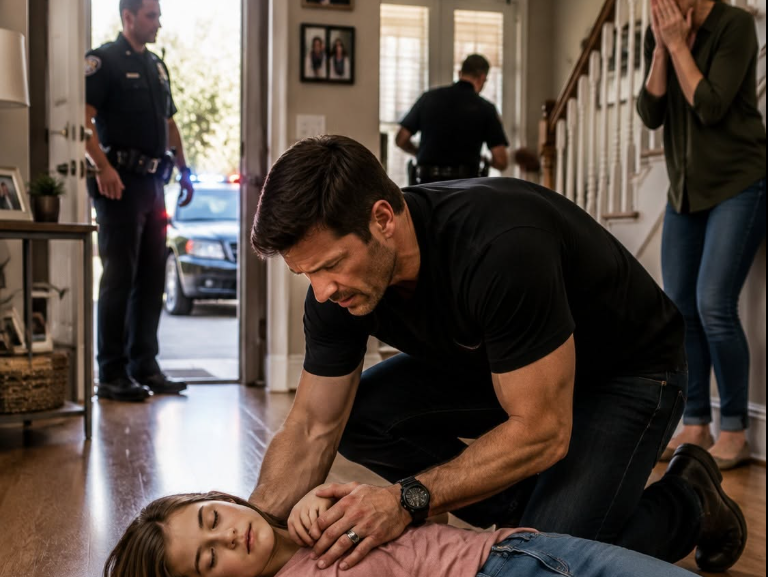
Kelsey Grant had been Violet’s best friend since seventh grade.
She had eaten dinner at our table, slept in our guest room, and spent so many weekends at our house that Harper kept her favorite cereal in the pantry.
Three months earlier, we had created a temporary alarm code for her so she could feed Violet’s cat while Harper visited her mother.
The code should have been deleted.
Apparently, it never was.
Detective Grant returned to the waiting area carrying two coffees.
He handed one to Harper and lowered himself into the chair across from me.
“We’ll need a list of valuables,” he said.
“Jewelry, cash, electronics.”
I locked my phone and studied him.
“Your daughter was at my house today.”
His hand stopped halfway to his cup.
It lasted less than a second.
For most people, it would have meant nothing.
For me, it meant everything.
“Kelsey?” he asked.
“You have another daughter?”
His face hardened.
“She was at volleyball practice.”
“The alarm was disarmed with her code.”
Grant leaned back slowly.
“Kids share codes.
Could have been anyone.”
“She told you she was at practice?”
“Yes.”
“Did you confirm it?”
His jaw moved.
“Mason,” Harper whispered, “what are you saying?”
I did not take my eyes off Grant.
“I’m saying no one broke into our home.”
Grant stood.
“You’ve been through a serious shock.
You need to be careful about making accusations.”
“And you need to stop calling this a robbery.”
His voice dropped.
“I am the detective assigned to this case.”
“That is exactly what concerns me.”
For a moment, the hospital corridor disappeared.
There was only the two of us and the truth standing between us.
Then the surgical doors opened.
A doctor in blue scrubs approached, and every ounce of anger inside me was replaced by fear.
Violet had survived the operation.
The pressure in her head had been reduced, but she remained unconscious.
The next twenty-four hours would be critical.
There could be memory loss, speech difficulties, or lasting complications.
Harper broke down in my arms.
I held her while staring over her shoulder at Detective Grant.
He was already walking away.
Not toward the elevators.
Toward a quiet corner, where he pulled out his phone.
I watched his lips move.
Then he looked directly at me.
That was not a father calling his daughter.
That was a man warning someone.
I stepped away from Harper and photographed every line of the alarm history.
Then I emailed the screenshots to myself, Harper, our attorney, the county sheriff’s office, and a former Army friend named Noah Briggs, who now worked as an investigator with the state police.
I attached one sentence.
Local detective may have a personal conflict.
Preserve this immediately.
In my old life, I had learned that evidence disappeared fastest when powerful people were frightened.
At 11:30 that night, a nurse brought me a clear hospital bag containing Violet’s belongings.
Her torn jacket.
One sneaker.
A silver bracelet I had given her when she turned fourteen.
And the school backpack that had been beside her in the hallway.
The police had searched it, but they had been looking for stolen items, not answers.
I sat on the floor beside Violet’s bed and emptied every pocket.
Textbooks.
Pens.
A crushed granola bar.
Three birthday cards.
A calculator.
When I picked it up, something rattled inside.
Violet had always hated math, but she had loved taking things apart.
When she was ten, she dismantled our toaster because she wanted to understand how the lever worked.
I removed the calculator’s battery cover.
Behind the batteries was a tiny memory card.
Harper stared at it.
“What is that?”
“Something Violet did not want anyone to find.”
There was no card reader in the room, but Noah arrived shortly after midnight carrying a laptop and two state investigators.
Unlike Grant, Noah did not tell me to calm down.
He examined the alarm screenshots, documented the memory card, and placed it into an evidence envelope before opening its contents on a secured computer.
The first folder contained photographs of school records.
The second contained screenshots of messages.
The third was labeled:
IF THEY COME TO THE HOUSE.
Harper covered her mouth.
Noah opened it.
There were audio recordings, lists of names, dates, payment transfers, and photographs of answer sheets from Violet’s high school.
For nearly a year, a group of students had been selling exam answers, changing attendance records, and threatening anyone who tried to report them.
At the center of everything was Kelsey’s older brother, Evan Grant.
Evan was eighteen, captain of the baseball team, class president, and the recipient of a university scholarship announced only a week earlier.
He was also Detective Grant’s son.
Violet had discovered the scheme accidentally when Kelsey used her laptop and forgot to close a shared message account.
At first, Violet had tried to convince Kelsey to tell the truth.
Instead, Kelsey had begged her to remain silent.
When Violet refused, the messages changed.
You don’t understand what this will do to my family.
My dad can fix it if you give us the files.
Please don’t make Evan angry.
The final message had arrived that afternoon.
I need to explain everything in person.
I’m coming over alone.
Please let me in.
Violet had replied:
You can come, but I’m not deleting the evidence.
Kelsey had not come alone.
A recording began at 3:43 P.M.
At first, the voices were quiet.
Kelsey apologized.
Violet told her to leave.
Then Evan’s voice entered the room.
He demanded the memory card.
Another male voice told Violet that her father was not home to protect her.
Harper began crying.
I could not.
I sat completely still as the recording captured shouting, furniture moving, and Violet ordering them to get out.
Then came a voice I recognized from the hospital.
Detective Grant.
He had arrived before I did.
“Everyone stop,” he said on the recording.
“Evan, get in the car.
Kelsey, give me the phone.”
Violet’s voice was weak but clear.
“I recorded everything.”
Grant answered with six words that ended his career.
“Not after I clean this up.”
The recording continued.
He ordered the teenagers to leave through the back door.
He removed Violet’s phone.
He opened drawers in the downstairs office to make the scene appear disturbed.
Then he told his son to throw away the clothing he had worn.
He did not call an ambulance.
He left my child on the floor and walked away because protecting his family’s reputation mattered more to him than saving her life.
Harper collapsed against the wall.
Noah closed the laptop.
The room became silent except for the machines beside Violet’s bed.
 Title: The Daughter They Abandoned Returned With a Secret Powerful Enough to Bring Down Her Family Empire and Reveal the Father They Never Knew Was Watching
 At the Divorce Hearing, My Husband Mocked Me and Swore I’d Never Touch His Fortune Again—Until the Judge Read One Sealed Letter, Laughed Out Loud, and Exposed the Truth That Destroyed His Empire Forever
I stood.
“Where is he?”
Noah stepped between me and the door.
“Mason.”
“Where is Grant?”
“We are locating him.”
“He left her there.”
“I heard the recording.”
“He looked me in the eye and called it a robbery.”
Noah did not move.
“You taught me something years ago,” he said.
“Anger makes you fast.
Discipline makes you accurate.”
I wanted to push past him.
I wanted Grant to feel the helplessness he had left inside my home.
For years, I had hunted dangerous men in places where rules had already collapsed.
A part of me understood revenge better than patience.
Then Violet’s fingers moved.
Barely.
But they moved.
I returned to her bedside and took her hand.
Her eyes remained closed.
“Dad,” she breathed.
One word.
Almost no sound.
But it brought me back.
I lowered my forehead to her hand.
“I’m here, baby.”
Her lips moved again.
“Don’t go.”
That was the order I obeyed.
State police officers arrested Evan Grant before sunrise.
The second teenager, Cole Mercer, was found at his uncle’s cabin forty miles away.
His family had been preparing to send him out of state.
Kelsey was located at her grandmother’s house.
She initially denied everything, but when investigators played the audio recording, she stopped protecting her brother.
She admitted that Evan had forced her to arrange the meeting.
She also admitted that her father had known about the cheating scheme for months and had pressured a school employee to stay silent.
Detective Grant was arrested at 6:20 the following morning.
He had not gone home.
He had driven to a storage facility where Violet’s phone, Evan’s clothing, and several school documents were later recovered.
By then, local news reporters were gathering outside the hospital.
The story was no longer about a robbery.
It was about a police detective who had attempted to protect his son by staging a crime scene and abandoning an injured teenager.
The school district suspended three employees.
The university withdrew Evan’s scholarship.
Families whose children had been threatened came forward.
One student admitted he had been paying Evan for months because Evan possessed photographs that could embarrass him.
Another revealed that his grades had been changed without his permission so he would appear responsible for the cheating operation if anyone investigated.
Violet had not simply discovered dishonesty.
She had uncovered a system built on fear.
She woke fully two days before her sixteenth birthday.
Her first clear question was whether the cat had been fed.
Harper laughed and cried at the same time.
I told Violet she had ruined my dramatic plan to surprise her.
She tried to smile, but the movement hurt.
“You were really coming home?”
“I was already home.”
Her eyes filled.
“I thought you’d miss it again.”
That sentence hurt more than anything Grant had done.
I had spent years believing that providing for Violet was the same as being present for her.
I told myself every deployment was necessary, every missed birthday understandable, every empty chair temporary.
But children do not measure love in explanations.
They measure it in who is standing beside them when the room becomes frightening.
“I’m sorry,” I said.
“You didn’t do this.”
“No, but I missed things I should have seen.”
Violet looked toward the window.
“I didn’t tell Mom because she was already worried about Grandma.
I didn’t tell you because you were overseas.
Everyone had something more important.”
Harper sat beside her.
“Nothing was more important.”
Violet’s expression was not angry.
That made it worse.
“I know that now.”
Recovery did not happen like it does in movies.
There was no moment when Violet stood from the hospital bed and instantly became the girl she had been before.
She needed physical therapy.
Bright lights caused headaches.
Crowded hallways frightened her.
For several weeks, she woke from sleep believing someone had entered the house.
She refused to use the front door.
I took emergency leave and stayed beside her.
When that leave ended, I requested reassignment.
My commander asked whether I was certain.
For fifteen years, the Army had been the structure around which I built my life.
Leaving the operational unit felt like removing part of my identity.
Then I remembered Violet whispering, “Don’t go.”
“I’m certain,” I said.
The trial began nine months later.
Grant’s attorney argued that he had panicked as a father.
The prosecutor answered that panic might explain one terrible decision, but not the removal of evidence, the false report, the intimidation of witnesses, or the failure to request medical help.
Violet did not have to testify in open court.
Her recorded statement was played instead.
She spoke calmly.
She described how Kelsey had asked to come inside, how Evan entered behind her, and how Detective Grant cared more about protecting a future scholarship than protecting a human life.
At the end of her statement, Violet addressed Kelsey directly.
“I trusted you.
I hope someday you become someone worthy of trust again.
But forgiveness does not mean pretending nothing happened.”
Grant was convicted of evidence tampering, obstruction, official misconduct, and several related charges.
Evan received a lengthy sentence after accepting responsibility for the assault and conspiracy.
Cole also pleaded guilty.
Kelsey cooperated with prosecutors.
Because she had arranged the meeting but had also attempted to stop her brother once the confrontation escalated, the court gave her a reduced sentence with strict supervision, counseling, and community service.
Some people thought Violet should have demanded the harshest possible outcome for everyone.
Violet disagreed.
“Justice should protect people,” she told me.
“It shouldn’t just satisfy anger.”
My sixteen-year-old daughter understood something I had spent a lifetime learning.
Destroying an enemy is easy when you have been trained for conflict.
The harder victory is refusing to let an enemy decide what kind of person you become.
One year after the attack, we celebrated Violet’s seventeenth birthday in our backyard.
There were no expensive decorations.
No large crowd.
Only Harper, Violet, me, two relatives, and a few friends Violet had learned she could trust.
The house had a new alarm system.
No guest codes.
No hidden access.
But the biggest change was not electronic.
We had begun talking honestly.
Harper stopped pretending she could handle every worry alone.
Violet stopped protecting adults from difficult truThS.
And I stopped treating home as a place that would remain unchanged while I was away.
Before Violet blew out her candles, she handed me a small wrapped box.
“It’s your birthday,” I said.
“Open it.”
Inside was a simple metal keychain engraved with four words:
THE ONE WHO CAME HOME.
I looked at her.
“I almost came too late.”
“But you stayed,” she said.
That was the part she remembered.
Not what I had threatened to do.
Not how many people I could have frightened.
Not the training, the anger, or the reputation others had built around me.
She remembered that when revenge called me toward the door, I stayed beside her bed.
I once believed strength meant being the most dangerous man in the room.
Violet taught me something better.
Real strength is knowing you could start a war—and choosing instead to end one.