
Daniel Mercer had spent years building a reputation around one carefully crafted image.
A brilliant attorney.
A respected husband.
A devoted father.
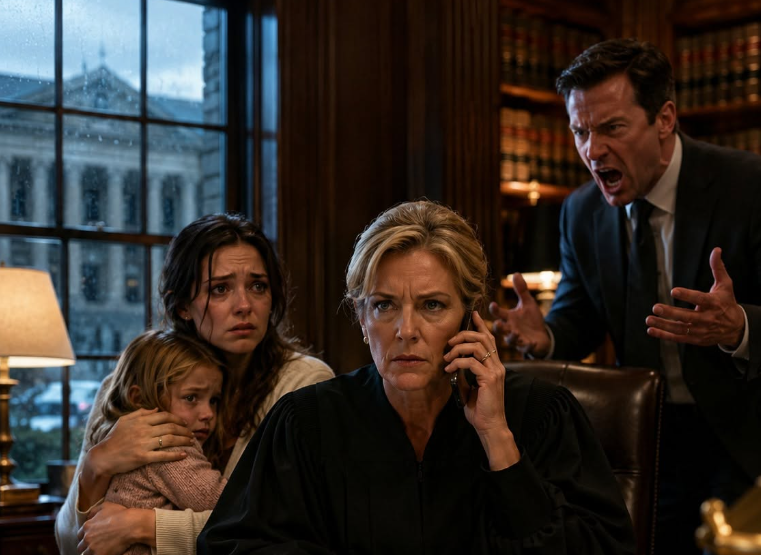
The kind of man people trusted because he always wore the right suit, used the right words, and knew exactly how to make others doubt themselves.
But there was one thing Daniel never understood.
People who truly know the law do not fear the truth.
They prepare for it.
That night, after the call ended, Clara sat silently on the edge of the hospital bed while Sophie slept safely beside her.
My daughter looked exhausted—not just physically, but emotionally, as if three years of fear had finally collapsed all at once.
“Mom,” she whispered, “you heard him.”
“I did.”
“He sounded so confident.”
I looked at her carefully.
“That is how people like him survive.
They convince everyone around them that they are untouchable.”
Clara lowered her eyes.
“I believed him.”
I reached across the table and held her hand.
“No, sweetheart.
You believed the person he pretended to be.
There is a difference.”
The next morning, Daniel arrived at the courthouse with his own attorney.
He expected a battle.
He expected Clara to be frightened.
He expected everyone to see him as the victim.
He walked through the entrance wearing the same calm expression he had used in conference rooms for years.
But this time, the room was different.
Because this time, the truth had arrived first.
Daniel approached the clerk’s office and submitted a request claiming that Clara had acted irrationally and removed their daughter without cause.
His attorney spoke confidently.
“My client is a respected member of the legal community.
He believes this situation has been exaggerated by emotional misunderstanding.”
Emotional misunderstanding.
Those three words almost made me close my eyes.
Because I had heard them before.
I had heard powerful people use polite language to hide painful realities.
But the law was not built to protect appearances.
It was built to protect people.
When the emergency hearing began, Daniel looked toward me for the first time.
Recognition slowly appeared on his face.
Not because I was Evelyn Cross.
Because he finally understood who I really was.
His confident expression disappeared.
“Judge Hart?” he whispered.
The courtroom became silent.
For years, Daniel had known my daughter’s mother as a quiet widow who preferred gardening, old books, and peaceful mornings.
He never imagined that the woman he dismissed was the same judge whose decisions had sent powerful criminals, corrupt executives, and dishonest officials to answer for their actions.
“You knew?” he asked.
I looked at him calmly.
“I knew my daughter was afraid.”
The judge presiding over the emergency matter reviewed the evidence submitted by the medical professionals, investigators, and advocates.
Daniel’s attorney attempted to argue that the situation was a private marital disagreement.
But the evidence showed a pattern.
Not one moment.
Not one argument.
A pattern.
The judge looked directly at Daniel.
“Mr. Mercer, this court is concerned not only with the allegations presented today, but with the documented circumstances surrounding your child’s safety.”
For the first time, Daniel looked uncertain.
The confidence he had carried for years began to disappear.
The temporary protective order remained in place.
Custody arrangements were immediately reviewed.
And a full investigation was opened.
But Daniel was not finished.
People who build their lives on control rarely surrender easily.
Over the following weeks, he attempted to protect his reputation.
He contacted former colleagues.
He sent carefully written statemenTS.
 I Returned Home After A Week Away And Found My Daughter On The Kitchen Floor, Then Opened Her Bedroom Door To Discover A Secret That Changed Our Family’s Life Forever
 I Signed the Divorce Papers Without a Fight, But My Husband Didn’t Know I Had Saved the Truth That Would Destroy His Perfect New Family Forever
He suggested that Clara was unstable.
But every accusation created another question.
And every question led investigators deeper.
They discovered financial records showing accounts Clara had never known existed.
They discovered messages where Daniel attempted to manipulate witnesses.
They discovered that several people close to him had been afraid to speak because they believed his professional position made him too powerful.
The man who claimed nobody would believe Clara had accidentally created a trail of evidence proving exactly why she needed help.
Meanwhile, Clara began rebuilding her life.
It was not immediate.
Healing rarely happens overnight.
Some mornings she woke up afraid.
Some nights she questioned whether she had done the right thing.
But every time she looked at Sophie, she remembered why she chose courage.
One afternoon, while we sat in my garden, Clara watched her daughter playing among the flowers.
“Mom,” she said quietly, “I’m sorry you had to see me like that.”
I turned toward her.
“Never apologize for needing help.”
“I thought I was protecting Sophie by staying.”
“You were surviving.”
She wiped away a tear.
“And now?”
I smiled gently.
“Now you are protecting her by showing her what strength looks like.”
Months later, the final hearing arrived.
Daniel entered the courtroom differently.
The expensive suit remained.
The professional appearance remained.
But the confidence was gone.
Because he had finally learned something important.
A title does not make someone powerful.
Money does not make someone powerful.
The truth is powerful.
The court granted Clara primary custody of Sophie and established protections designed around their safety and stability.
Daniel’s professional reputation suffered as the investigation continued, and the legal community that once praised him began questioning the choices he had made.
After the hearing, Clara stood outside the courthouse holding Sophie’s hand.
The same courthouse where she once believed she had no voice.
She looked at me.
“I thought he had all the power.”
I looked at my daughter and granddaughter walking beside me.
“No, Clara.
He only had the power you believed he had.”
That evening, we returned home.
The rain started falling again, just like the night she first came through my door.
But everything felt different.
The house that once held fear now held laughter.
Sophie colored pictures at the kitchen table.
Clara prepared dinner.
And for the first time in years, my daughter looked peaceful.
Later that night, she placed an old photograph on my desk.
It was a picture of her as a little girl, sitting beside me after my first day on the bench.
“You always told me the law exists because people deserve a voice,” she said.
“I still believe that.”
She smiled.
“You gave me mine back.”
I shook my head.
“No, sweetheart.
I only reminded you that you always had one.”
Years later, when Sophie was old enough to understand what happened, Clara told her daughter a simple truth.
She did not tell her about fear.
She did not tell her about the pain.
She told her about courage.
She told her that sometimes the strongest people are not the ones who never fall.
They are the ones who find the strength to stand again.
And every time I walked into a courtroom after that, I carried a reminder with me.
Justice is not only found in laws, documents, and decisions.
Sometimes justice begins with a mother opening a bedroom door…
Seeing her child’s pain…
And choosing, without hesitation, to stand beside her.